

5 Minutes
Picture this: a metal tube hurtling through a -50°C sky at roughly 900 km/h, slicing clouds like a knife. You open your laptop, join a video call, or stream a movie without missing a beat. It feels ordinary. It is anything but.
The ability to move data to and from an aircraft cruising at about 35,000 feet is one of the quietest engineering miracles of our era. It blends aerospace design, radio physics, and clever networking into a single, invisible service. How did we get here? The path is littered with ambitious experiments, costly failures, and sudden leaps forward.

At the turn of the millennium Boeing tried to rewrite the rules. In 2001 it launched Connexion, a satellite-based internet service aimed at airlines. Lufthansa flew the first commercial aircraft with Connexion in 2004. The idea worked on paper. Reality was brutal: half-million-dollar retrofit bills per plane, heavy hardware, and a post-9/11 travel slump that crushed demand. Boeing shelved the project in 2006 after pouring hundreds of millions into an engineering success that failed commercially. Still, it proved a core point—Internet in the sky was doable.
After Connexion, engineers pursued cheaper fixes. Why bounce signals to space if you can use towers on the ground? Air-to-Ground systems (ATG) answered that question. Companies like Gogo launched ATG services in the late 2000s that pointed specially shaped antennas upward from terrestrial cell towers. Airplanes got belly-mounted receivers to catch those skyward beams.

ATG worked for domestic routes, but it was limited. Speeds were modest—think 3 Mbps shared across hundreds of passengers—and once an aircraft crossed an ocean the signals vanished. It was reliable, affordable, and roughly as exciting as dial-up.
The long-haul fix turned back toward space. Geostationary satellites (GEO) orbit roughly 35,786 kilometers above Earth and appear fixed over the equator. To keep a link to a GEO bird, modern airliners wear a protective dome on the roof called a radome. Inside that dome a small dish sits on a gimbal that must track a satellite thousands of kilometers away while the plane rolls, pitches, and yaws. Onboard processors feed GPS and inertial data into control loops that nudge the antenna orientation thousands of times per second.

That choreography is impressive. But physics bites back. A request from your browser can travel up to space and back, then to a ground station and back up again—hundreds of thousands of kilometers in round trips. Even at light speed, that journey imposes latency on the order of 600–800 milliseconds. Fine for loading web pages. Rough for multiplayer games or real-time voice calls.
There are subtler headaches, too. When an aircraft moves at 900 km/h toward or away from a radio source, the Doppler effect shifts the apparent frequency of the signal. Routers and modems aboard the aircraft must continuously estimate and correct that frequency shift to prevent bit errors and corrupted frames. Meanwhile, the radome itself can't be a chunk of metal—it would block radio waves—so manufacturers use advanced composite shells that are electromagnetically transparent but astonishingly rugged: resistant to bird strikes, hail, and extremes of temperature.
Enter the revolution: Low Earth Orbit (LEO) satellite constellations. Systems like Starlink and OneWeb sit a few hundred to about 1,200 kilometers above the planet—roughly 70 times closer than GEO satellites. Shorter distance equals dramatically lower latency. Where GEO links often hovered near three-quarters of a second, LEO networks can push round-trip time under 30 milliseconds—on par with many home broadband connections. Suddenly, airlines can offer connectivity that behaves like terrestrial fiber.

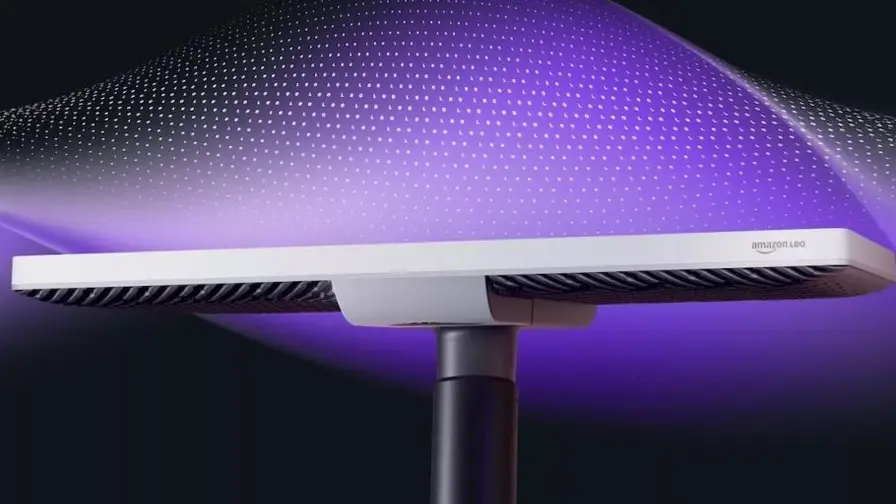
LEO also changes the hardware game. The bulky, motorized dish under a radome is increasingly obsolete. Phased-array antennas—flat panels populated with thousands of tiny radiating elements—steer beams electronically with no moving parts. They lock onto satellites by tweaking signal phase across the array in microseconds. The panels are thin, flush with the fuselage, and create far less aerodynamic drag than older domes. Less drag means real dollars saved on fuel, which is why airlines are rapidly adopting these systems.
There is a poetic quality to it. Data packets now perform a ballet: bouncing between aircraft-mounted arrays, a nearby satellite whizzing overhead, and back to ground facilities, all while the airplane climbs or descends, banks, or accelerates. Engineers have spent decades taming timing, frequency shifts, heat, weight, and electromagnetic interference so that passengers see a clean video or a sent message without thinking about the forces at play.
Connectivity at cruise altitude is less about glamour and more about relentless engineering—tiny adjustments, split-second calculations, and materials science working together to make global, on-the-move networks seamless.

The result is that internet on planes is no longer a luxury headline; it's becoming an expectation. From Connexion’s costly experiments to Gogo’s ATG towers, to GEO dishes and now LEO arrays, each phase taught lessons that pushed the next innovation forward. The next time your call completes at 35,000 feet, consider the invisible choreography and the fact that the skies are now part of the global network—waiting to be used, improved, and challenged once more.

Leave a Comment
Comments (2)
Is LEO really the cure all? What about congestion, regs and handoffs mid flight?.. sounds almost too good to be true
wow didnt know so much ballet goes into plane wifi… phased arrays are wild. fuel savings? interesting, skeptical tho about costs and maintenance