
3 Minutes
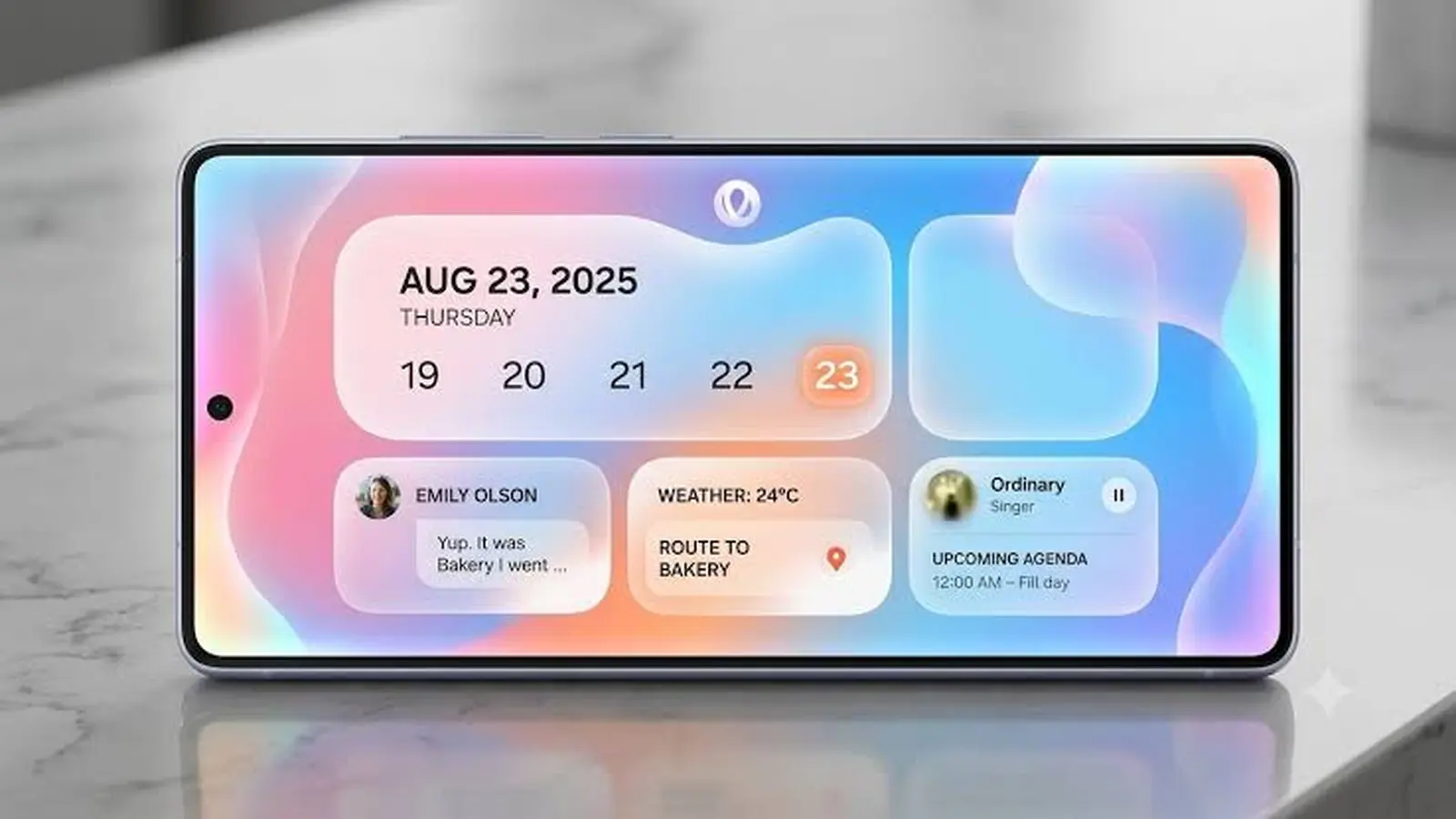
Imagine your phone rearranging itself to fit the task at hand — not obeying you, but anticipating you. That’s the impulse behind Samsung’s new Fluid AI Design System, a generative interface concept that just snagged a Red Dot Design Award for 2026 and offers a striking glimpse at how One UI could evolve.
Not a downloadable update yet, but a design manifesto. Samsung’s idea rejects the rigid grid of static apps in favor of a living surface made of adaptive, floating elements. Think of information as flexible cards: they expand, contract, merge and shift depending on context. Short on space? A card trims itself. Need more detail? It unfurls into a focused view. Simple actions become elastic, shaped by what you’re doing in the moment.

It’s practical imagination. A meeting reminder can do more than ping you: it could pull in your calendar, map the fastest route, surface relevant chat threads and show the people you’ll meet — all inside a single, seamless pane. A tiny date picker might swell into a proactive scheduling assistant that coordinates times and suggests venues. The aim is clear: reduce friction and cut the constant app-hopping that fragments your attention.
This is less a skin and more an operating partner for your day.
Fluid AI sits squarely inside Samsung’s wider Galaxy AI push. Over the last year the company has stitched more on-device smarts and cloud AI into its stack, and this concept imagines taking intelligence out of isolated features and weaving it through the entire interface. Instead of intelligence bolted onto apps, the interface itself becomes generative and context-aware.
That’s an exciting promise, but one that comes with real engineering headaches. How will third-party apps play along when UI elements can rearrange themselves at will? What about consistent performance on low-end models? And how do you keep the experience predictable so people don’t feel disoriented when a familiar screen suddenly behaves differently?

Design prototypes often shift — sometimes radically — between concept and shipping product. Samsung may never release Fluid AI exactly as imagined. Still, the concept is valuable because it signals intent: a future where the phone behaves less like a drawer of apps and more like a situational assistant. The company could fold these ideas into future One UI releases, perhaps around One UI 10 or later, or apply select pieces to Galaxy AI features we’ll see sooner.
Whether Fluid AI arrives whole or in fragments, it’s a reminder that interfaces are not finished objects. They’re experiments in anticipation, and Samsung’s latest design language pushes that experiment forward. If your device could meet you halfway, what would you want it to do first?


Leave a Comment
Comments
No comments yet. Be the first.