
2 Minutes
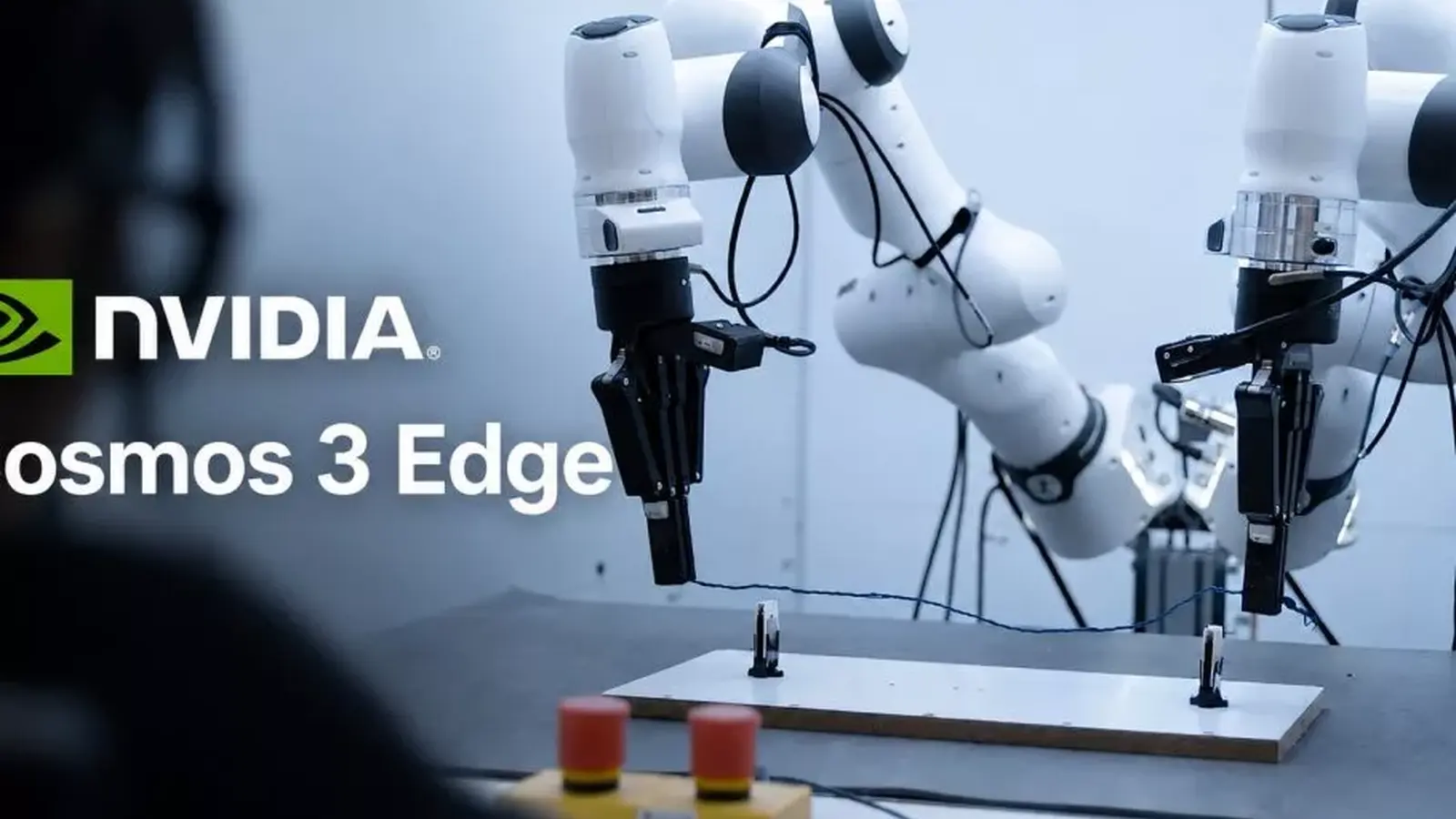
Robots that can 'see' a factory floor and react before a human blinks are no longer sci‑fi. Nvidia just rolled out Cosmos 3 Edge, a compact but powerful world model designed to give machines instant situational awareness.
At roughly four billion parameters, Cosmos 3 Edge sits in the family of world models—architectures built to fuse cameras, lidar, touch and other sensor streams into a coherent, actionable sense of place. Think of them as spatial brains, not language parrots. Unlike large language models that chew on text, world models digest the messy, multimodal noise of the real world and learn from it.
Nvidia says developers can adapt Cosmos 3 Edge to specific robots, vehicles or sensor setups in about a day using the NVIDIA Cosmos platform. Lightweight is the operative word: the model runs across a range of GPUs, making edge deployment realistic instead of theoretical. Faster iteration. Fewer hardware headaches. Better real‑time navigation and perception for autonomous cars, industrial robots and smart sensors.

Cosmos 3 Edge is not an isolated product. It follows the broader Cosmos 3 release Nvidia announced in May, and it slots into a strategy that treats physical environments as the next big frontier for AI. Why? Because intelligence that stays in the cloud can't react quickly enough to a dropped crate, a stray child, or a shifting road surface. Localized, multimodal models change that calculus.
Jensen Huang used the launch to underline a global push: during a visit to Japan he unveiled collaborations with industrial heavyweights such as Fujitsu, Hitachi and Kawasaki Heavy Industries. The message was blunt and optimistic—this is a moment for countries with deep manufacturing know‑how to retool for an era of intelligent machines and connected factories.
Market context matters. Estimates from trade organizations peg Japan's AI market approaching tens of billions of dollars by 2029, and Tokyo is already steering policy and investment toward infrastructure and industrial adoption. Nvidia’s plans extend beyond robotics too. In Japan the company is advancing into biotech and drug discovery, contributing compute and tooling to a Tokyo‑1 pharmaceutical consortium led by a firm called Zivorka and leveraging Nvidia's BioNeMo Agent Toolkit for molecular simulations.
This is one more sign that AI is climbing off screens and into the physical world, where latency, safety and multimodal understanding rule. The question now is not whether machines can map spaces in real time, but what we will build once they do.


Leave a Comment
Comments
No comments yet. Be the first.