
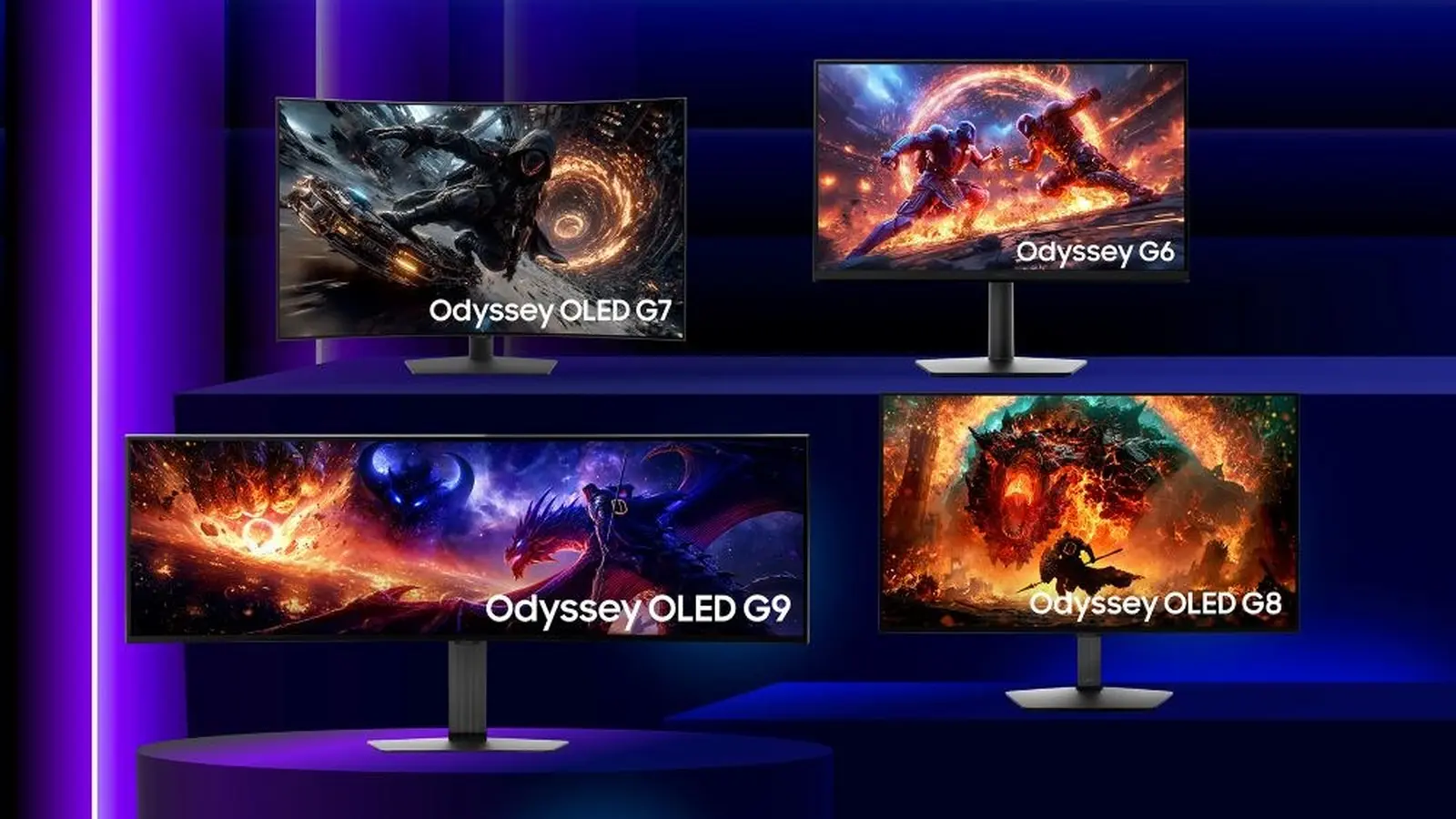
Over a thousand hertz? Samsung says yes. At Gamescom 2026 the company tore up expectations with a new slate of Odyssey monitors that read like a specification fever dream: extreme refresh rates, massive OLED panels and at least one product that demands you rethink what ‘smooth’ means.
Leading the pack is the Odyssey OLED G9, a 49-inch Dual QHD beast with a 360Hz refresh rate on a curved 5th-gen QD‑OLED. Samsung claims the panel is roughly 1.3x more efficient than the prior generation and doubles its longevity. Text looks unexpectedly crisp thanks to a full RGB stripe at the pixel level, and peak brightness hits around 1,300 nits in a small 3% window when pushed to 4K-equivalent luminance. Native mode runs at 5,120 x 1,440 at 360Hz with a quoted 0.03ms GtG response; drop the resolution and you can enable a higher-rate mode—sacrificing pixels for speed.

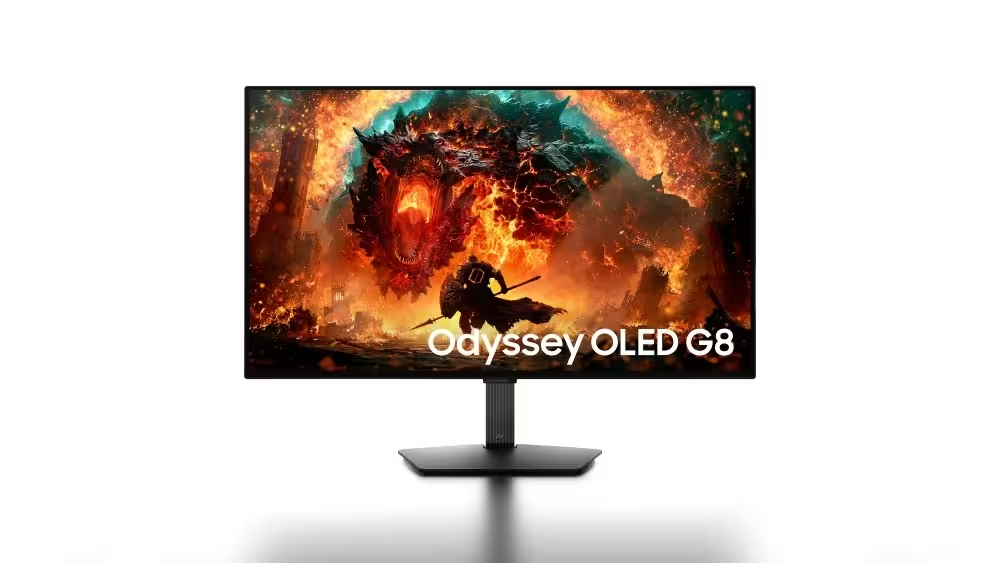
The Odyssey OLED G8 shrinks the canvas but keeps the intensity. A 32-inch UHD QD‑OLED that can run 360Hz natively, it also offers stepped modes—520Hz at QHD and even 680Hz at FHD—so users can choose whether to prioritize clarity or raw frame rate. Practical touches show up too: Samsung’s Glare Free film trims sheen by roughly half versus typical anti-reflection layers, the panel is VESA DisplayHDR True Black 600 certified, and compatibility spans AMD FreeSync Premium Pro and NVIDIA G‑Sync. The I/O is built for bandwidth—DisplayPort 2.1 UHBR20 sits alongside two HDMI ports, a USB-C port with 98W power delivery, and a small USB hub with KVM support for multi-system setups.
Not everyone wants a widescreen behemoth. The Odyssey OLED G7 is a 42-inch, 16:9 curved (1000R) monitor aimed at players who want a large, traditional aspect ratio with OLED contrast and 4K resolution, capped at 165Hz—still plenty fast for console and PC gaming when fidelity trumps frame count.
Then there’s the headline-grabber that risks sounding apocryphal until you see the spec sheet: the refined Odyssey G6 27-inch IPS LCD now claims a 1,100Hz maximum refresh rate at HD. Yes, 1,100Hz. That’s at 720p territory; step up to QHD and you still get a blistering 600Hz. It’s a trade-off—resolution for ultra-low-frame latency—and one that will appeal to a very specific subset of competitive gamers chasing every millisecond.

Samsung isn’t only selling panels. It also announced a content push: a partnership with Activision Blizzard to bring HDR10+ Gaming to 20 AAA titles, rolling out by the first half of 2027 and kicking off with Call of Duty: Modern Warfare 4. HDR10+ Gaming is a royalty-free dynamic HDR format backed by Samsung and a handful of other vendors, offering game-specific metadata and features designed to preserve contrast and color in fast-moving scenes. There’s also HDR10+ Advanced for cinematic content, for viewers who want the same dynamic approach on movies and shows.

These monitors are as much about positioning as performance. Samsung is signaling that the race for higher refresh rates and denser OLED tech isn't finished; it's accelerating. Whether gamers, streamers or creators will embrace the trade-offs between resolution, latency and price remains to be seen. For now, the message is clear: if you thought 240Hz was peak, you haven’t been paying attention.
Samsung just pushed monitor spec sheets into a new orbit—expect debate, excitement and a scramble to see who actually needs the speed.


Leave a Comment
Comments
No comments yet. Be the first.