
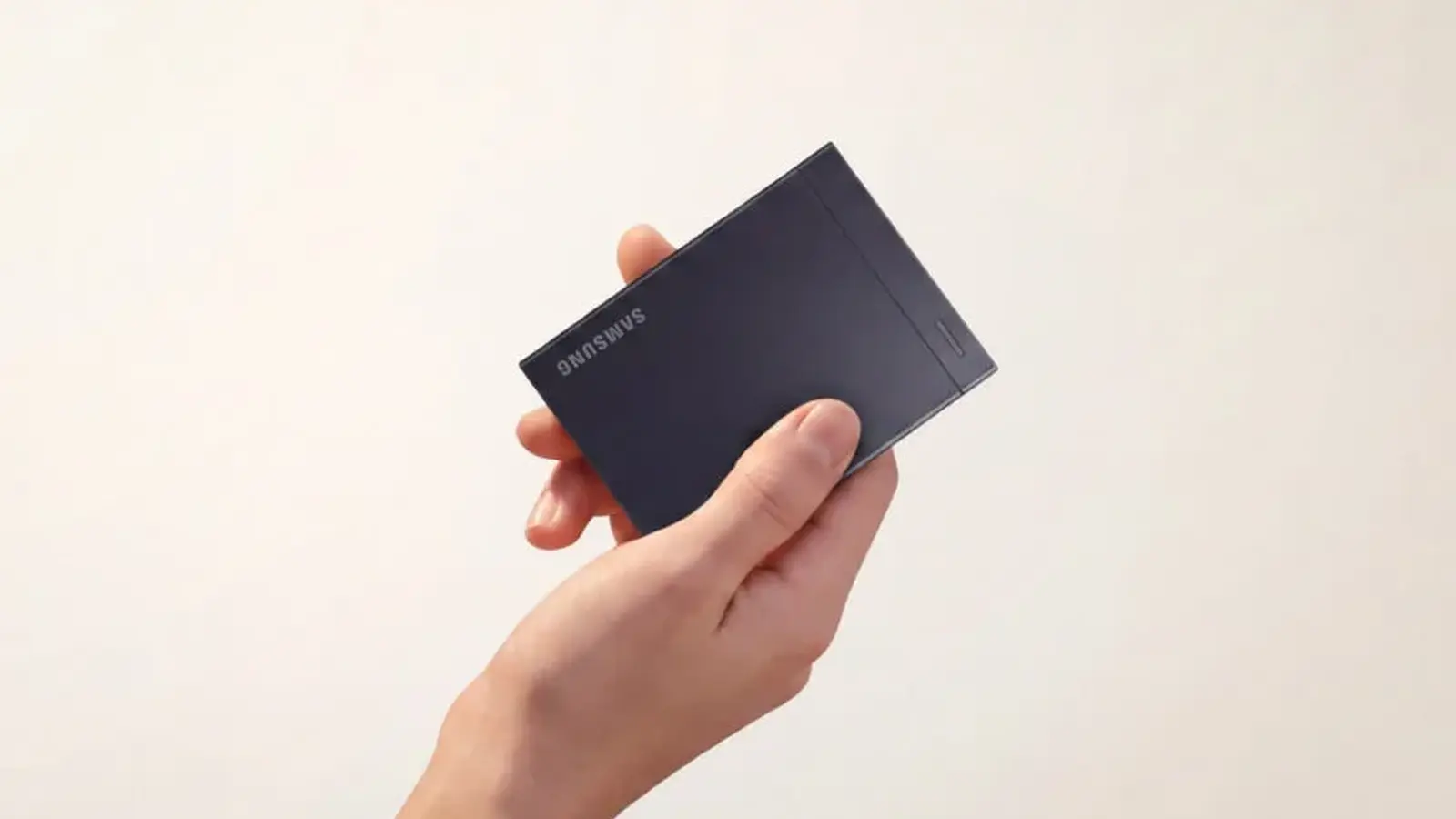
Imagine copying a library-sized project in the time it takes to make coffee. That's the promise Samsung is selling with its newest portable SSDs, the P9 and P7. No fluff. Just raw throughput and a clear split: P9 for pros who move massive files fast, P7 for everyday users who want future-proof speed without breaking the bank.
The P9 is the headline. Sequential read speeds hit 4,000 MB/s and writes peak at 3,800 MB/s, roughly doubling the bandwidth of Samsung's previous T9 model, which topped out around 2,000 MB/s. What that translates to in practical terms is fewer waiting moments when you offload multiterabyte video shoots or shuffle large RAW photo libraries between devices.

Samsung says the P9 is the world's first 8TB USB4 portable SSD capable of 4,000 MB/s. It also picked up an innovation award at CES 2026, a nod to how far portable storage has come in a short time.
Engineered for steady sustained writes, the P9 is pitched squarely at creatives: filmmakers wanting to record directly to external storage at ultra-high resolutions; photographers handling uninterrupted bursts of large RAW files; post houses needing consistent throughput under load. The drive's endurance and thermal behavior have been tuned so long takes and large transfers remain stable, not just fast in short bursts.
Design-wise, both P9 and P7 share a compact footprint — roughly 8.89 cm by 6.60 cm and 0.76 cm thick — and weigh just under 100 grams. They use a single USB-C port and rely on USB4 to unlock the higher speeds and broader compatibility with modern Macs, iPads, PCs, consoles and some cameras.
- Models: P9 (flagship) and P7 (mainstream)
- Interface: USB4 via USB-C
- Speeds (P9): up to 4,000 MB/s read, 3,800 MB/s write
- Capacities: 1TB, 2TB, 4TB, 8TB
- Dimensions: 8.89 × 6.60 × 0.76 cm; Weight: ~99.79 g
- Resilience (P7): rated for drops from ~2 meters; shock and vibration resistant
- Pricing (USD): P9 — 1TB $339.99 to 8TB $2,699.99; P7 — 1TB $289.99 to 8TB $2,289.99
- Availability: Global launch starting August 31, 2026
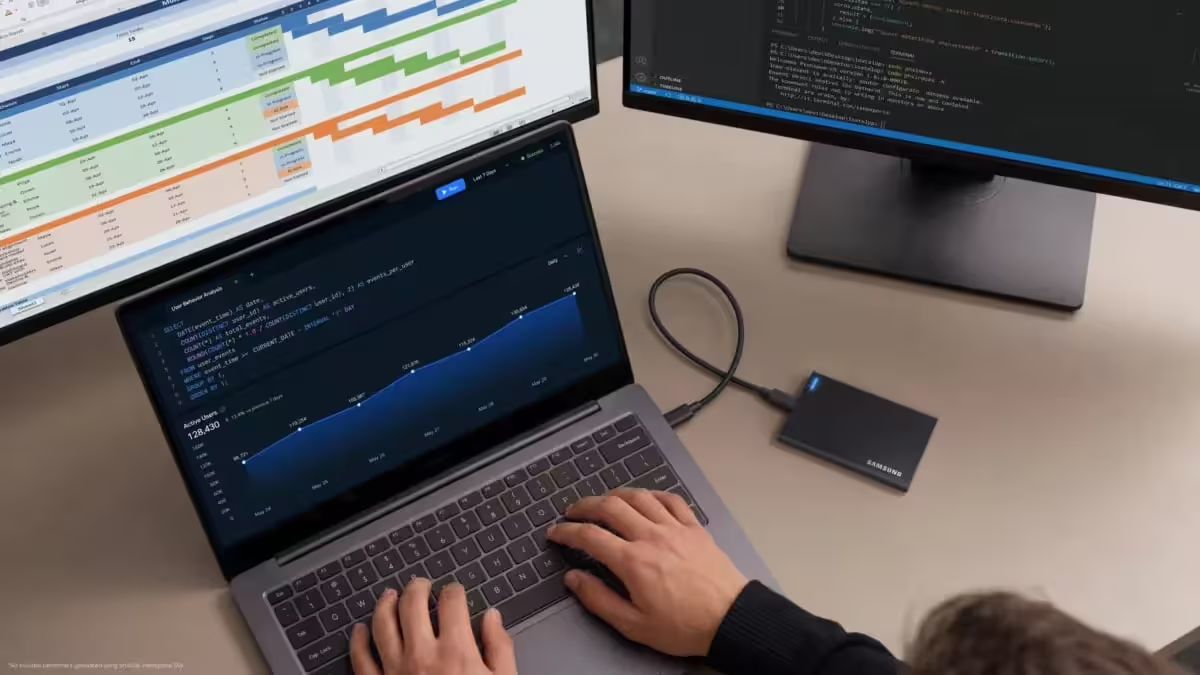
The P7 takes many of the P9's advances but packages them for general users. It still uses USB4 and mirrors the compact build of its sibling, while focusing more on durability and cross-device compatibility than on being the absolute fastest drive available. Think of it as a sensible, speedy option for creators and enthusiasts who don't need every ounce of peak performance.
There are trade-offs to consider. Performance this high expects USB4 hosts to fully support the standard; older USB-C ports may bottleneck these drives. Prices at the top end are steep as expected for desktop-class portable capacities. But for studios and pros who regularly move terabytes of footage, the time saved — and frustration avoided — can be worth the premium.
Samsung is betting that the next wave of portable storage won't be measured by gigabytes alone, but by how reliably and quickly you can get data where it's needed. If you work with large files, the P9 and P7 are strong evidence that external SSDs are finally catching up with the demands of modern workflows.


Leave a Comment
Comments
No comments yet. Be the first.