
Weekly NFT Volume Slides as Participation Expands
NFT sales volume across major blockchains tumbled 44.70% week-over-week to $63.33 million, according to CryptoSlam data captured with the seven-day filter on Aug. 29. While total dollar volume contracted substantially, the wider picture shows more distinct buyer and seller addresses active in the market, suggesting broader participation that did not translate into higher aggregate spending.
Ethereum leads weekly NFT blockchain sales
Key market figures
- Total NFT sales value: $63.33 million (down 44.70% from prior seven days)
- Transactions: 802,330 (down 14.13%)
- Buyer addresses: 227,316 (up 30.48%)
- Seller addresses: 247,373 (up 54.64%)
These address counts refer to blockchain addresses rather than verified individual users; a single collector can control multiple addresses and vice versa. The drop in transactions amid rising addresses indicates trading activity was spread across more wallets but with fewer transfers per wallet on average.
Macro context: Crypto prices and market cap
The NFT slowdown coincided with a broader pullback in cryptocurrencies during the reporting window. Bitcoin traded near $77,600 and Ether hovered around $2,440 at the snapshot time, while total crypto market capitalization was roughly $2.71 trillion, down more than 2% over 24 hours. Although the timing aligns, the data do not prove a direct causal link between lower NFT volume and the wider price movements.
Blockchain-by-blockchain NFT performance
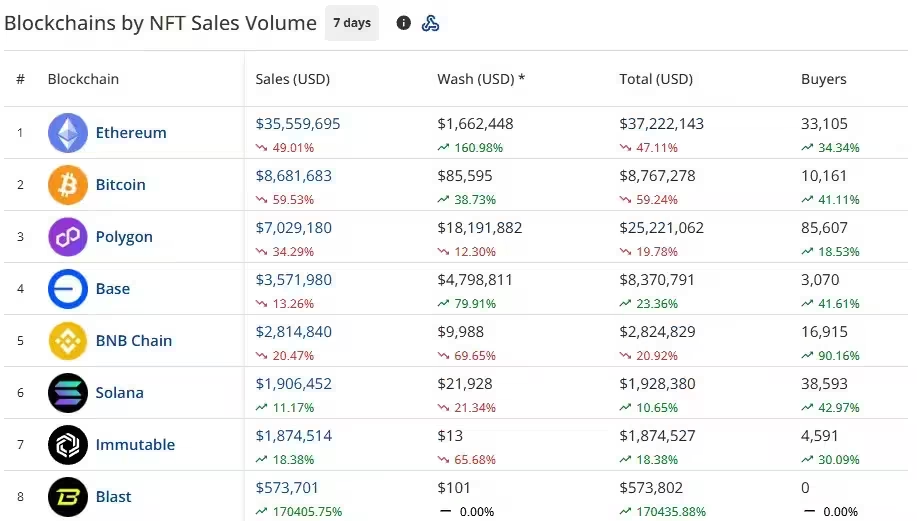
Ethereum remained the dominant NFT marketplace by organic sales, recording $35.56 million for the week despite a 49.01% decline from the previous period. CryptoSlam separates organic NFT volume from suspected wash trading and reported $1.66 million in wash volume on Ethereum, bringing its combined figure to $37.22 million. Notably, Ethereum buyer addresses increased 34.34% to 33,105 despite the fall in monetary volume.
Bitcoin followed in second place with $8.68 million in organic NFT sales, a 59.53% decrease week-over-week. Bitcoin wash trading was relatively small by comparison at $85,595, yielding a combined total of $8.77 million. Bitcoin’s buyer addresses rose strongly, up 41.11% to 10,161.
Polygon posted $7.03 million in organic sales (down 34.29%), but the network’s wash volume was unusually high at $18.19 million — more than twice its organic figure — highlighting how wash trading can distort apparent liquidity. Polygon buyers declined 18.53% to 85,607 addresses.
Base and BNB Chain recorded $3.57 million and $2.81 million in organic sales, respectively. Base buyers increased 41.61% to 3,070 while Base’s wash trading of $4.80 million lifted its combined total to $8.37 million. BNB Chain buyer addresses surged 90.16% to 16,915 despite a 20.47% decline in sales. Solana bucked the downward trend among the top networks, with sales up 11.17% to $1.91 million and buyers up 42.97% to 38,593.
Together, the six leading networks accounted for roughly $59.56 million — about 94% of global organic NFT sales — underscoring how heavily concentrated NFT volume remains among a handful of chains. Immutable also increased, adding $1.87 million after an 18.38% rise.

Wash trading remains an important signal
The divergence between organic volume and wash volume across several chains reinforces why tracking wash trading is critical for accurate analysis of NFT market health. When wash volume becomes a large share of reported totals, it can inflate perceived liquidity and mislead buyers, sellers, and market observers.
Top collections and concentrated high-value trades
Courtyard, a Polygon-based collection, led all NFT collections for the week with $6.09 million in sales, even though its total fell 37.55% from the prior period. The collection recorded 98,531 transactions, with 17,969 buyer addresses and 11,755 seller addresses.

Courtyard tops weekly NFT collection sales
Ethereum-native Argonauts placed second with $5.70 million across 11,271 transactions. A notable Bitcoin-native BRC-20 collection, $X@AGI, ranked third with $2.58 million — a 74.89% jump — but that total was driven almost entirely by a very small number of exceptionally large transactions.
CryptoPunks remained in the top ranks with $2.07 million (up 7.64%) across 19 sales involving 17 buyers and 18 sellers. Base-based Beezie generated $1.88 million from 11,186 transactions, while Blokyz posted $1.83 million from 4,212 transactions. Pudgy Penguins climbed 27.19% to $1.04 million on 97 transactions, and Bored Ape Yacht Club drew $977,831 in weekly volume across 53 transactions.
Single trades can dominate weekly tables
The week’s largest individual NFT sale was a $X@AGI BRC-20 token that traded for 27.1798 BTC (about $2.14 million) roughly two days before the snapshot. CryptoSlam categorized the transfer as an NFT sale, but the dashboard does not provide enough transaction-level context to determine the economic purpose behind the transfer. That single sale accounted for approximately 83% of the $X@AGI collection’s weekly volume and 3.4% of total global NFT sales, illustrating how concentrated high-value trades can skew headline metrics.

Bitcoin NFTs dominate the week’s largest sales
Other notable high-value transfers included Flying Tulip PUT #8494 at $484,791, a tokenized perpetual put position that settled for 200 wrapped Ether and represents a financial instrument rather than a standard art or profile-picture collectible. Multiple other large BRC-20 transfers also featured prominently in the top-five sales for the week.
What this means for collectors and investors
- For collectors: rising buyer and seller addresses suggest renewed interest and broader participation, but lower average transaction values mean collectors should scrutinize liquidity and beware of one-off, outsized trades that can distort market perception.
- For investors: wash-trading figures and concentration of volume in a few high-value sales are warning signs. Evaluate on-chain provenance, average sale price, and active buyer counts rather than headline dollar volume alone.
- For market analysts: coupling organic sales with wash-trading metrics provides a clearer picture of real demand across chains, particularly where collections or networks show outsized wash percentages.

In summary, the NFT market experienced a sharp decline in dollar volume for the week, even as on-chain participation increased. Ethereum remained the largest NFT ledger by organic sales, while Bitcoin-hosted BRC-20 trades and a handful of high-ticket transactions strongly influenced weekly top-sale rankings. Monitoring wash trading and transaction concentration will remain essential for anyone tracking NFT market health and liquidity.

Leave a Comment
Comments
No comments yet. Be the first.