
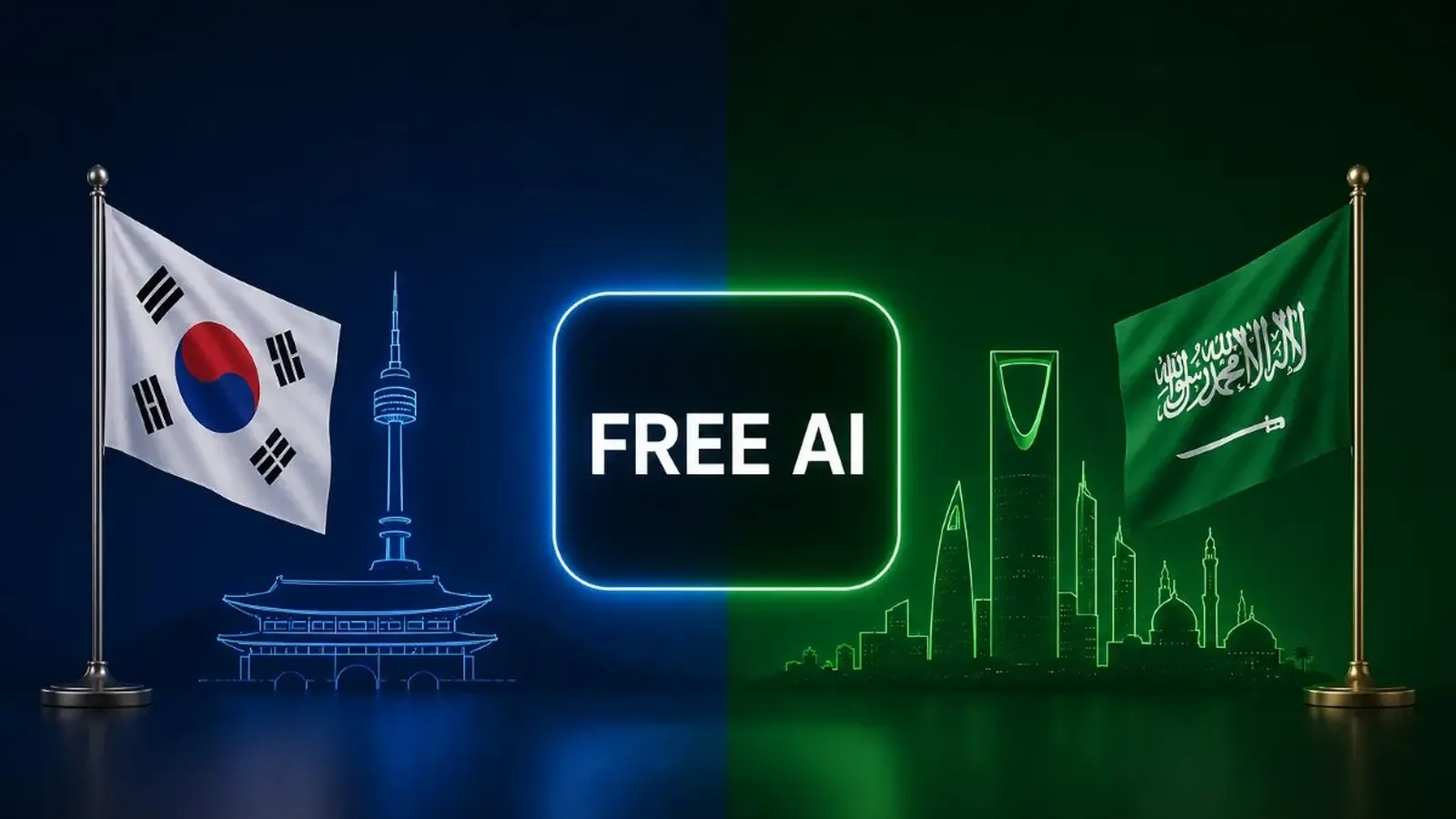
Imagine the state handing out AI the way it hands out library cards. That’s the scene unfolding in Seoul and Riyadh, where two very different governments are betting that free access to artificial intelligence will accelerate digital skills, local content and commercial innovation.
In South Korea, a program called "AI for All" promises unlimited-token access to premium AI services for every citizen. The idea is ambitious and simple at once: build AI into everyday public services — from booking medical appointments and finding housing to tax guidance and personalized learning recommendations for parents. Small businesses get practical tools too, such as automated tax checks and eligibility assessments for government support.
Three technology consortia will deliver the apps, led by the country’s two largest telecom operators and Kakao, the messaging and platform giant. Seoul has supplied each consortium with more than 512 NVIDIA B200 chips and is covering part of the rollout costs. A pilot kicked off in September, with a broader launch slated for later this year.

Why the urgency? Partly to reduce dependence on foreign AI ecosystems. Tens of millions of South Koreans already use AI services: roughly 23.45 million rely on the free ChatGPT tier, around 8.45 million use Google’s Gemini and about 2.41 million use Claude, while only some 1.8 million hold paid subscriptions. New rules will force operators to route at least 50% of processing through domestic foundational models and a further 30% through other Korean companies, nudging native solutions toward an 80% share. The state has also earmarked about $7.2 billion for AI in 2026 — triple last year’s allocation — aligning with big-ticket efforts elsewhere, such as the EU’s $232 billion plan and India’s $1.25 billion project.
Across the Arabian Peninsula, Adobe has struck a high-profile deal with Saudi Arabia’s Ministry of Communications and IT and local firm Humain to offer 12 months of free access to Adobe AI tools for more than 27 million eligible residents. The commitment is valued at over $4 billion. Users will receive Adobe Firefly standard access and premium Adobe Express capabilities, including a new image-generation model tuned to Arabic language prompts and cultural nuances, co-developed by Adobe and Humain. The rollout is expected to begin before the end of 2026.
Both governments are effectively seeding ecosystems: free AI access as public infrastructure to grow local talent, content and commerce while carving out independence from dominant foreign platforms.
These moves raise familiar questions. Will free tiers convert curiosity into sustainable local products? Can governments balance openness with safety, moderation and privacy? The experiments in Seoul and Riyadh will be watched closely — not just for the technology, but for the social and economic choreography that follows when millions suddenly gain easy access to generative tools.
Either way, the message is clear: access matters. Give people tools, and they will build habits — and sometimes entire industries — around them.

Leave a Comment
Comments
No comments yet. Be the first.