

Anthropic published an economic model showing AI could raise U.S. GDP by as much as 32.4 percent by 2030 while triggering large job losses, including a 21.5 percent decline in cognitive employment in its most extreme scenario.
The company released a technical paper and an interactive tool that divides the economy into tasks AI can leave unchanged, assist with, fully automate, or create anew, then models how different speeds of AI development and adoption affect growth, wages and employment in the United States.
The paper’s authors explicitly caution that these are scenario exercises, not forecasts. They write: "These scenarios are not predictions and we do not assign any particular probability to them."
In the low-impact scenario, U.S. GDP in 2030 is 1.6 percent higher than in a world without AI. Annual growth rises to 2.4 percent and employment in cognitive occupations, including management, professional roles, sales and clerical work, falls only 0.5 percent. Unemployment remains essentially unchanged.
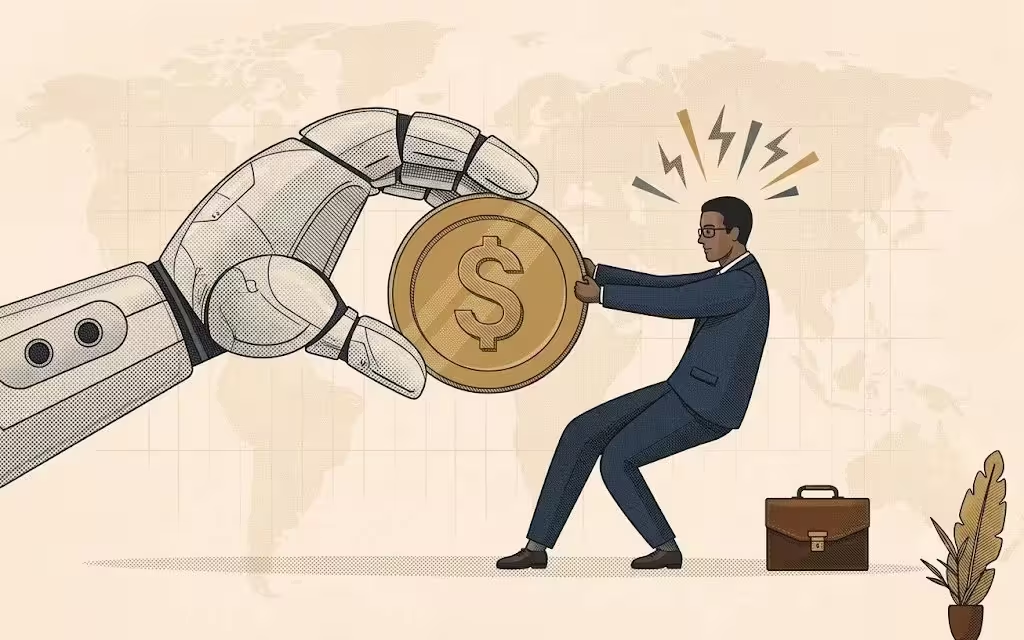
In the significant-impact scenario, the economy’s growth rate doubles to 5.4 percent as AI gains the ability to perform roughly half of knowledge work tasks, though most tasks still proceed without AI assistance. GDP ends the period 8.3 percent higher, cognitive employment falls 3.9 percent, and unemployment among administrative staff rises to 4.5 percent. Wages for cognitive workers dip slightly while wages for other groups rise by nearly 6 percent.
In the extreme scenario, annual growth reaches 15.4 percent, GDP is 32.4 percent above the no-AI path at the end of the period, and the economy roughly doubles in size about every 4.5 years. Cognitive employment drops 21.5 percent, unemployment in that group reaches 17.9 percent, and overall unemployment rises to 11.9 percent. Administrative-worker wages fall 11.5 percent while other wages increase 33.6 percent.
Under the extreme outcome, labor’s share of national income falls from 60 percent to 45.2 percent while income from capital rises by more than 80 percent. The authors note that AI could make the economy substantially wealthier but shift a large share of gains from workers to asset owners.
The model focuses on U.S. outcomes and examines a range of development and adoption speeds; Anthropic provides the interactive tool and technical paper as the basis for these scenarios.


Leave a Comment
Comments
No comments yet. Be the first.