
PI price and Protocol 28 timing
Pi Network has moved quickly from Protocol 27 into active Protocol 28 testing while the PI token remains below the psychologically important $0.10 mark. As the project prepares for a Mainnet protocol upgrade mid-October, traders and developers are watching price, on-chain developments, and upgrade deadlines closely.
Current market snapshot
At the time of writing, PI trades near $0.0893 according to CoinGecko data. Market activity shows light daily volumes relative to a market capitalization close to $1 billion and roughly 11.24 billion PI circulating. Over the last 24 hours PI slipped about 2%, while a seven-day view shows modest gains around 2.3%—a sign of short-term consolidation rather than a decisive breakout.
Key market metrics
- Price: ~ $0.0893 (CoinGecko)
- Market cap: ~ $1 billion
- Circulating supply: ~ 11.24 billion PI
- 24-hour volume: ~ $6.4 million
These metrics highlight a relatively low turnover environment for a token with sizeable valuation, which can accentuate price inertia until trading activity increases.
Technical picture: resistance at $0.10 and mixed momentum
After a steep decline from highs above $0.20 earlier in the year, PI has traded in a horizontal band between about $0.08 and $0.10 since July. The token has repeatedly tested the $0.10 zone in September but has not sustained a move above it, leaving that area as a key near-term resistance.
Momentum indicators point to neutral-to-weak directional bias. The Relative Strength Index (RSI) sits just under the neutral midline, near 48, indicating neither oversold nor overbought conditions. The Aroon Oscillator reading, modestly negative (around -14), suggests bearish pressure is currently greater than bullish pressure but not showing aggressive downside momentum.
Price will need to clear the recent short-term pivot near $0.094 before it can realistically challenge $0.10. Moving averages continue to act as hurdles — PI has recently traded below its 20-, 50-, 100- and 200-day exponential moving averages at various points during late September, underscoring the difficulty of sustaining rallies while longer-term averages remain above price.
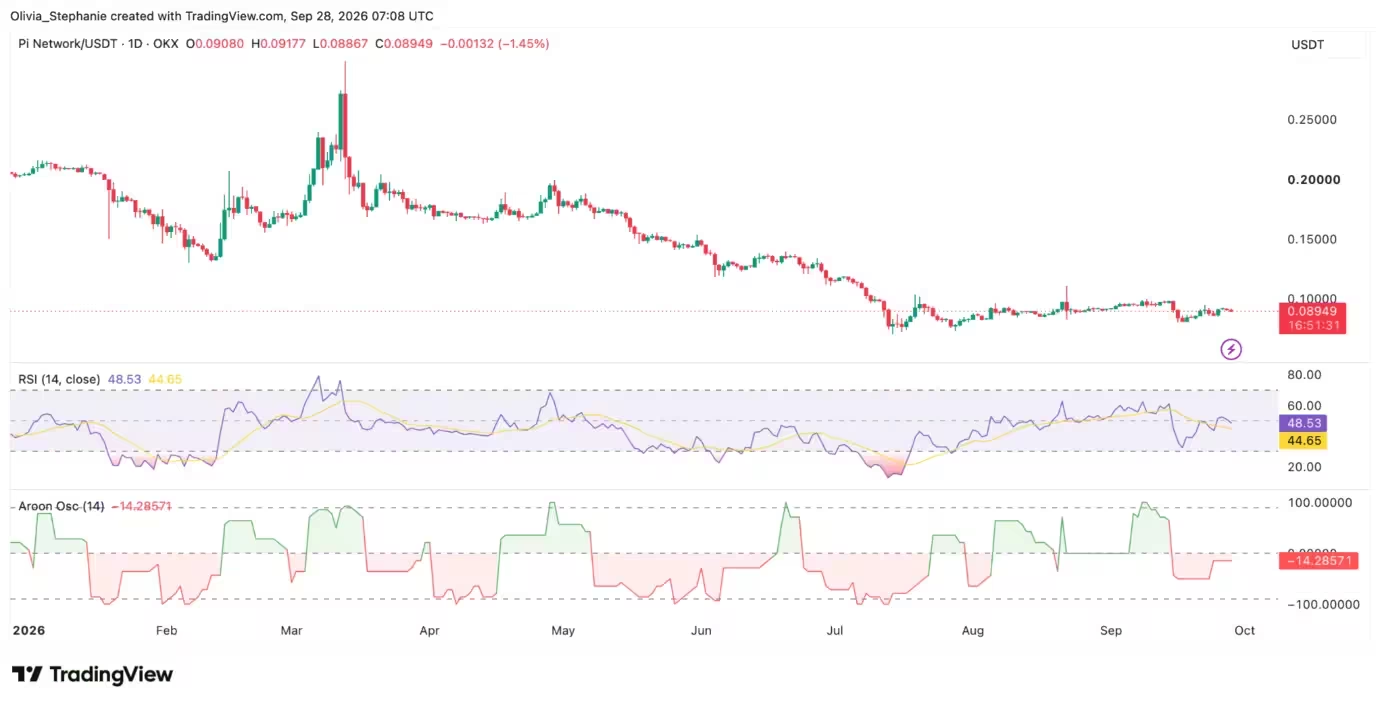
Pi Network price chart
.webp "Pi Network Eyes Rebound as Top Whale Resumes Buying")
Protocol 28: what changes and why it matters
Pi Testnet has already upgraded to Protocol 28 after the Pi Core Team confirmed successful completion of Protocol 27 on Mainnet. Protocol 28 focuses on improving how the network handles transaction data delays and introduces features to help developers manage smart-contract updates and stored data changes more safely.
Protocol 28 is expected to reach Mainnet on October 16, 2026. Node operators must install the Protocol 28 update by October 13 to participate in the Mainnet rollout without interruption. The Core Team’s communications stress that this upgrade is required for all Mainnet nodes and encourage operators to update promptly.
Developer and application implications
- Group smart-contract upgrades: Protocol 28 aims to let developers deploy coordinated updates for related contracts rather than performing piecemeal changes, improving safety during multi-contract migrations.
- Better handling of transaction data delays: Enhancements to data delay handling can reduce edge-case failures for dApps and improve transaction reliability.
- Safer stored-data adjustments: The upgrade includes mechanisms to let applications modify persisted data more securely during development cycles.
These changes are designed to support a growing ecosystem of decentralized applications on Pi Network and to reduce friction for developers as the platform matures.
Upgrade timeline and node operator requirements
The official schedule gives node operators until October 13 to install Protocol 28 client updates. The Mainnet activation is slated for October 16. Protocol 27 — which expanded smart-contract authentication flexibility and added other infrastructure improvements — was completed on Mainnet before the team advanced Testnet to Protocol 28 testing.
Historically, Pi’s upgrade cadence through 2026 has included several numbered protocol releases (Protocol 22, 25, 26, 27 and now 28), reflecting an iterative approach to adding features and hardening the network.
Price action and investor sentiment ahead of Mainnet upgrade
Since mid-September, PI has shown repeated, short-lived rebounds above $0.09 but has not been able to convert those into a sustained breach of $0.10. CoinGecko historical data show a close near $0.0983 on Sept. 14 before the token fell to roughly $0.0812 by Sept. 17, then partially recovered to intraday highs around $0.0945.
Volume distribution is concentrated on a handful of centralized exchanges — Gate, OKX, CoinW and others — with OKX and Gate handling significant PI/USDT liquidity. OKX’s PI/USDT pair accounts for over $2 million in 24-hour volume in recent snapshots, while Gate’s pair adds over $1.2 million. Concentrated liquidity can influence volatility and order book depth around key levels like $0.10.
PI remains far from its all-time high of $2.99, trading roughly 97% below that peak. That historic gap emphasizes both the token’s previous speculative extremes and the current consolidation phase.

KYC, Mainnet migration and user onboarding updates
Beyond protocol updates, Pi Network has been addressing user verification and wallet migration matters. In September the project published KYC and Mainnet migration fixes to resolve stuck applications and migration claims. Notably, the team cleared over 417,000 users previously flagged for potential duplicate accounts and addressed issues affecting roughly 497,000 Fast-Track wallets that lacked gas funds to claim migrated PI.
These administrative and technical fixes are important for user trust and network usability. Successful KYC and migration flows help broaden the active on-chain user base and reduce friction for token holders trying to access their assets on Mainnet.
Why KYC and migration matter for PI tokenomics
- Liquidity activation: Resolving migration problems lets more users access and move funds, which can increase on-chain liquidity.
- User confidence: Clear verification processes reduce uncertainty for holders worried about claiming or using PI.
- Ecosystem growth: Removing friction helps developers and applications gain a more stable user foundation.
Improved onboarding and migration processes are complementary to the protocol upgrades designed to make the platform more developer-friendly.
Outlook: Can PI hit $0.10 before Oct. 16?
Technically, PI could test $0.10 in the run-up to the October Mainnet activation, but several factors work against a clean breakout:
- Momentum is muted: RSI and Aroon readings imply weak directional conviction, so price needs a catalyst to ramp buying activity.
- Resistance and moving averages: The $0.094 pivot and multiple moving averages above price pose hurdles that must be cleared decisively.
- Low trading volume: Current daily volumes are modest relative to market cap, making meaningful breakouts harder without institutional or retail influx.
Key catalysts that could push PI above $0.10 include strong positive news around Protocol 28 testing or Mainnet activation, higher-than-expected adoption metrics from dApp launches, or a spike in liquidity and trading interest from major exchanges. Conversely, missed deadlines, technical regressions, or broader crypto market weakness would likely keep PI capped or push it lower.
Conclusion
Pi Network’s move into Protocol 28 testing and the approaching October 16 Mainnet upgrade are meaningful technical milestones for the project. From a market perspective, PI remains range-bound below $0.10, with mixed momentum indicators and thin trading volumes. While a pre-Protocol 28 push above $0.10 is possible, it will likely require a clear catalyst or sustained volume pickup to overcome the resistance cluster and technical hurdles.
For traders and long-term observers, focus on the October 13 node upgrade deadline, October 16 Mainnet activation, developer adoption signals, and liquidity changes on major exchanges. These factors will collectively shape whether PI can break the $0.10 level and sustain a higher trading range in the weeks following Protocol 28’s Mainnet rollout.


Leave a Comment
Comments (1)
Wait, PI still under $0.10? kinda wild. Protocol 28 could flip it, or it could fizzle… volume is tiny, pump risk is real, imo