
Zcash rallies as co-founder reaffirms $5,000 year-end target
Zcash (ZEC) has surged roughly 102% over the past month, trading near $1,535 as of late September. The sharp rally reignited attention on ZEC after co-founder Eli Ben-Sasson restated his bullish prediction that Zcash could reach $5,000 by the end of 2026. That projection follows an earlier short-term target of $1,200, which the token surpassed during September’s momentum.
Ben-Sasson’s renewed commentary has drawn interest from institutional and retail crypto investors alike. In a recent post on X (formerly Twitter) he wrote that he still sees his $5,000 year-end call as achievable after ZEC cleared his prior monthly target, while also acknowledging uncertainty about the immediate drivers of the move.
Ben-Sasson did not publish a mathematical price model or a sequence of intermediate levels that would map a direct path to $5,000. Instead, his remarks have been taken by parts of the market as a definitive endorsement of long-term upside for ZEC.
Price action and technical context
ZEC briefly traded above $1,600 during the September rally before retreating closer to $1,500. On the Binance daily chart captured on Sep. 26, Zcash opened the session at $1,555.74, reached a high near $1,559.02 and posted a low around $1,527.56. The coin remained above the chart’s $1,500 Murrey Math level after pulling back from the peak, with the next overhead levels at $1,625 and $1,750. On the downside, marked levels sit at $1,375 and $1,250.
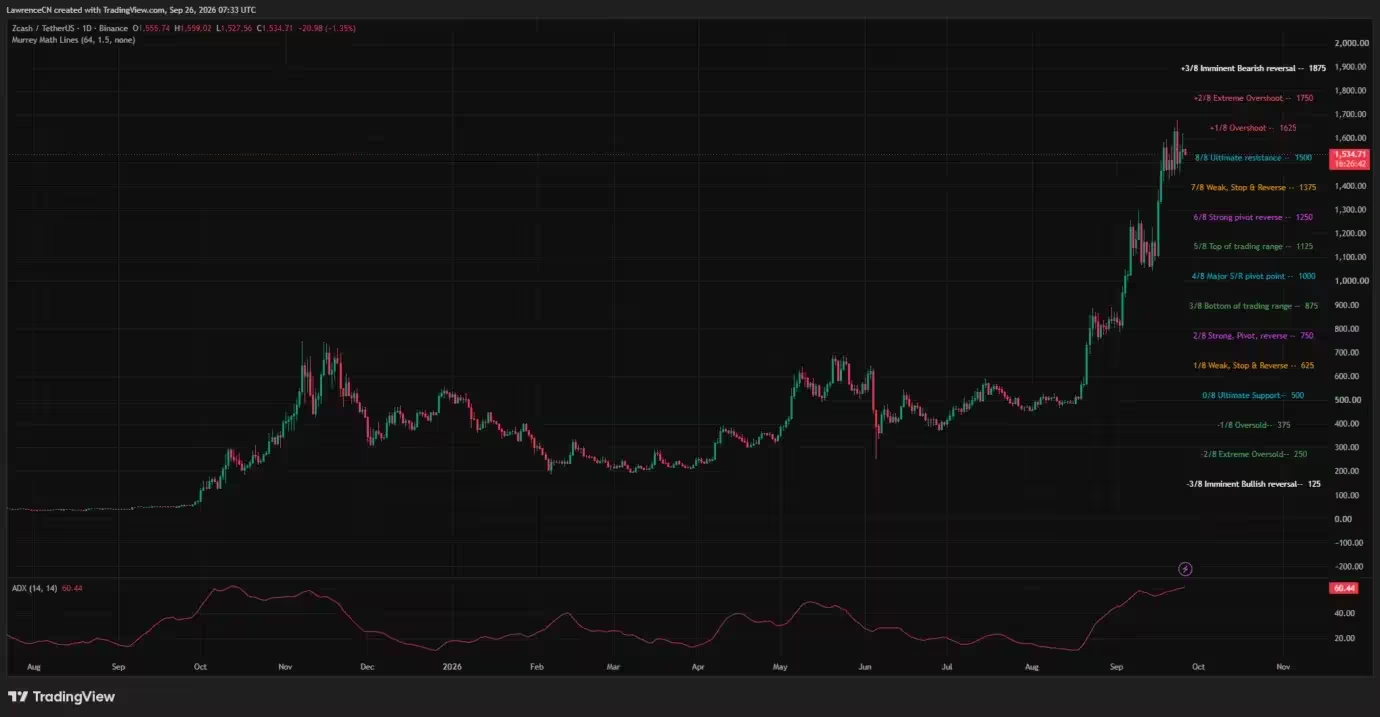
Zcash price daily chart — Sep. 26
Momentum indicators reflect a very strong trend: the daily average directional index (ADX) was around 60.44, indicating the current price movement is powerful even if ADX does not indicate direction itself. That directional context is supplied by ZEC’s recent gains through September resistance points.

The speed of the appreciation has created high volatility, producing rapid reversals in short windows. For example, on Sep. 18 ZEC spiked to $1,535.82 before correcting toward $1,455. Earlier in September the token climbed from roughly $814 to above $1,200, crossing $1,000 on Sep. 4 — a push amplified by short-liquidation events. Subsequent legs of the rally moved ZEC through $1,250 and $1,375.
Whales, liquidity and catalysts
Large holders have reportedly been asking Ben-Sasson what fueled the recent advance. While he admitted he didn’t know the exact catalyst, a few likely contributors include growing institutional access to ZEC, short squeeze dynamics, and renewed retail interest. Market participants often cite the convergence of new exchange-listed products, technical upgrades, and shifting liquidity conditions as compound drivers for substantial token moves.
Grayscale’s Zcash fund and product flows
Institutional access to ZEC has expanded recently. Grayscale converted its Zcash Trust into a U.S.-listed exchange-traded product trading on NYSE Arca under the ticker ZCSH on Aug. 25. That listing provides a way for U.S. brokerage accounts to gain exposure to ZEC without holding the underlying asset, an important consideration for many regulated investors.
Grayscale launched the fund with about $304 million in assets under management (AUM). Within weeks assets grew past $500 million and, roughly one month after listing, exceeded $1 billion — a mix of investor inflows and the appreciation of ZEC already held by the product. The fund has also scheduled a three-for-one forward split: investors on record at the close of Sep. 28 will receive two additional shares per share held, with distribution on Sep. 29 and split-adjusted trading beginning before market open on Sep. 30. The split increases share count and reduces net asset value per share proportionately without changing the total value of holdings at the time of the adjustment.
For U.S. investors weighing direct ZEC ownership against fund exposure, Grayscale notes that ZCSH is not registered under the Investment Company Act of 1940. Shares trade in brokerage accounts, while direct owners maintain custody of the cryptocurrency itself. This distinction can influence tax, custody, and regulatory considerations for investors.
European ETP and expanded market access
Outside the U.S., 21Shares launched a physically backed Zcash exchange-traded product listed on Euronext Paris and Amsterdam in September. That ETP provides eligible European brokerage clients another regulated route to ZEC exposure, complementing the U.S.-listed ZCSH and increasing institutional and retail accessibility to the token across major markets.
Network upgrade NU7: timeline and implications
Developers on the Zcash protocol have set a near-term timetable for Network Upgrade 7 (NU7). According to the project’s published schedule, testnet activation is targeted for Oct. 6. The upgrade proposes to shorten the block target time from 75 seconds to 25 seconds, a change designed to increase throughput and lower confirmation latency.
Following testnet validation, the project team plans to make a final mainnet activation decision on Oct. 20, with mainnet activation targeted for Nov. 5. The NU7 package also includes updates to older transaction formats and modifications to the network’s funding mechanism. ZEC stakeholders supported the faster block target in a September governance poll: nearly 99.9% of participating coinholders favored the 25-second block proposal while about 98.9% voted to retain the existing halving schedule.
Faster block times can have meaningful effects on user experience, miner/validator reward cadence, and short-term transaction fee dynamics — all factors traders and long-term holders will monitor as the upgrade approaches.
What traders and investors should watch next
Key areas to monitor in the coming weeks include:
- Price levels and liquidity around $1,500, $1,625 and $1,750 — critical technical zones derived from recent Murrey Math levels.
- Fund flows into ZCSH and the 21Shares ETP, which could sustain institutional demand for ZEC.
- Volatility indicators and potential short squeezes, especially after large price gaps.
- NU7 testnet rollout and the mainnet activation decision in late October, which could serve as a fundamental catalyst.
- On-chain metrics such as large transfers, exchange inflows/outflows, and wallet clustering that may reveal whether whales are accumulating or redistributing positions.
While Eli Ben-Sasson’s $5,000 year-end target has energized bullish sentiment, readers should remember that price predictions are speculative. Traders should combine technical analysis, fundamentals — including network upgrades and institutional adoption — and risk management before making investment decisions. This coverage is informational and not investment advice; always do your own research (DYOR).
Bottom line

Zcash’s strong monthly rally has pushed ZEC into a new range and brought renewed market focus thanks to high-profile commentary and growing institutional product availability. With Grayscale’s ZCSH surpassing $1 billion in assets and a planned network upgrade approaching, the market is watching whether liquidity, technical momentum and protocol improvements can sustain the move toward the much-discussed $5,000 target by year-end.

Leave a Comment
Comments
No comments yet. Be the first.