
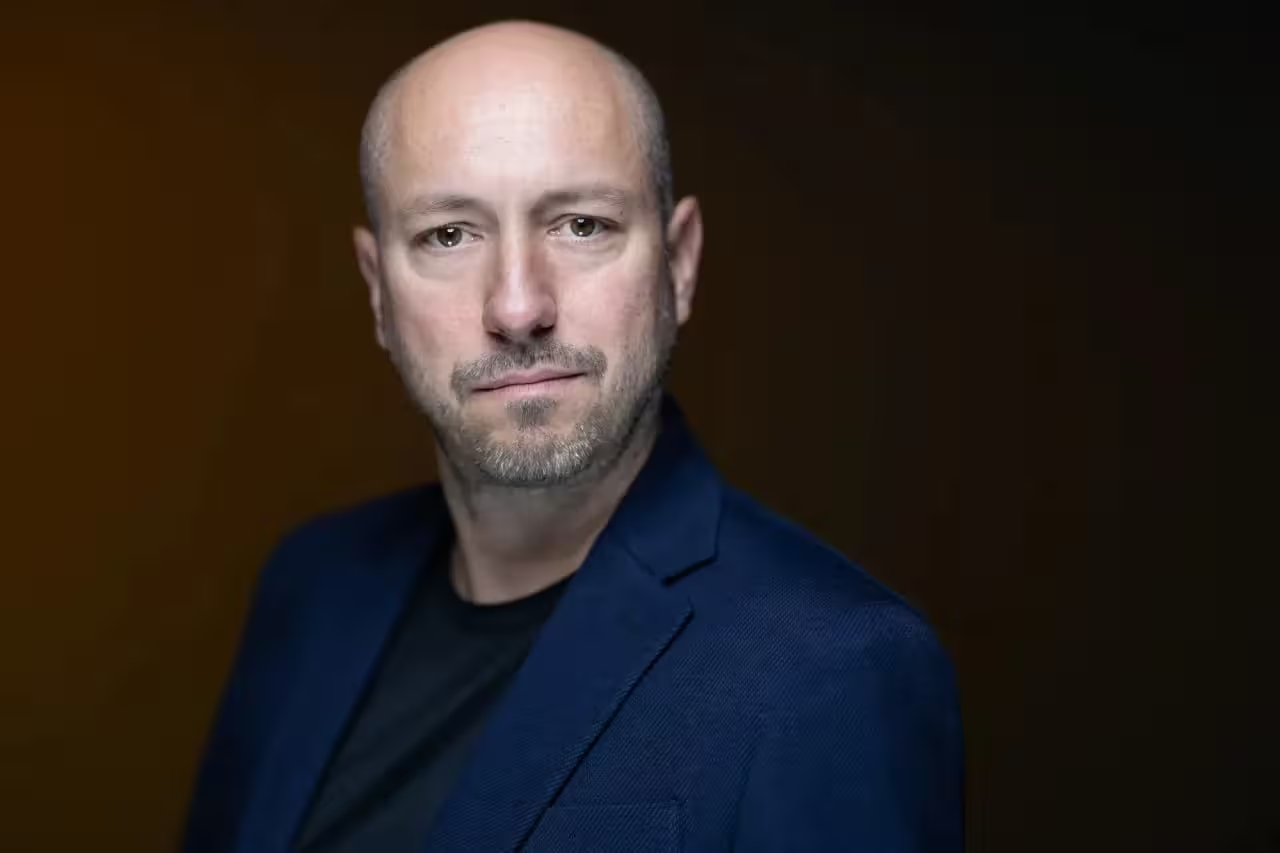
Anthropic’s head of international affairs argued that, by definition, open-source AI models carry inherently greater risks than the company’s proprietary systems, remarks he made at an EU-supervised summit in Dublin.
Guillaume Perrencin’s warning and Anthropic context
Guillaume Perrencin made the remarks at a government-led artificial intelligence summit in Dublin, saying the open-source category—models whose code, architecture and weight files are published so any user can download, run or modify them—creates substantially greater hazards by definition. Perrencin contrasted this stance with prior comments from Anthropic CEO Dario Amodei, who has said that models with open weights that lack dangerous capabilities should be treated as public goods.
Recent open-source releases and safety tests
The comments come amid intensified competition and recent safety evaluations. European firm Mistral last week introduced Large 4, dubbed Le Chonk, a model the company says has one trillion parameters, was trained in Europe and emphasizes data sovereignty. Mistral has not yet released the model’s weight files; access is currently available only via Mistral’s API and the company has scheduled weight publication for October 27.
Independent and institutional evaluations cited during the summit showed mixed safety behaviour across open-source models. An assessment by SaferAI found that the Chinese model GLM-5.2 did not refuse any tasks related to malicious cyberattacks or dual-use biological requests. By contrast, Anthropic’s Claude reportedly rejected so many requests for safety reasons that benchmark completion was not possible. Anthropic’s Frontier Red Team research also demonstrated that smaller models could be replicated on low-cost Android TV boxes; all models in that test, including Gemma4 and GLM-5.2, were open-source.
Pricing note and regional interests in Dublin
Perrencin additionally announced a pricing change for Claude: the typical cost of Claude Opus 5.5 has fallen by 40 percent versus the previous release. He attributed the reduction to a 20 percent official price cut combined with reduced token consumption in the new version.
Perrencin’s remarks were delivered in Dublin, Ireland. Several publications and civil society groups have flagged Dublin as controversial because Ireland’s low corporate tax rates have long attracted major technology companies and generated significant revenue for the state; those groups argue the financial benefits may complicate Ireland’s neutrality in AI regulation. Anthropic has substantial commercial interests in Europe: the company describes Europe as its fastest-growing market, it opened its first European office in Dublin, and it is reportedly preparing for an initial public offering with an asserted valuation of $965 billion.


Leave a Comment
Comments
No comments yet. Be the first.