

Ethereum testnet activation set for December 15
Ethereum core developers have agreed to schedule the Glamsterdam upgrade activation on the Hoodi testnet for December 15, closing a near seven-week delay that followed concerns about smart contract compatibility under the proposed gas-pricing model. The decision to retain the current EIP-8037 specification comes after security audits and extensive internal review, and it arrives as ETH’s market price climbed roughly 3% to about $1,740.
What the Hoodi activation means
The Hoodi testnet will flip the Glamsterdam changes at epoch 143616, scheduled for 19:12 UTC on December 15 (03:12 Beijing time on December 16). The deployment was previously postponed from its October 26 target after researchers flagged potential impacts to existing smart contracts under the new state-gas accounting rules.
Developers revisited alternative designs and audit findings before reaching a ‘‘rough consensus’’ to proceed with the existing Glamsterdam spec. While this clears the path for further testing on Hoodi, a mainnet date for Glamsterdam has not been set.
EIP-8037 and how it changes gas accounting
At the core of Glamsterdam is EIP-8037, which separates accounting for gas consumed during execution from the costs associated with creating permanent state — such as storing contract bytecode on-chain. Under the current proposal, contract creation would carry a state gas charge of 183,600 units alone, compared with the prior base creation cost of 32,000 gas units. Execution steps and bytecode storage would be billed independently.

Proponents argue this recalibrates incentives for storage and helps manage long-term state growth after the network increased block gas capacity from 30 million to 60 million units. Average daily state growth rose notably following that block gas-limit increase, prompting calls for clearer price signals to limit bloat.
Security audits flagged compatibility issues
Before greenlighting the Hoodi activation, the Ethereum Foundation commissioned security firms ChainSecurity and Dedaub to scan the ecosystem for contracts that might break under the new charging model. The combined assessment returned roughly 200 compatibility findings: three high severity, 30 medium, and 167 low.
Fixed gas budgets were the most common problem, appearing in 182 of the findings — about 91% of the total. While many of these issues can be mitigated via configuration fixes, the auditors identified 24 cases requiring contract upgrades or migration. The Foundation estimates that between 10,000 and 15,000 of Ethereum’s roughly 90 million deployed contracts could encounter difficulties without adjustment.
The team reached out to more than 50 potentially affected projects to estimate remediation timelines and to support safe transitions where needed.
Consensus-layer coordination and safety measures
To avoid introducing consensus-breaking behavior, consensus-layer developers agreed on a validation mechanism for execution payloads via pull request 5770. This approach aims to ensure that nodes maintain consistent block validation while allowing the execution-layer changes proposed in Glamsterdam to be tested in an isolated environment.
Hegotá, FOCIL and the shift toward quantum-resistant crypto
With the Hoodi schedule resolved, attention is shifting to the next upgrade, Hegotá. A central debate concerns whether to keep Fork Choice-Enforced Inclusion Lists (FOCIL) — a design intended to reduce censorship by restricting block builders from excluding eligible transactions — or to reallocate engineering effort to post-quantum cryptography work.
Some researchers, including Ethlabs’ Caspar Schwarz-Schilling, have urged the community to prioritize quantum-resistant cryptographic upgrades over FOCIL. Others argue both efforts can proceed in parallel. The conversation follows proposals to narrow Hegotá’s scope to accelerate cryptographic resilience work.
In related research, Ethereum Foundation contributor Kev Wedderburn has proposed adopting Keccak-256 as a common hash across Ethereum’s post-quantum infrastructure, citing the function’s extensive analysis and deployment history. Meanwhile, researcher Justin Drake has outlined a late-2028 target for completing Ethereum’s transition to post-quantum and post-AI secure primitives, a timeline he presented during Devcon in Mumbai.
Developers plan to revisit Hegotá’s feature list at the next consensus-layer meeting in two weeks, balancing censorship resistance, performance, and cryptographic security priorities.

Market reaction: ETH price edges higher
On the market front, Ethereum’s price rose by about 3% over 24 hours to near $1,740 as of November 27, outpacing Bitcoin in a broader crypto rebound. Over the preceding 24-hour window, ETH traded between roughly $1,670 and $1,750.
Technical indicators show a tentative bullish signal: the Moving Average Convergence Divergence (MACD) line crossed above its signal line on the daily chart — a common momentum marker. At the time of the crossover, MACD readings remained negative (MACD: -143.55; signal: -153.03), while the histogram turned modestly positive at 9.48, implying early-stage bullish momentum that has not yet fully negated the prevailing downtrend.
The Stochastic Relative Strength Index (Stoch RSI) has pushed into overbought territory, with %K and %D values near 96.49 and 92.24 respectively, suggesting short-term upside may be stretched.
Immediate technical resistance sits near $1,750, followed by the $1,800–$1,850 zone and the psychological $2,000 level. On the downside, support clusters around $1,667, $1,600 and $1,500. Despite the recovery, ETH still trades far below its August 2025 all-time high around $4,950 — roughly 65% lower.
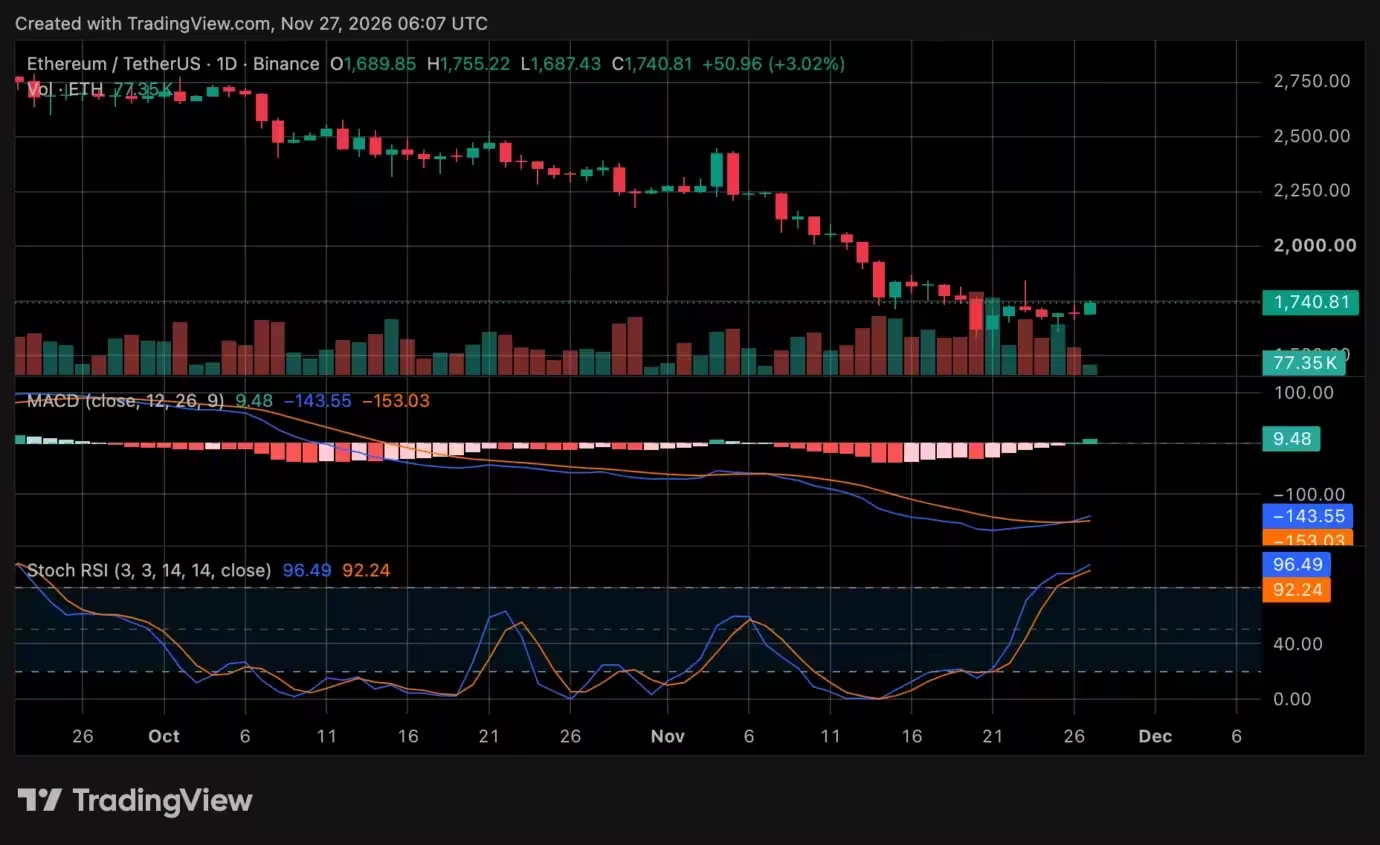
Ethereum price chart
Outlook for traders and developers
For traders, the next meaningful levels to watch are the $1,750 resistance and whether daily momentum indicators can sustain a move above zero. For developers and projects building on Ethereum, the Hoodi activation offers an opportunity to test deployments against the revised state-gas model and to confirm compatibility or implement required migrations.
Until a mainnet activation date is announced, teams should use the Hoodi window to validate contracts, adjust fixed gas budgets, and coordinate any necessary upgrades. The Foundation’s outreach to potentially affected projects underscores the importance of proactive testing and timely fixes to avoid disruptions after mainnet activation.
Key takeaways
- Ethereum’s Glamsterdam upgrade will be tested on Hoodi at 19:12 UTC on December 15.
- Developers retained EIP-8037’s current gas-accounting design after security audits and debate.
- Audits found ~200 compatibility issues; 24 cases need contract upgrades or migration.
- Ethereum price rose about 3% to near $1,740 amid a broader market rebound, with mixed technical signals.
- Hegotá’s scope and FOCIL remain under discussion as the community weighs post-quantum cryptography priorities.
The coming weeks should clarify both the technical path for Ethereum’s gas-accounting changes and the market’s appetite for continued ETH recovery. Projects building on Ethereum should prioritize testing on Hoodi and planning migrations where the audits flagged unavoidable incompatibilities.

Leave a Comment
Comments (1)
Wait 10,000-15,000 contracts could fail? sounds wild. 24 need upgrades ok, but who pays for migrations, devs, projects, users? hurry up Hoodi testing…