

3 Minutes
Huawei’s bold timetable for AI compute
Huawei used its recent customer event in Shanghai to map out a multi-year plan for large-scale AI infrastructure, despite ongoing U.S. export controls that limit access to the most advanced foreign semiconductors. The company confirmed it will deploy two generations of interconnected superpods—branded Atlas 950 and Atlas 960—starting in late 2026 and continuing into 2027, with the goal of linking dozens of these units into vast SuperClusters that deliver massive AI compute capacity.
What is a superpod?
A superpod is not a single server but an integrated system of thousands of AI accelerators and supporting components designed to run and train large models. Huawei says its Atlas 950 and Atlas 960 SuperPoDs will combine many Ascend-series accelerators and high-bandwidth interconnects to scale performance across training and inference workloads.
Ascend roadmap: chips and schedule
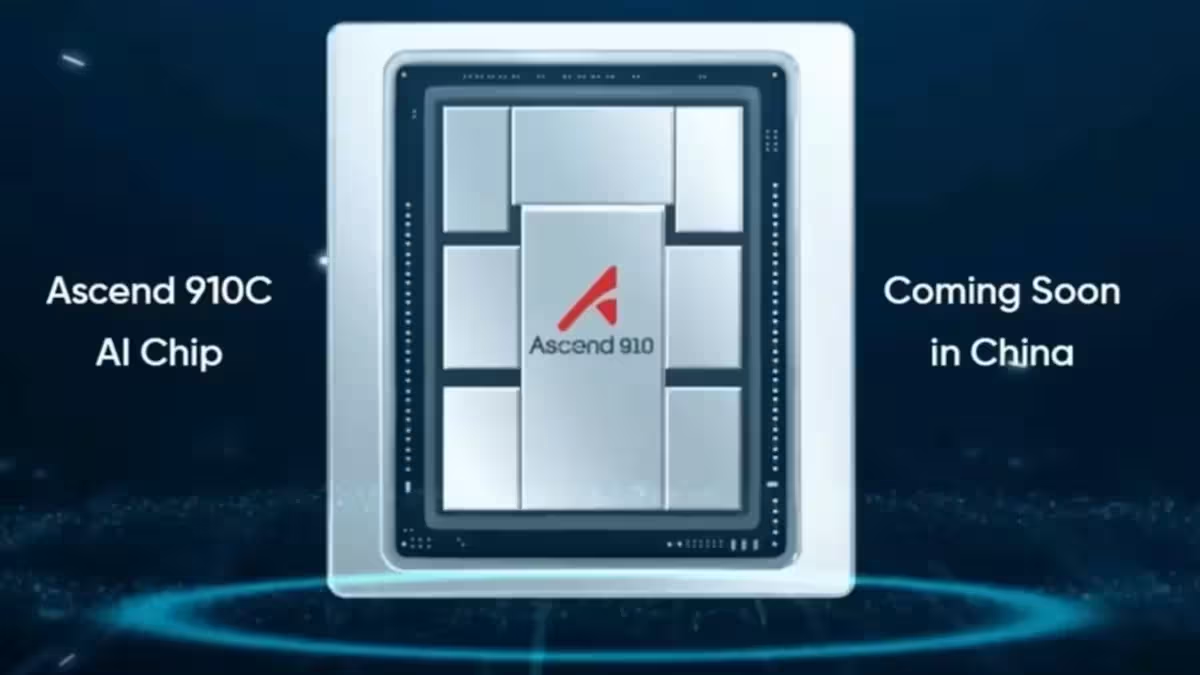
Huawei outlined a three-year cadence for its Ascend AI accelerators. According to the company, the Ascend 950 is slated for 2026, the Ascend 960 for Q4 2027, and the Ascend 970 could follow in late 2028. Huawei executives emphasized a roughly annual release rhythm and a plan to increase compute density and bandwidth with each generation.
"Our strategy is to build a new computing architecture and scale SuperPoDs into SuperClusters to meet long-term demand for AI compute," a Huawei executive explained during the keynote. Industry observers see the moves as an explicit push toward hardware self-reliance amid tighter export controls.
Sanctions, competition and the market context
U.S. restrictions have limited shipments of top-tier AI accelerators—most notably Nvidia's highest-end H100-class chips—to China. That has created a bifurcated market where Nvidia remains dominant globally but Chinese firms are accelerating domestic alternatives. Huawei argues it can close the gap by optimizing system design, creating tighter software-hardware integration, and deploying many chips in parallel.
Forrester and other analysts characterize the announcements as a milestone in China’s drive for technological resilience. Still, global availability and ecosystem support remain open questions: Ascend accelerators are largely China-focused today, while Nvidia and its partners retain broader international distribution.
Potential use cases and advantages
- Training large language models (LLMs) and other deep learning architectures
- Large-scale inference services for cloud and enterprise applications
- Research clusters for AI labs and national compute infrastructure
Advantages Huawei highlights include tighter integration between chip, software stack, and networking, plus an emphasis on energy efficiency and model training techniques that reduce some compute requirements.
Outlook
Huawei’s roadmap is ambitious and deliberately framed as a multi-year program to scale compute capacity domestically. Whether Atlas SuperPoDs and Ascend chips will match the global leaders in raw performance remains to be verified once independent benchmarks and broader availability appear. For now, the plan reinforces a broader trend: the fragmentation of the AI hardware market, with regional stacks and strategies emerging in response to export controls and geopolitical tension.
"AI compute is central to the next phase of model development," the company noted, stressing that even with model-efficiency improvements, large-scale projects—from AGI research to physical AI systems—will continue to demand substantial compute resources.














Leave a Comment
Comments
No comments yet. Be the first.