
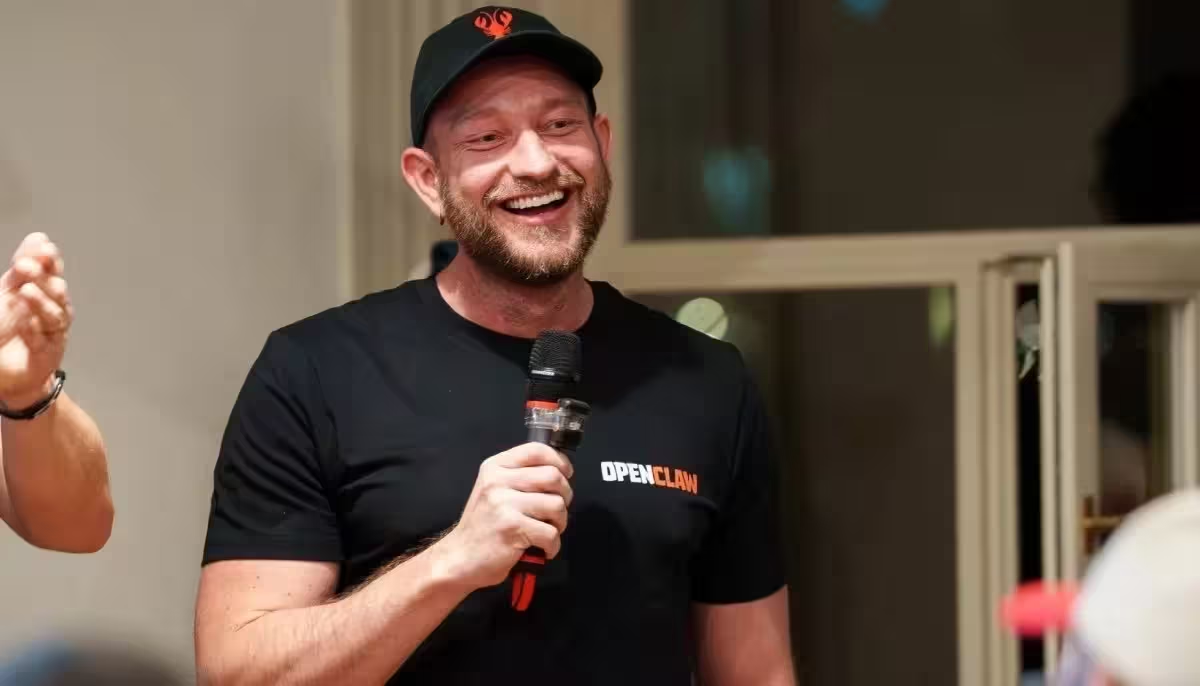
Something is quietly changing at the core of OpenAI. Not a product tweak. Not a new chat skin. Think bigger: systems that coordinate, delegate, and collaborate with purpose. That was the message when OpenAI announced the arrival of Peter Steinberger, the engineer behind the once-popular OpenClaw platform.
Peter built OpenClaw into a hub where autonomous AI agents could talk to one another, chain tasks, and solve problems collaboratively. Developers loved it. Users experimented with it. And yet, the founder says scaling it into just another commercial company did not excite him. Instead, he chose a faster, broader route to impact: joining OpenAI to help move agent orchestration from experimental playground to mainstream infrastructure.
Sam Altman has been explicit about the direction. He described Steinberger as someone with fresh, surprising ideas about how agents should interact. The implication is clear: OpenAI wants to shift from single-turn chat experiences to a landscape of interoperating agents that can negotiate, specialize, and work together on complex workflows. Short prompts no longer suffice when tasks demand sustained, coordinated behavior.
What does that look like in practice? Picture small specialist agents—one for research, one for scheduling, another for code execution—handing off sub-tasks, validating each other, and arriving at a solution faster and more reliably than a lone model fumbling through a long prompt. It sounds ambitious. It is ambitious. But teams at OpenAI have already shown they are serious, shipping agent-related tools and even a standalone Codex agent controller for Mac.
OpenClaw itself, formerly known as Moltbot and Clawdbot, became a proving ground for such ideas. That design experience is the real prize here; the codebase matters less than the mental model Steinberger brings—how to build systems that treat models as collaborators instead of one-off answer machines.
Financials of the move remain private. That did not stop Altman from assuring the OpenClaw community that their work and users will not be abandoned. For OpenAI, landing a founder with hands-on experience in agent ecosystems is a timely win, especially after the company lost several notable engineers to competitors and spinouts in recent cycles.
Timing also matters. OpenAI recently introduced GPT-5.3-Codex-Spark, a compact model tuned for faster inference, and has been experimenting with agent-focused interfaces. A smaller, quicker model pairs well with agent architectures where many lightweight components must coordinate in real time rather than relying on one huge, slow inference step.
Will this pivot change how everyday users interact with AI? Probably. Expect more multi-step assistants that take responsibility for outcomes, negotiate constraints, and call on specialist modules when needed. It is a shift from conversation to coordination. The real question is how gracefully these agents will handle failure, ambiguity, and trust—challenges that Peter Steinberger and his new team now face head-on.
.avif "OpenAI Gears Up for GPT-5 Launch with Advanced Reasoning Integration and Open-Weight Model Release")

Leave a Comment
Comments
No comments yet. Be the first.