

4 Minutes
Imagine two dead stars that refuse to behave like other corpses of the cosmos. They glow in X-rays. They spin like tiny turbines. They are magnetic giants squeezed into the size of planets. And there is no partner tugging on them. Curious? So were the researchers at the Institute of Science and Technology Austria.
Called Gandalf and Moon-Sized, these objects started as ordinary white dwarfs in the aftermath of stellar violence: two stars that merged and left behind ultra-dense remnants. Yet these remnants share an odd bundle of properties—five, to be exact—that set them apart from the familiar menagerie of white dwarfs. They are ultra-massive, intensely magnetic, rapidly rotating, companionless, and, remarkably, X-ray bright. Two examples with five overlapping traits are enough, the team argues, to suggest a new class of stellar remnant.
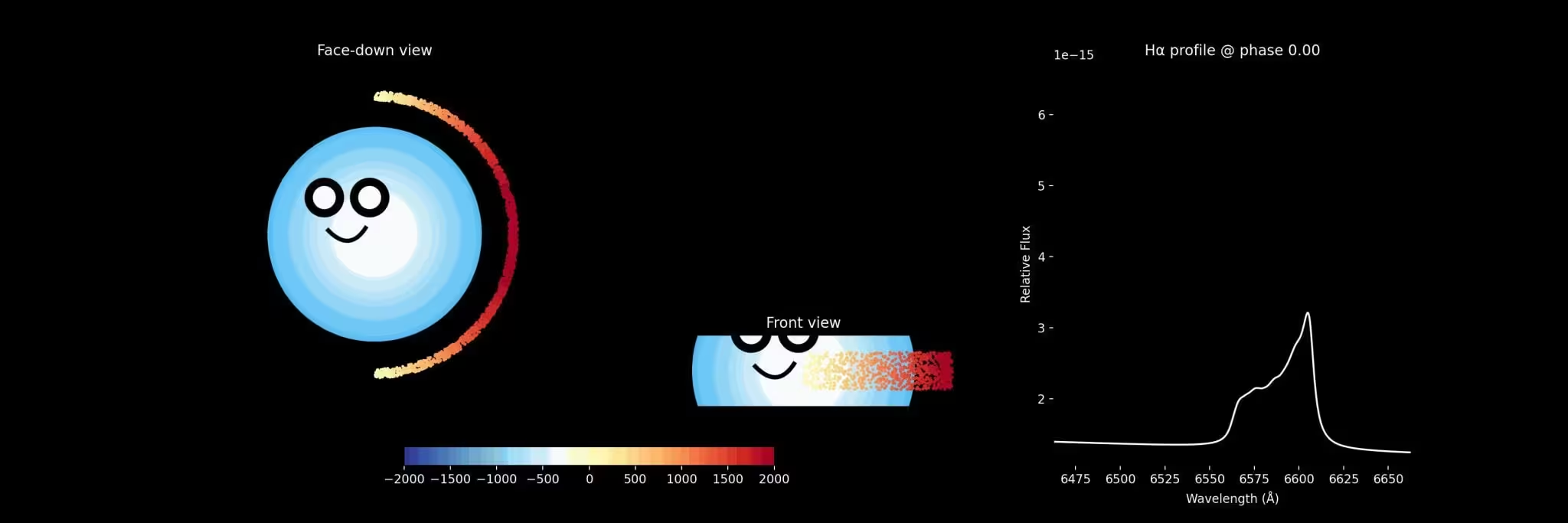
Gandalf was first flagged as unusual during follow-up work by the team. It rotates every six minutes. That is blisteringly fast: many binary systems with compact objects synchronize their spin with the orbital period of a companion; the fastest such orbit known is roughly 80 minutes. Gandalf’s furious rotation, coupled with signs of hydrogen emission that flip between two peaks each spin cycle, paints the picture of a half-ring of material locked in place by an asymmetric magnetic field. Half-ring. Not a full disk. Not something astronomers have seen around a white dwarf before.
Moon-Sized, reported earlier and now reanalyzed with new data, is an extreme in its own right: roughly the mass of the Sun compressed into a body comparable to the Moon. It, too, is highly magnetic and rapidly rotating, but it lacks the obvious circumstellar structure visible around Gandalf. The two objects differ in age too. Gandalf’s merger likely occurred tens of millions of years ago; Moon-Sized’s collision dates back about half a billion years. Gandalf shines in X-rays about a hundred times more brightly than Moon-Sized, suggesting either a waning engine or divergent post-merger paths.
How do isolated white dwarfs produce X-rays? That is the puzzle at the heart of this discovery. One compelling idea borrows from the physics of pulsars: a strong, fast-rotating magnetic field can strip charged particles from the star itself and launch them outward, generating high-energy emission without any companion. It is an elegant solution because it relies solely on the remnant’s internal power. But pulsar-like outflows have not, until now, been simulated in white dwarf conditions.

A different possibility invokes leftover merger debris. In violent collisions, not all material falls in immediately. Streams of matter on eccentric orbits can return and accrete gradually over millions of years, producing intermittent high-energy emission as they slam back onto the remnant. This fallback idea naturally explains long-lived X-ray activity, but it requires a reservoir of material arranged just so.
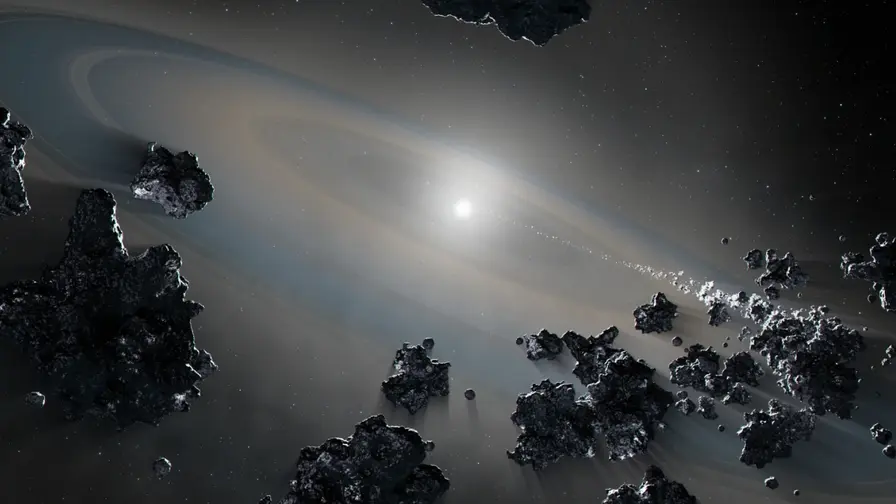
There is also the mundane but plausible source of external pollution: asteroids, planetary fragments, or other small bodies nudged inward and consumed by the dense remnant. Many white dwarfs show traces of such pollution in their spectra. Gandalf hints at this kind of contamination via carbon- or silicon-rich signatures, while Moon-Sized does not—making the planetary-debris scenario harder to apply uniformly to both objects.
What makes these two stars especially interesting is how they force astronomers to rethink classification. Discoveries often start with an oddball that sparks a search for siblings; here, two siblings have already been found. The presence of X-rays in isolated, magnetic, fast-spinning merger remnants raises the prospect that a whole population of similar objects may be hiding in survey data, misclassified or overlooked because their behavior does not fit standard templates.
Beyond taxonomy, there are implications for stellar and planetary evolution. If magnetically driven outflows are real, they alter how we understand angular momentum loss and magnetic field evolution after mergers. If fallback accretion dominates, then the timing and geometry of merger ejecta matter in ways observers have yet to fully map. If planetary debris occasionally feeds these remnants, then the story links stellar death to the fate of surrounding planetary systems—a bleak epilogue where worlds are ground into gas and dust and briefly reignite their dead suns.
The ISTA team, led by Ilaria Caiazzo with key contributions from PhD students Andrei Cristea and Aayush Desai, published their findings in Astronomy & Astrophysics and shared a detailed preprint on arXiv. Their work opens immediate paths for follow-up: deeper X-ray observations, targeted spectroscopic campaigns to search for more half-ring signatures, and theoretical modeling to test pulsar-like outflows in white dwarf physics.
Two strange remnants. Five shared traits. Several competing explanations. The Universe has a knack for serving questions with new puzzles; the hunt is now on to find who else answers in the same strange voice.

Leave a Comment
Comments (2)
Is this even real though? Two cases sound neat but could be selection bias, are they sure it's not binary leftovers, or...
Wow, mind blown... isolated white dwarfs acting like pulsars? If that's real, wild. Need more obs, deeper X-rays asap!