
4 Minutes
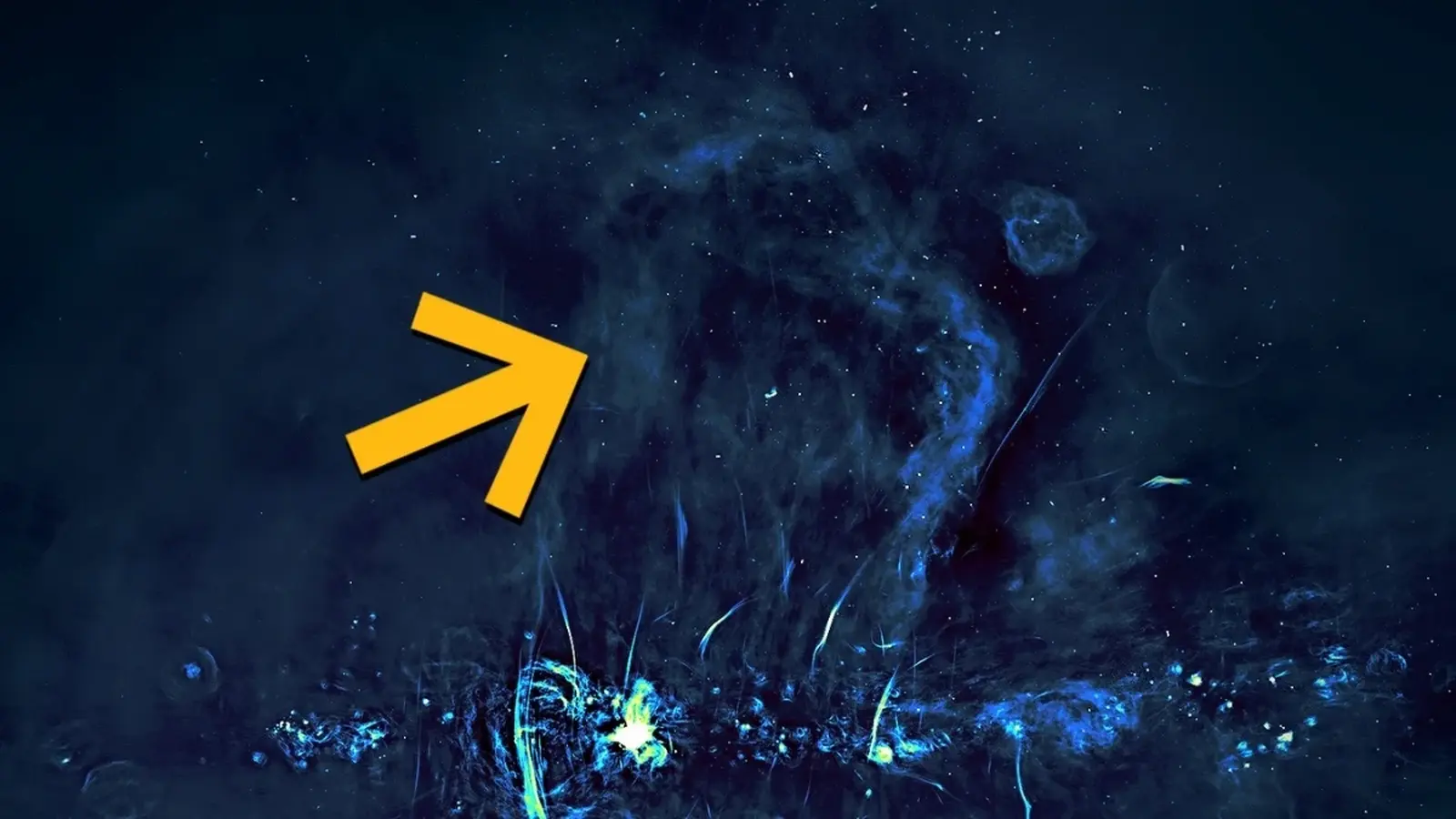
Look up at a radio map of our galaxy and you might swear you see something erupting from the central churn — a towering structure, arcing like a cosmic eyebrow over the Milky Way’s heart. For forty years that eyebrow had astronomers arguing, guessing, and publishing competing origin stories. Supernova remnant? Black hole tantrum? A relic from the galaxy’s violent youth? The truth turned out to be quieter — and closer.
Astrophysicist Kathryn Kreckel and her team at Heidelberg University have untangled the long-running puzzle of the so-called Galactic center lobe. Their paper, published in Astronomy & Astrophysics, shows this famous radio feature is neither at the Galaxy’s center nor shaped like a classical lobe. Instead it’s a closed, foreground loop — a bubble roughly 6,520 light-years from Earth. Suddenly the object shrinks from a gargantuan galactic monument to a more modest, local structure roughly 115 light-years across.

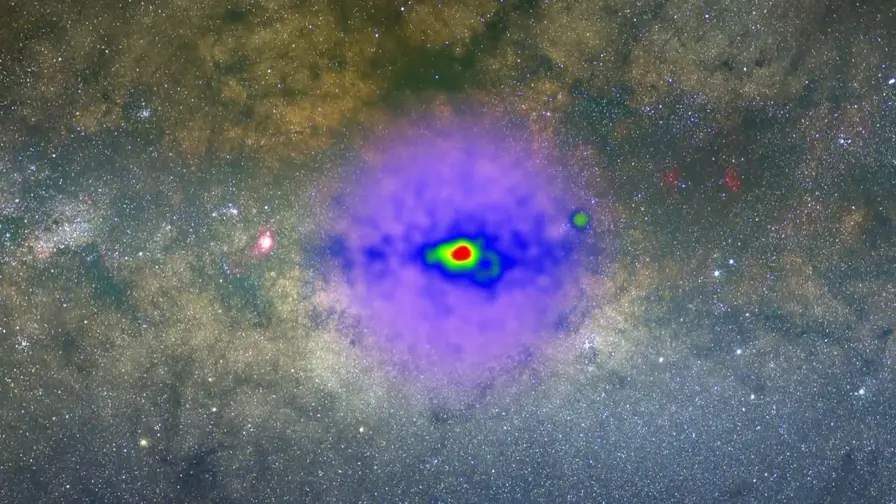
The galactic center in optical and radio light.
How did something so unmistakable in radio images become so misleading? Projection. Dust. Crowded sightlines. When you peer toward the Galactic center you’re looking through the densest part of the Milky Way: stars, molecular clouds, and confusing layers of emission all piled along the same line of sight. In radio maps the lower rim of the bubble blends into emission from the galactic plane, making a closed loop look like an outward-sweeping lobe. Our perspective created an illusion.
The breakthrough came by changing the way the object was examined. Kreckel’s team used data from the SDSS‑V Local Volume Mapper, which maps glowing gas across optical and near‑infrared wavelengths. One tracer proved decisive: ionized sulfur. Emitting in the red, sulfur lines pierce dust more effectively than bluer emissions. Where radio left ambiguity, the sulfur glow disclosed structure. Sections that seemed absent in radio light became visible, revealing the loop’s continuity and helping pin down how much interstellar dust sits between us and the bubble.

A map of the ionized sulfur emission.

Distance matters. If the loop were at the Galactic center — about 26,000 light‑years away — its size and energy budget would imply a cataclysmic origin, perhaps linked to past activity of the central supermassive black hole. At 6,520 light‑years, however, the energy requirements drop dramatically. Kreckel and colleagues showed that the amount of reddening affecting the sulfur emission matches three‑dimensional dust maps that place the structure squarely in the foreground. The Galactic center lobe becomes, in their words, the “greatly confused loop.”
So what carved this bubble? The team finds compelling parallels to structures like Barnard’s Loop in Orion. Large stellar nurseries spawn populations of massive stars that live briefly and die violently. Their winds and supernovae evacuate cavities in the surrounding gas and dust, producing shock fronts that compress adjacent material and spark new star formation. Intense ultraviolet radiation from hot, young stars then ionizes the shell of gas, making the bubble’s rim glow so brightly it outlines itself against the sky — a ring on the sky, but really the edge of a three‑dimensional bubble.
Within the newly localized loop, hydrogen gas glows under strong ultraviolet illumination. The specific ionized sulfur signature helped the authors estimate both the ionization state and the extinction along the line of sight. They have not yet pinned down the precise stellar culprits, but the evidence points to an earlier generation of massive stars in the same region — born, lived fast, and likely exploded, leaving a carved, glowing shell in their wake.

Images showing the hydrogen-alpha and ionized sulfur.
Size comparisons clarify the picture. At around 115 light‑years across, the loop is smaller than Barnard’s Loop but close enough in scale and morphology to suggest a shared formation mechanism: clustered massive stars, winds and supernovae, and the subsequent ionization of the evacuated shell. The feature is prominent in radio, yes, but the optical and infrared perspective finally supplies the missing pieces.
This is a neat astrophysical sleight of hand. The Milky Way masks its own architecture with layers of emission and absorption. Even among well‑studied regions, foreground and background features can impersonate each other. What looked like a giant lobe connected to the Galaxy’s nucleus now reads as a foreground bubble — a reminder that perspective rules in astronomy. We map not only space, but our place inside it.
There’s more to do. Identify the stars that lit the bubble. Model its kinematics. Compare it to similar loops across the Milky Way. Each step peels back a layer of the galaxy’s history, and shows how combining spectral tracers with modern 3D dust maps can turn an old mystery into a local story worth following.

Leave a Comment
Comments (2)
Is this even solid? projection and dust can trick images sure, but 6,520 ly feels specific. how confident are those 3D dust maps? havent they checked velocities?
wow, that 'greatly confused loop' flip is wild. From galactic monument to local bubble, crazy how dust & perspective fool us. mind blown...