

Breakups sting. They also raise a quieter question: why does loss feel like failure? For many people with depressive symptoms, that question turns into a harsh inward blame—another reason to sink further into isolation.
Researchers in Bucharest tested an unusual answer: look at separation through the lens of our evolutionary past. The idea is simple but striking—some emotional alarms evolved to protect ancient needs for safety and social bonds. Interpreting heartbreak as an alarm, not a character flaw, might change how someone reacts to their distress.
To explore that idea, investigators adapted cognitive behavioral therapy by folding in evolutionary explanations about belonging and attachment. The result was a concentrated, two-day group program: 16 hours of therapy delivered in groups of five to seven over two consecutive eight-hour days. Participants first completed questionnaires mapping life difficulties so sessions could target the most pressing relational pains right away.
Sixty-one adults with depressive symptoms entered the trial. Thirty-one were randomly assigned to the evolutionary-informed program and 30 were placed on a waiting list. Symptoms were measured before treatment, one week later and then at three months, using a standard depression scale that runs from 0 to 42.
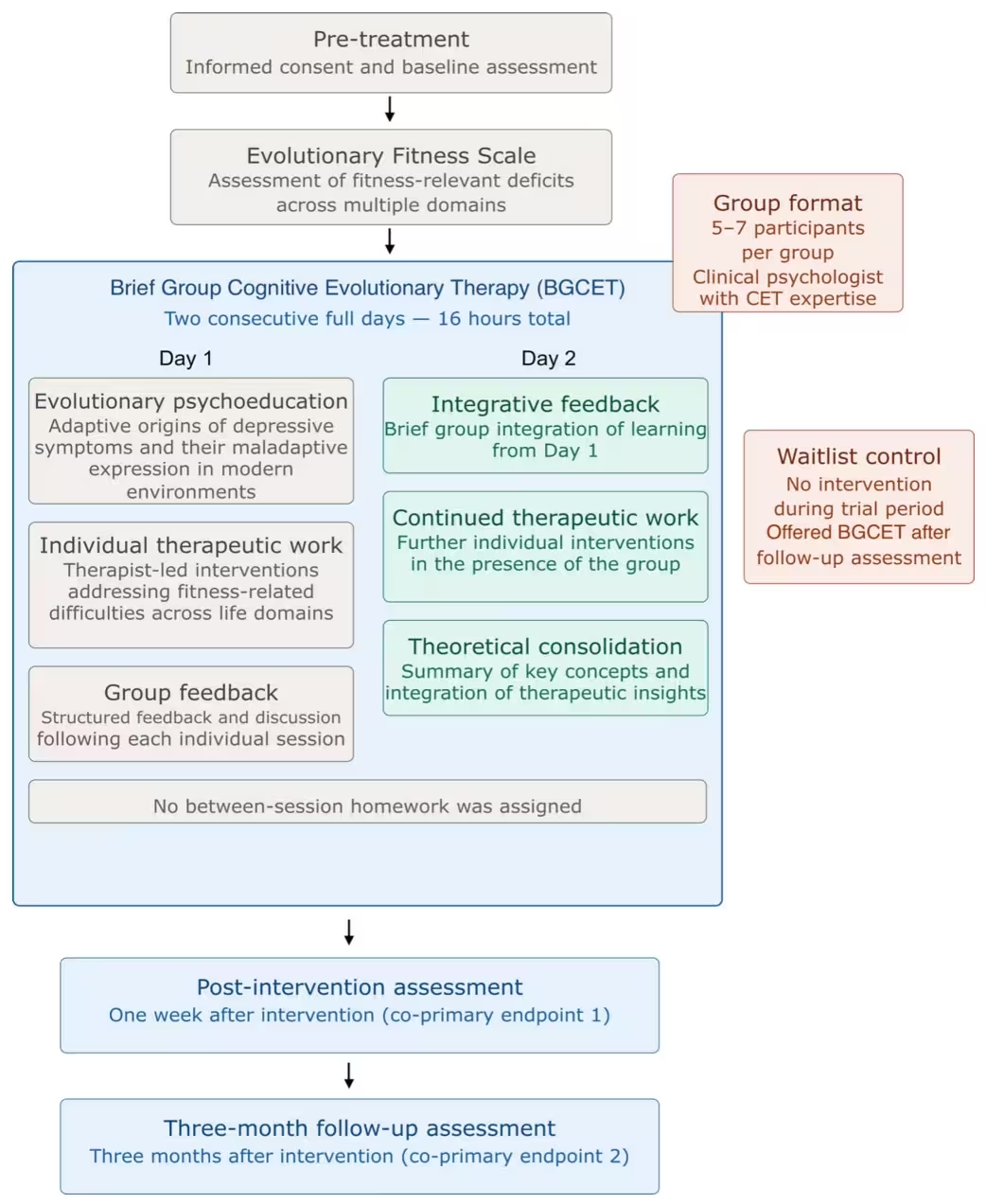
How the two-day group therapy worked: participants completed questionnaires, then attended 16 hours of therapy over two days in groups of five to seven. Researchers assessed their symptoms at one week and at three months later.
The short-term payoff was notable: therapy participants scored about 7.5 points lower on depression measures at one week—an effect that was large and hard to ignore. Anxiety and life satisfaction also improved alongside mood. The delivery felt theatrical at times: a therapist worked with one person in front of the group, then opened the floor for structured feedback. There was no between-session homework; the work happened live, in the room.
But the story doesn’t end there. By three months the advantage had dwindled to roughly 3.1 points and lost statistical significance. Some participants in the waiting group improved too. Attrition and design issues complicate the picture: six people assigned to the therapy never attended, leaving 25 treated; seven in the waiting group dropped out before the three-month check. Most participants were women. Treatment was run by a single therapist who also recruited and grouped participants, and one of the study’s co-authors authored the therapy manual—factors the team acknowledged could bias results.
Other limits: the trial did not require formal clinical diagnoses, outcomes were self-reported, and a waiting-list control cannot separate the effects of evolutionary framing from the benefits of concentrated attention, peer support, or simply meeting expectations. The authors call for larger, independent trials that compare the two-day model directly with standard group CBT, involve multiple therapists and cities, include clinician assessments, and track people for longer.
Short and sharp interventions have obvious appeal—less time off work, faster access, lower cost—but brevity cuts both ways. Can a weekend reset hold against months of life pressures? Could a follow-up session or booster strengthen gains? The study, published in BMC Psychology in 2026, offers a provocative pilot: reframing emotional pain as an ancestral signal may reduce self-blame and hasten early recovery, but whether that lift endures remains an open question worth testing.


Leave a Comment
Comments
No comments yet. Be the first.