
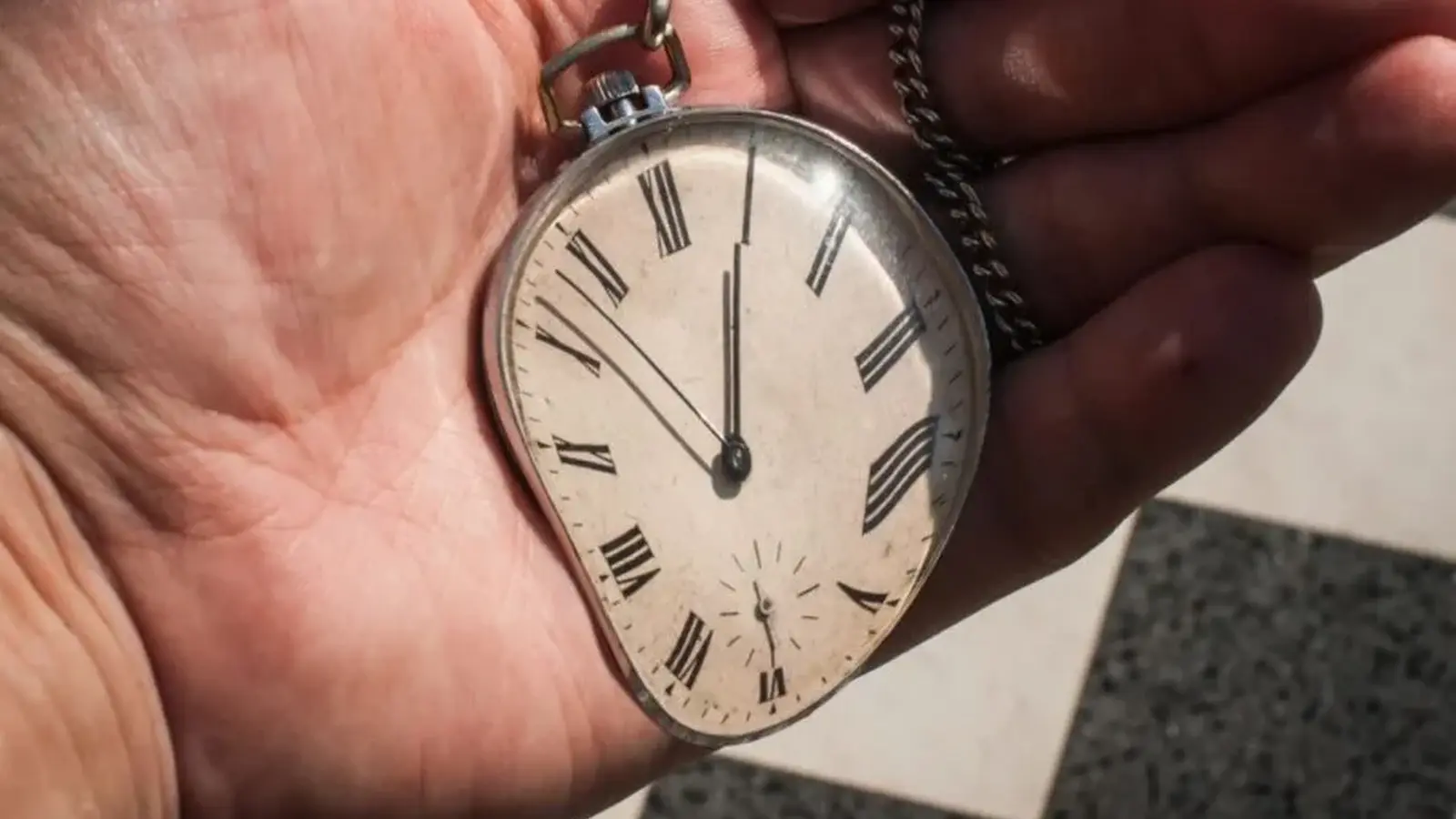
Imagine ice that never quite loses its pattern as it melts — fragments of crystalline order drifting inside a liquid. Strange. Beautiful. Unsettling. Could time behave the same way?
Two physicists at the Max Planck Institute for the Physics of Complex Systems, Zuo Wang and Marios H. Michael, have sketched a theoretical universe where it does. Their model replaces a perfectly metronomic drive with a noisy, thermally jittering environment and asks what happens to a discrete time crystal when its steady beat is stolen.
To follow their thinking, picture a two-dimensional sheet of tiny quantum arrows — spins — each nudging its neighbors. Now place that sheet inside a hollow electromagnetic cavity. In the usual story, an external periodic force (a laser, say) nudges the spins and the system responds at a subharmonic rhythm: two kicks from the driver produce a single collective oscillation. That is a discrete time crystal — periodic structure in time rather than space.
But Wang and Michael swapped the smooth hammer of a perfect drive for the restless tapping of thermal fluctuations. The cavity’s noisy field becomes an irregular drummer. Simulations of the interacting-spin lattice under this capricious drive revealed a surprising persistence: many spins still lock into a rhythm at half the cavity’s average frequency. They keep time together, but only locally. Every so often the pattern slips and a region flips to an equivalent timing. These flips march through the system like localized defects in time; the authors call them time solitons.
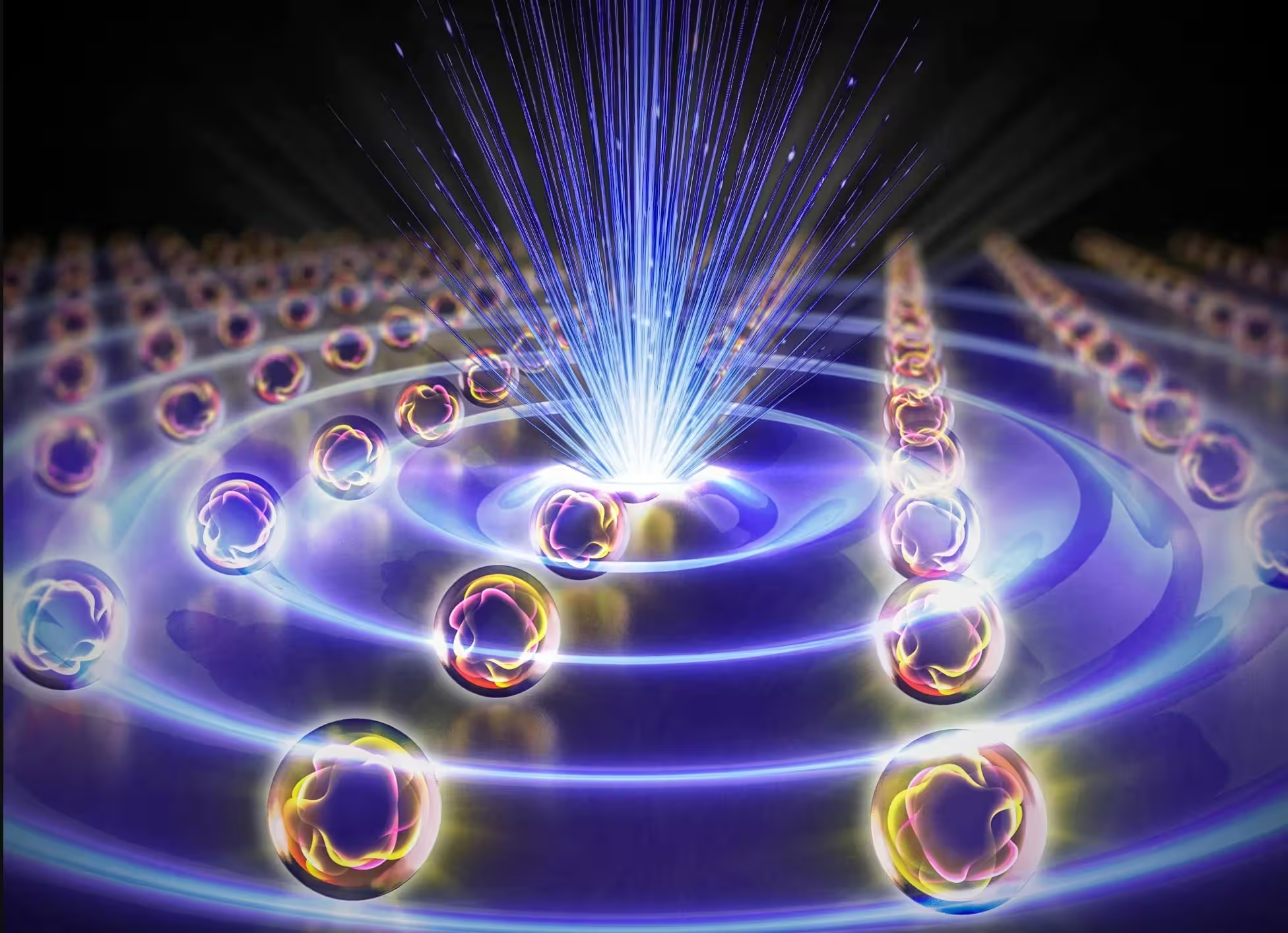
The result is neither crystal nor chaos. Instead it behaves like a liquid of time: short-range temporal order survives, while long-range coherence dissolves. Think of water formed from ice. The broad crystalline symmetry of ice is gone, yet nearby molecules still dance in small, recurring motifs. The temporal analogue preserves local beats but loses an overarching, forever-steady phase.
Perhaps the most counterintuitive finding is heat’s ambivalent role. Thermal jitter does not simply erode order. At very low temperatures the noisy drive is too weak to nucleate a collective rhythm. Turn up the temperature and a clear subharmonic pattern blooms. Heat, for a window of parameter space, actually helps the system synchronize. Too much agitation and, predictably, the coherence collapses again.
Why does this matter? Because it nudges open a conceptual door. Time crystals traditionally required out-of-equilibrium driving and protection against thermalization. A time liquid, on the other hand, hints that temporal order might persist even when the drive is imperfect, even possibly in thermal equilibrium — a setting where conventional time crystals usually cannot survive.
All of this lives, for now, on paper and in numerical experiments. The team has posted their work on arXiv ahead of peer review. Laboratory confirmation will be the hard part: building a platform where interacting spins couple to a noisy cavity and watching for half-frequency rhythms and wandering time solitons is nontrivial. Yet if experiments do catch this behavior, it could reshape how we think about order emerging from noise — not just in condensed matter, but across driven quantum systems.
If confirmed, a time liquid would force us to rethink how order emerges in noisy environments.

Leave a Comment
Comments
No comments yet. Be the first.