
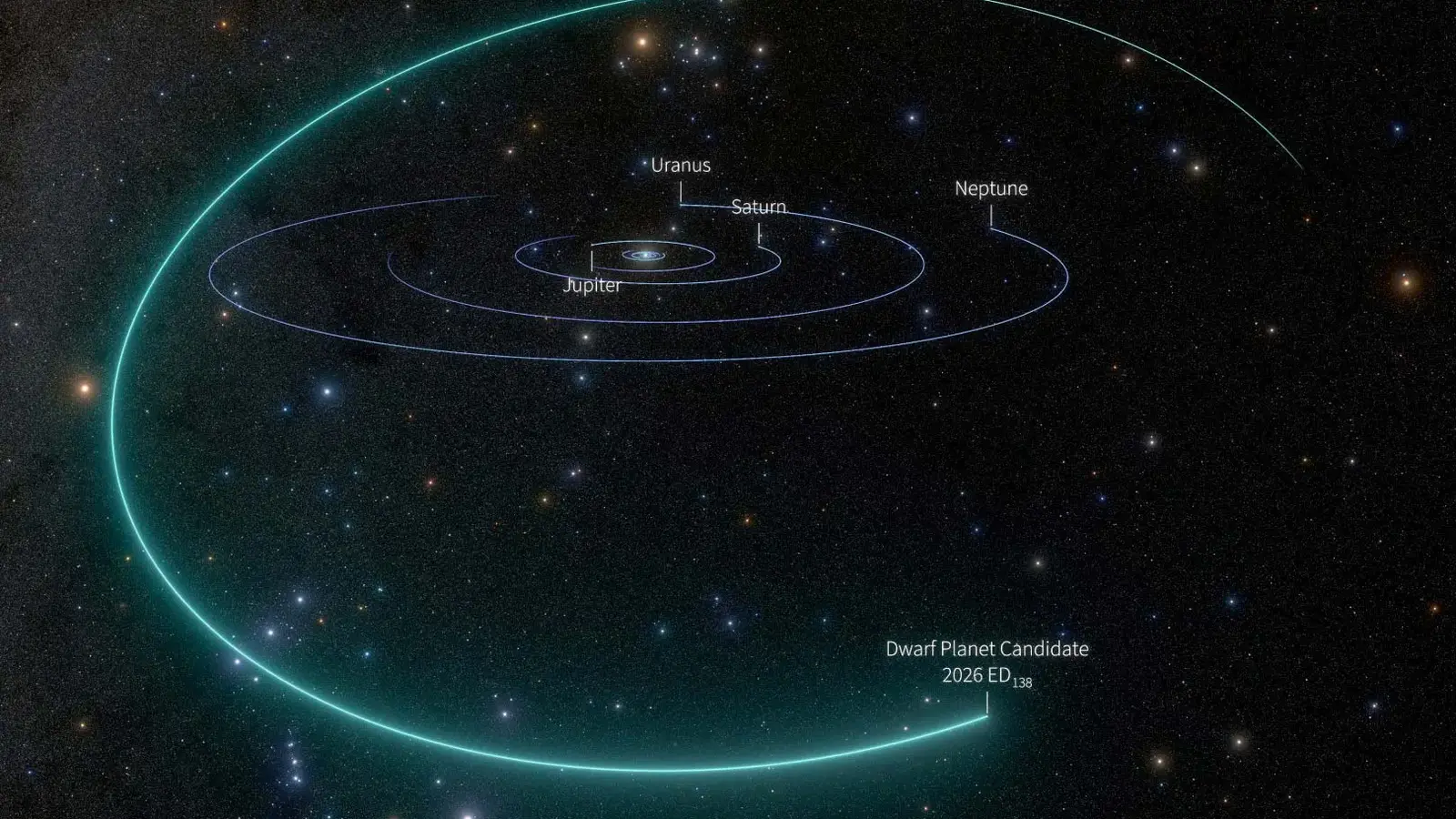
On a routine data pass, a speck of light refused to behave. It moved too slowly for a star, too bright for a typical trans-Neptunian rock. Matthew Holman, scanning images from the Vera C. Rubin Observatory on October 13, flagged an object beyond Neptune that immediately stood out.
The object, provisionally designated 2026 ED138, sits roughly 46 astronomical units from the Sun — farther out than Pluto’s average orbit. Early estimates put its diameter between about 600 and 1,500 kilometers. That’s significant because bodies in that size range can pull themselves into rounded shapes. In other words, this icy wanderer checks a key box used to separate dwarf planets from ordinary asteroids.
If confirmed, 2026 ED138 would be the sixth dwarf planet known in our solar system. Until now astronomers have counted five clear members in that club: Pluto, Ceres, Eris, Haumea and Makemake. Finding another would reshape our census of the outer Solar System and deepen questions about how these distant worlds formed and moved.
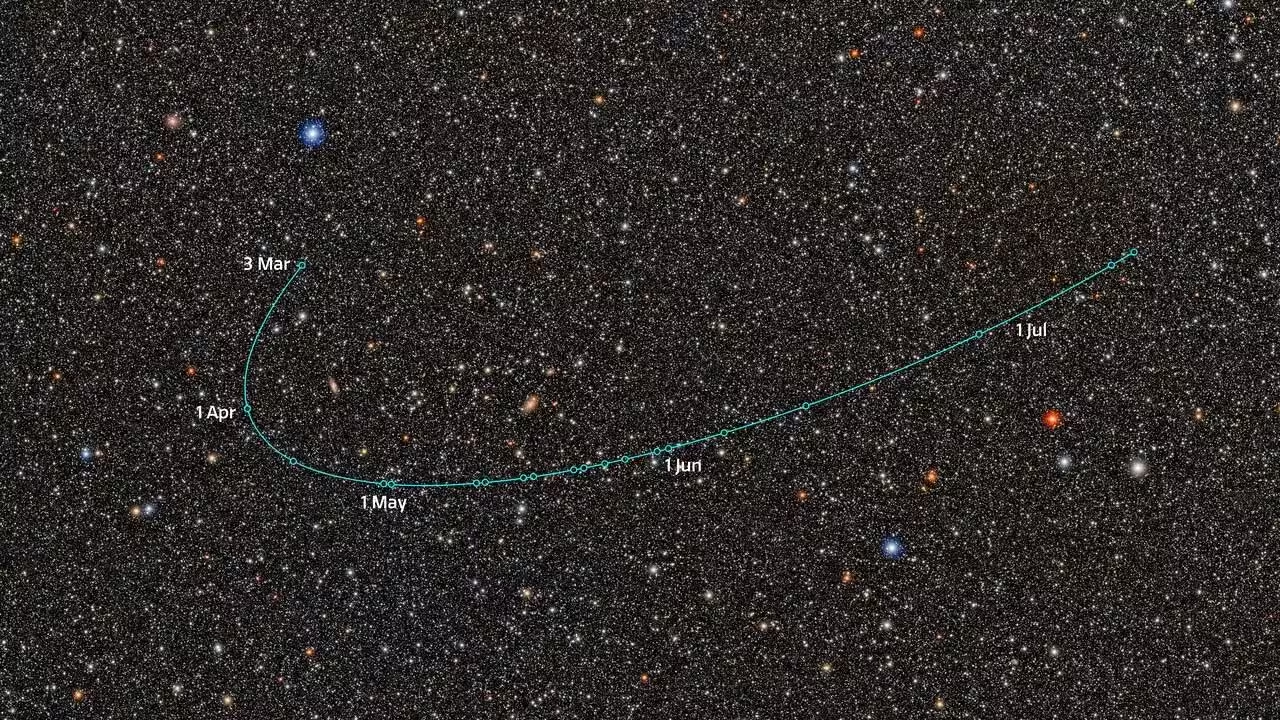
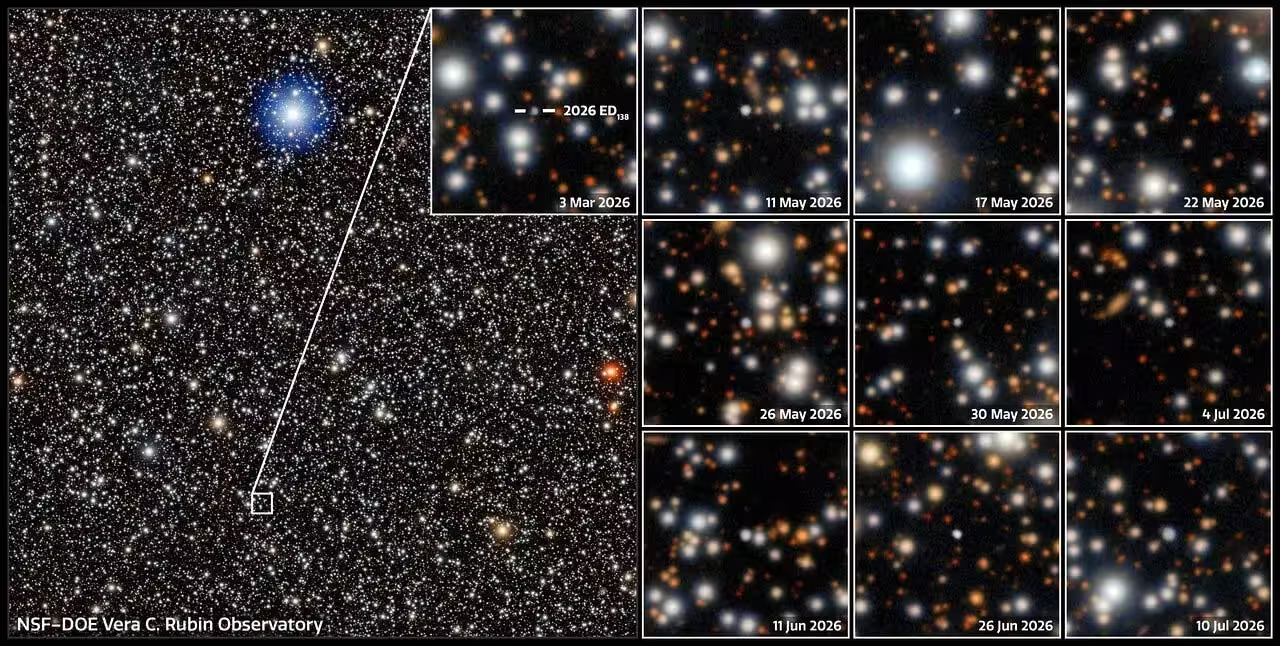
Holman, who works at the Harvard–Smithsonian Center for Astrophysics, didn’t find the object in a single flash. The Rubin Observatory’s Legacy Survey of Space and Time (LSST) captured 2026 ED138 thirty times across twenty separate nights between March 4 and July 11 of this year. Those repeated sightings allowed the team to map a consistent path against the star field and rule out a transient artifact.
Additional confirmation came from a different instrument: the Dark Energy Camera on the 4-meter Víctor M. Blanco Telescope at Cerro Tololo. DEC’s archive reaches back to 2016 and contains multiple detections of the same object, helping astronomers extend its observed arc and refine its orbit.
That orbit is curious. The path of 2026 ED138 tilts about 25 degrees relative to the plane where most planets orbit. Such an inclination hints at a turbulent past—one where interactions with Neptune likely nudged it off the main plane and sent it into a more tilted, distant track.
The Rubin Observatory itself is central to this discovery. Perched on Cerro Pachón in northern Chile at 2,682 meters elevation, the telescope has an 8.4-meter primary mirror and—more strikingly—a 3.2-gigapixel camera, the largest digital camera built for astronomy. After first light in April 2025, Rubin began the decade-long LSST in June, sweeping the southern sky every few nights and producing a high-resolution time-lapse of millions of objects. So far, Rubin’s surveys have turned up more than 11,000 new asteroids, and 2026 ED138 may be the first of several new dwarf-planet candidates.
Still, caution is warranted. Diameter estimates depend on assumptions about the object’s reflectivity, and brightness alone can be misleading. To pin down its true size and composition astronomers need infrared observations—measurements that reveal thermal emission and help separate a small, bright rock from a larger, darker world. The James Webb Space Telescope is optimized for precisely that kind of follow-up.
We also lack detailed information about 2026 ED138’s rotation, surface features, and whether it might host a tiny moon—each of which would add valuable context. The coming months will likely see coordinated campaigns: more ground-based tracking to tighten orbital parameters, and targeted infrared time on space telescopes to estimate size and temperature.
Discoveries like this arrive at the intersection of patience and technology. A new instrument scans familiar skies, centuries-old questions get sharper, and a dot of light becomes a potential world with a story to tell. Watch this space; the outer Solar System is quietly revealing another chapter.


Leave a Comment
Comments
No comments yet. Be the first.