
The atmosphere just posted a new high score — and it is not the kind anyone wants to celebrate. The World Meteorological Organization’s latest bulletin shows that concentrations of the three major long-lived greenhouse gases climbed to record levels in 2025, locking more heat into the climate system and making near-term warming harder to avoid.
WMO data for 2025: carbon dioxide reached 426.8 ppm, methane 1,948 ppb, and nitrous oxide 339.1 ppb — all historic highs.
Those numbers are not annual emissions tallies. They are the amount of those gases now sitting in the air — the accumulated burden that continues to trap heat year after year. Roughly half of the CO2 emitted each year stays in the atmosphere; the rest is taken up by oceans and land ecosystems, which themselves are changing as the planet warms.
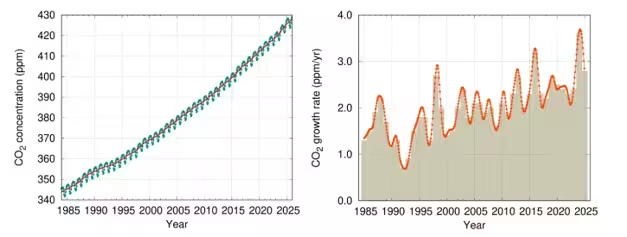
Carbon dioxide remains the heavyweight. Global mean CO2 rose by 2.8 parts per million from 2024 to 2025 — faster than the average rise seen over the last decade, though not as dramatic as the exceptional jumps recorded in 2023 and 2024. Compared with pre-industrial levels (1750), today's CO2 concentration is about 53% higher. The pace of increase has accelerated: the annual rise that averaged around 0.8 ppm in the 1960s is now three times larger, roughly 2.4 ppm per year during 2011–2020.
Methane, a far more potent greenhouse gas per molecule though shorter-lived, also climbed. At 1,948 parts per billion in 2025, methane levels are roughly 267% of their pre-industrial value. The WMO estimates around 35% of methane emissions come from natural sources such as wetlands, and about 65% are human-caused — livestock, rice paddies, fossil fuel extraction, landfills and the burning of biomass all contribute. Natural sources themselves respond to warming, making methane a climate feedback as well as a driver.
Nitrous oxide, the third major long-lived gas, reached 339.1 ppb in 2025 — about 26% above pre-industrial levels. Emissions come from both nature and people: agricultural fertilizers, certain industrial processes, and biomass burning are important human sources. Together with CO2 and methane, rising N2O tightens the greenhouse trap.
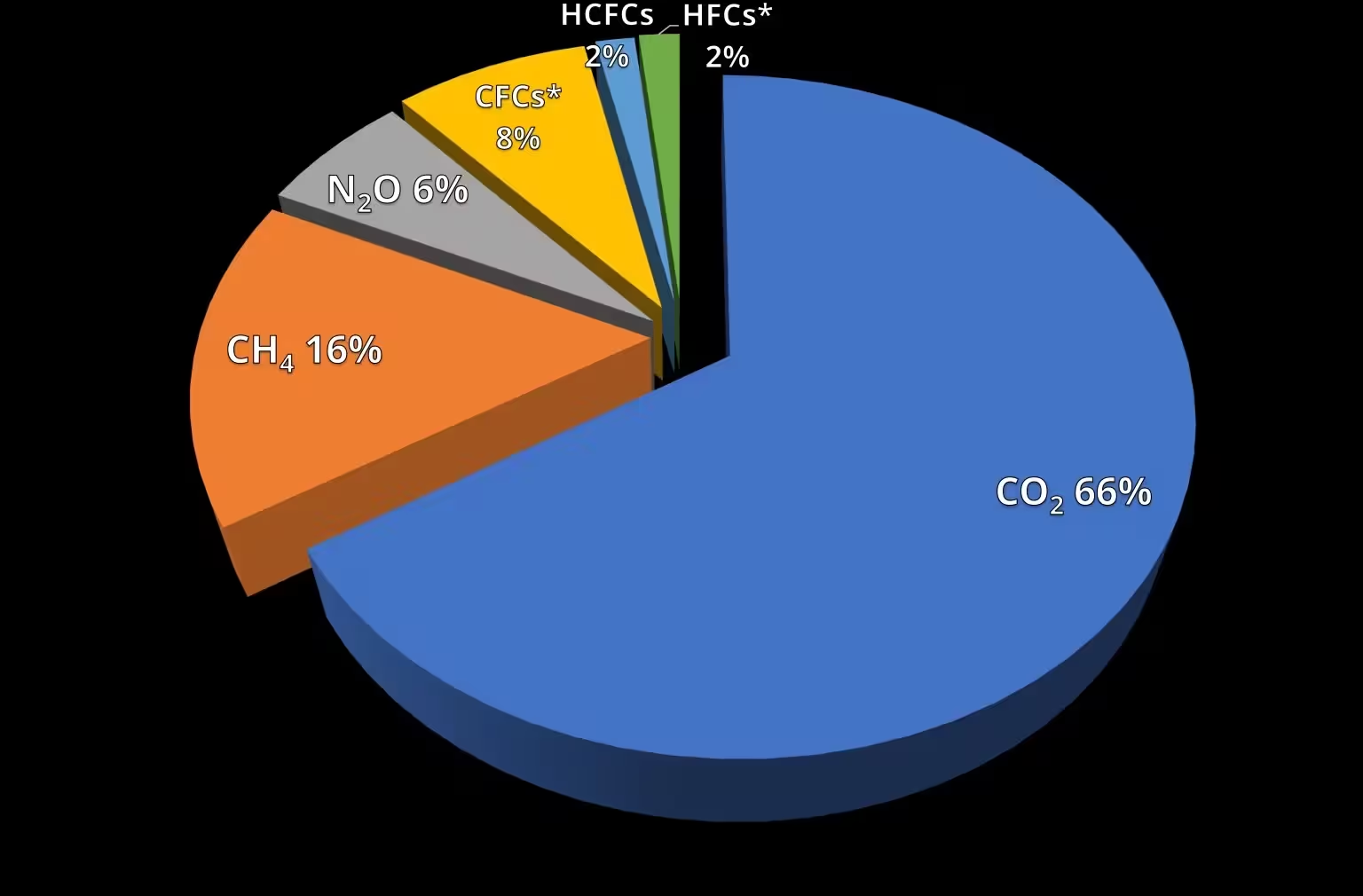
To put the combined effect in perspective, NOAA’s annual greenhouse gases index shows the radiative forcing — the extra energy trapped by long-lived greenhouse gases — rose roughly 56% between 1990 and 2025. Carbon dioxide accounts for about 81% of that increase; methane contributes roughly 16%.
These findings arrive ahead of the UN climate conference, COP31, scheduled for November 9–20, 2026, in Antalya, Turkey. Delegates will meet with these records in hand: hard measurements that underline how far atmospheric composition has shifted since the industrial era and how much ambition will be needed to change the trajectory.
Numbers tell a blunt story. They also ask a question: will policy and action match the urgency the measurements demand?

Leave a Comment
Comments
No comments yet. Be the first.