

A faint electrical whisper in the brain might explain why perception, speech and behavior go awry in schizophrenia. Scientists hunting for a unifying clue scanned the tiny rhythms of neural activity and kept returning to the same signal: beta-band oscillations that were both slower and weaker in people with schizophrenia.
Researchers used high-resolution magnetoencephalography (MEG) at the McConnell Brain Imaging Centre in Montreal to record brain activity from 25 people diagnosed with schizophrenia and 25 healthy volunteers while they performed timing tasks that mixed sights and sounds. The team then analyzed participants' speech for signs of disorganization and compared those behavioral markers with the neural recordings. The result: the same dampened beta rhythm appeared across perception, movement and speech.
Why does that matter? Beta-band activity helps the brain predict and integrate sensory information — a kind of internal metronome that keeps perception and action in sync. When that rhythm falters, the brain’s model of the world may be slower to update or noisier than it should be. Patients who showed the largest reductions in beta power tended to struggle more with sensory processing, had more disorganized speech, and scored higher on clinical severity measures.
“The pattern kept cropping up in different tasks,” the study’s lead author Hsi (Tiana) Wei explained, describing the surprising consistency across domains. It’s a small study, yet the convergence is striking: what looks like separate symptoms — hallucinations, communication breakdowns, motor timing problems — may be different faces of a single disrupted computation in the brain.
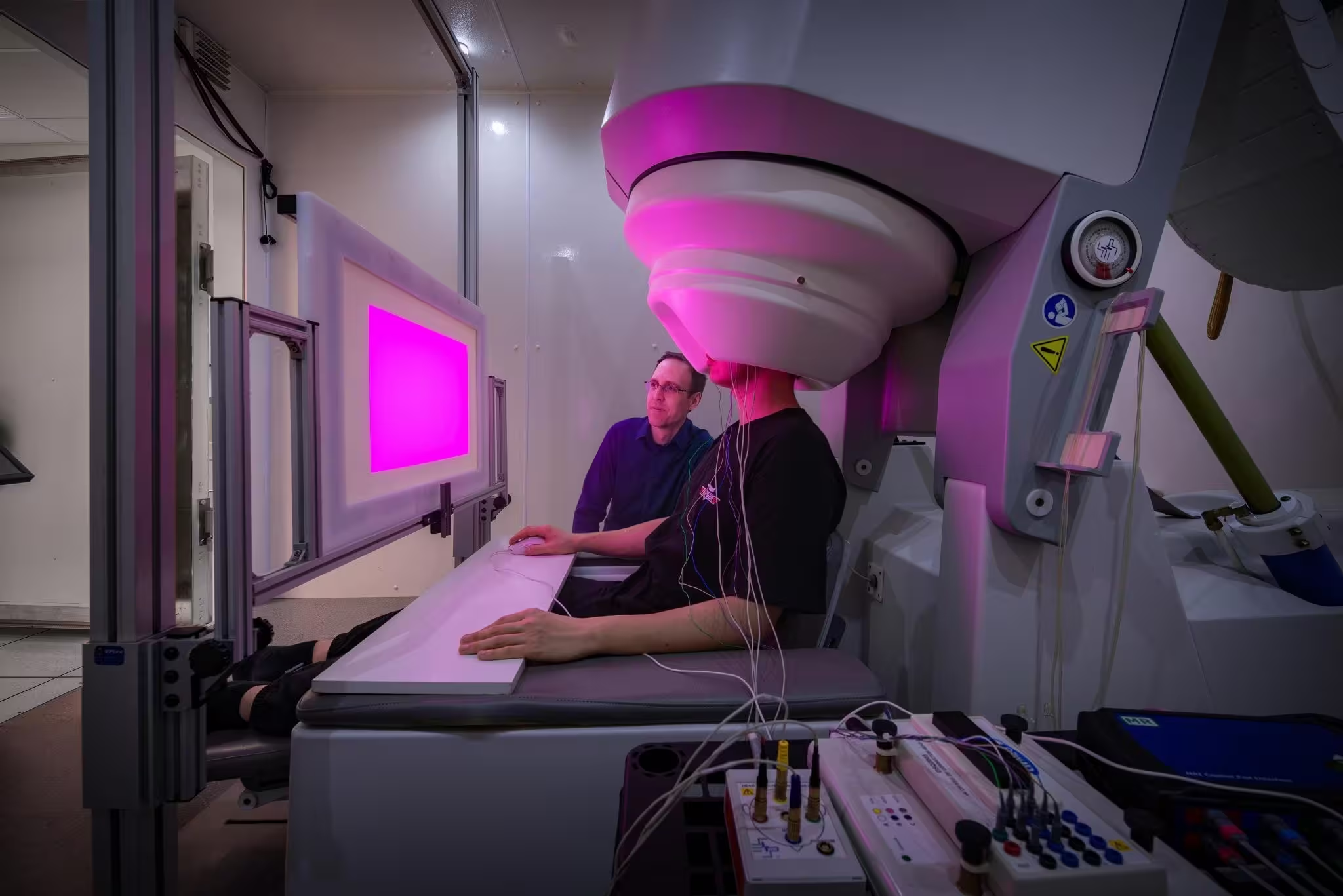
The study relied on high-resolution MEG imaging carried out at the McConnell Brain Imaging Centre at the Montreal Neurological Institute-Hospital (The Neuro).

The work, published in Science Advances and led by researchers at McGill University and the Douglas Research Centre, is provocative for clinicians and neuroscientists alike because it suggests a measurable, physiological marker that links multiple clinical features. Dr. Lena Palaniyappan, senior author of the study, argues that such neural measures could someday help clinicians spot young people at risk of psychosis earlier than today’s behavioral assessments allow. The first signs often appear in adolescence and can be missed; an objective brain signal might sharpen early detection.
There is caution built into the claim. The study’s sample — 50 people total — is modest, and the findings are correlational. That means weakened beta activity is associated with symptom severity, but it hasn’t been proven to cause those symptoms. Larger, independent studies are needed to test whether this rhythm reliably predicts who will develop psychosis or whether it can be manipulated to improve symptoms.
Still, the idea of a common neural fault line is appealing because it reframes schizophrenia not as a patchwork of isolated problems but as a disturbance in the brain’s ability to construct and revise its internal model of the world. If that conceptual shift holds, it opens two practical paths: using neural signatures for earlier, more objective screening, and exploring whether therapies — from brain stimulation to targeted cognitive training — can restore the rhythm.
The same dampened beta rhythm showed up across sight, sound and speech — suggesting a shared neural thread behind diverse schizophrenia symptoms.
What comes next? Replication. Larger cohorts. Longitudinal monitoring to see if beta changes precede symptom onset. And, of course, independent labs testing whether interventions that nudge beta activity can change clinical outcomes. For now, the discovery reads like a hint: subtle, measurable, and potentially transformative if the signal proves robust enough to guide diagnosis or treatment.
Science rarely hands over simple answers. But when multiple puzzles start to align around one faint electrical pattern, researchers take notice — and clinicians, sooner or later, start asking how to listen.


Leave a Comment
Comments
No comments yet. Be the first.