
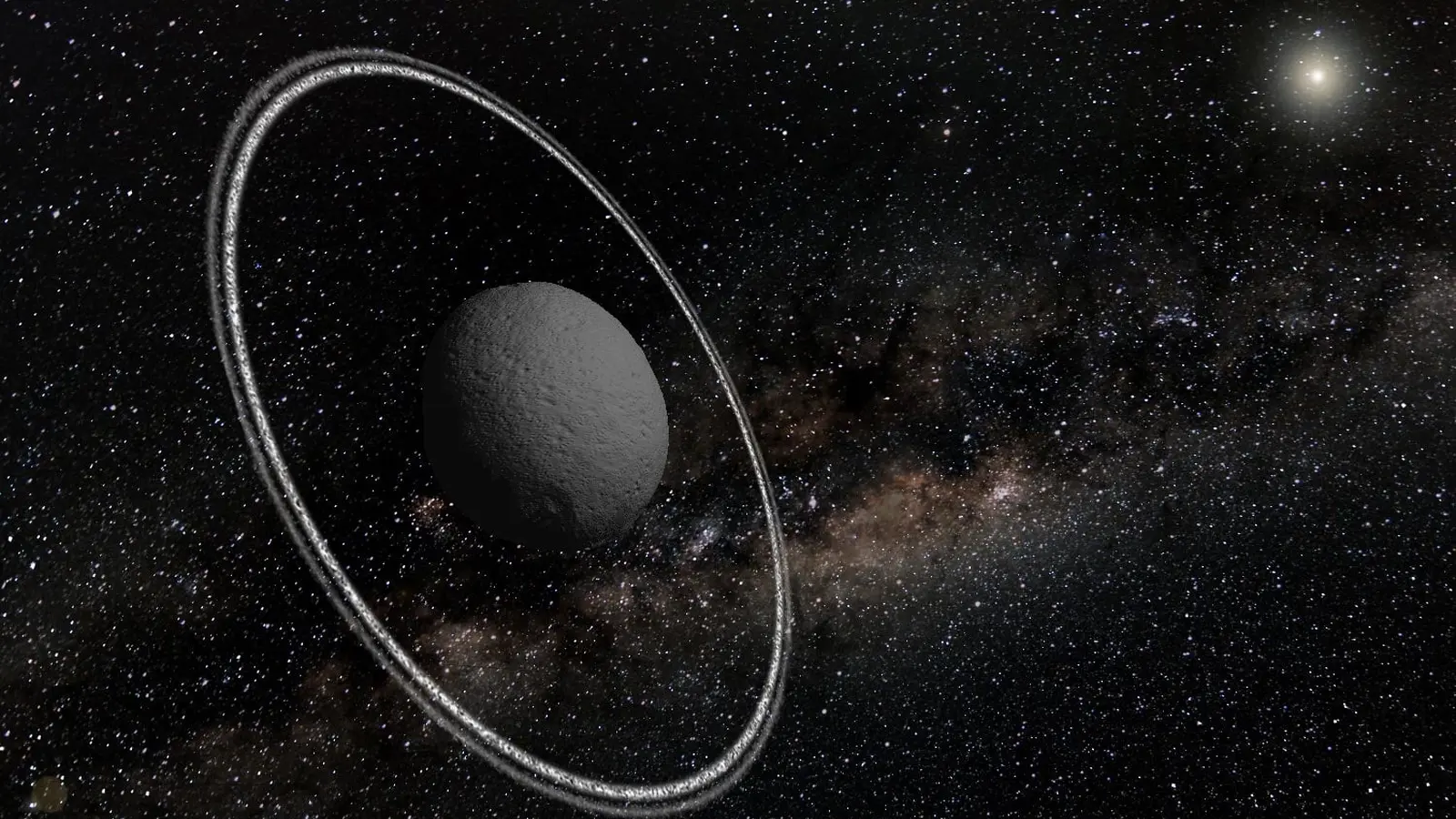
Imagine a tiny world, roughly the size of a small country, wearing not one but two rings—and then changing them in ways that contradict each other. That is what the James Webb Space Telescope has just shown us about Chariklo, a 250-kilometer centaur roaming between Saturn and Uranus at about 17 astronomical units from the Sun.
Rings seemed like the exclusive luxury of the gas giants until 2013, when astronomers found two dense, narrow rings encircling Chariklo. Now, observations made on October 18, 2022—using a carefully predicted stellar occultation observed by JWST—reveal that those rings are not frozen relics. They are shifting, and they are doing so in opposite directions: the inner ring has grown noticeably more opaque while the outer ring has become fainter.
How do astronomers read such faint signals? They watch a star wink out. As Chariklo and its rings sweep in front of a distant star, each ring casts a brief shadow in the starlight. Those tiny dips encode the rings’ width, structure, and opacity. By comparing the 2022 JWST occultation with a sequence of occultations over the past decade, the team led by the Institute of Astrophysics of Andalusia (IAA-CSIC) identified clear, measurable changes over only a few years.
The discovery carries a technical triumph as well as a scientific surprise. This was the first stellar occultation that had been specifically predicted for JWST and then observed successfully. Pulling that off required pin-point knowledge: Chariklo’s orbit, the star’s exact position courtesy of ESA’s Gaia mission, and JWST’s own path around the Sun-Earth L2 point—about 1.5 million kilometers from Earth—had to line up. Small course corrections to keep the telescope near L2 were part of the planning, and the payoff was exceptional spatial clarity.
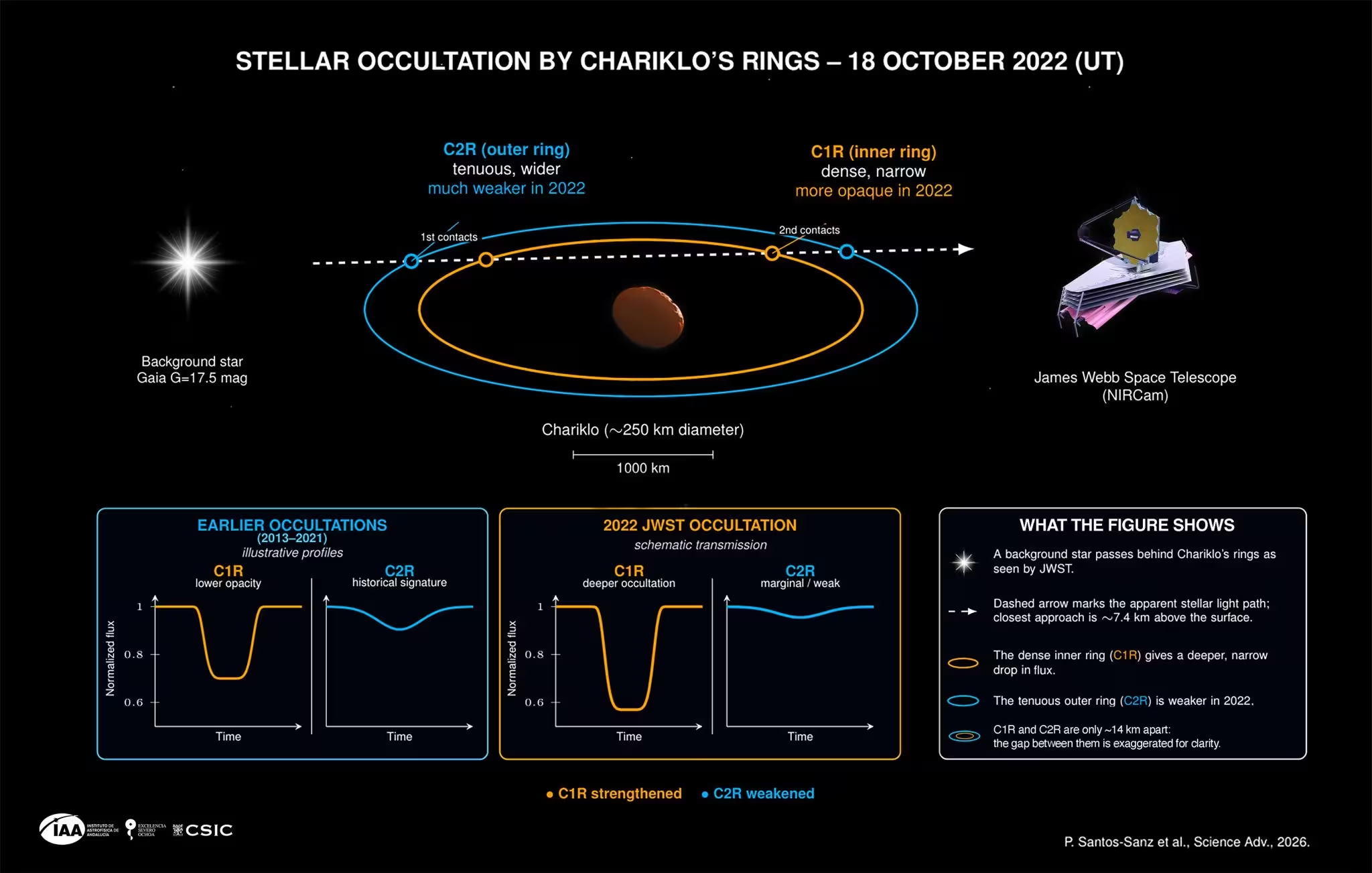
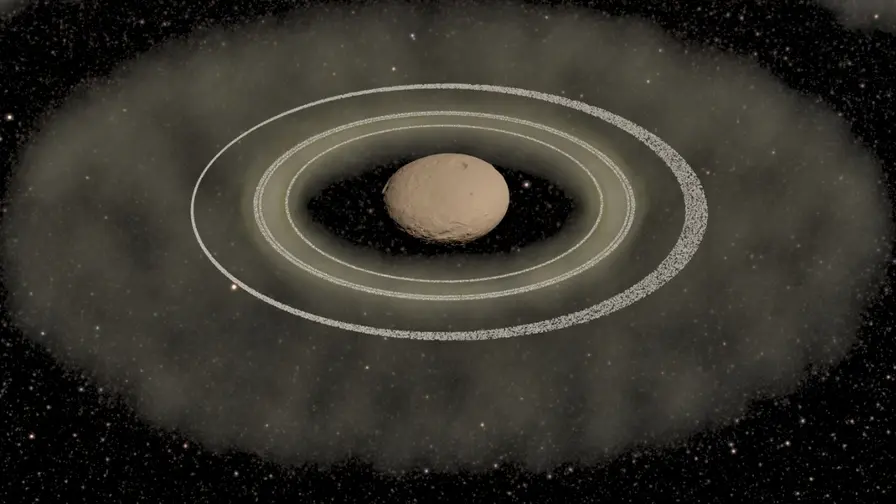
Schematic representation of the stellar occultation by Chariklo’s rings observed with the James Webb Space Telescope (JWST) on 18 October 2022. Comparison with previous occultations reveals opposite changes in the two rings: C1R shows a stronger signal, while C2R appears much weaker.
During the event, Chariklo moved relative to JWST at a deliberate 2.5 kilometers per second. Slow, in celestial terms. That slow rate stretched the occultation signal in time, allowing the telescope to tease out fine-scale features of the rings that would otherwise blur together. Even JWST cannot image Chariklo’s rings directly at that distance; occultations are the microscope.
What does this tell us about rings around small bodies? For years, many assumed that if tiny objects acquire rings they would remain fairly stable—slowly evolving, perhaps, but not dramatically. The opposing trends in Chariklo’s two rings upset that tidy picture. The inner ring growing denser while the outer ring weakens suggests active processes at work. Collisions among ring particles, subtle gravitational nudges from unseen moonlets, or the slow effects of sunlight and charged particles could all be in play. Or, some fraction of the change could be observational: different instruments and filters across years can bias how opaque a ring appears.
Which interpretation is right? The short answer is: we don’t know yet. The team’s statistical modeling, however, supports the reality of the changes rather than noise or fluke. If rings around centaurs can evolve on multi-year timescales, then theories about how such ring systems form and persist must be revisited. That has ripple effects for our understanding of small-body dynamics across the Solar System.
The IAA-CSIC coordinated the whole effort—from predicting the occultation to running the models that turned tiny dips in starlight into physical constraints on ring opacity. The collaboration spans Spain, Brazil, France, Hungary, and the United States, a reminder that teasing secrets from the dark between the planets is a global enterprise.

So what’s next? More occultations. More careful comparisons. Better filters. And patience. Rings are storytellers; they archive collisions, migrations, and tiny gravitational arguments. We are just beginning to read Chariklo’s latest chapter.

Leave a Comment
Comments (2)
Wow, rings changing opposite ways? mind blown. Occultations as microscopes, neat. Patience payin off, more occultations pls 🙂
Wait so a tiny 250km rock can change rings in just a few years? sounds cool, but could instrument differences or filters explain this, or is it real? curious..