
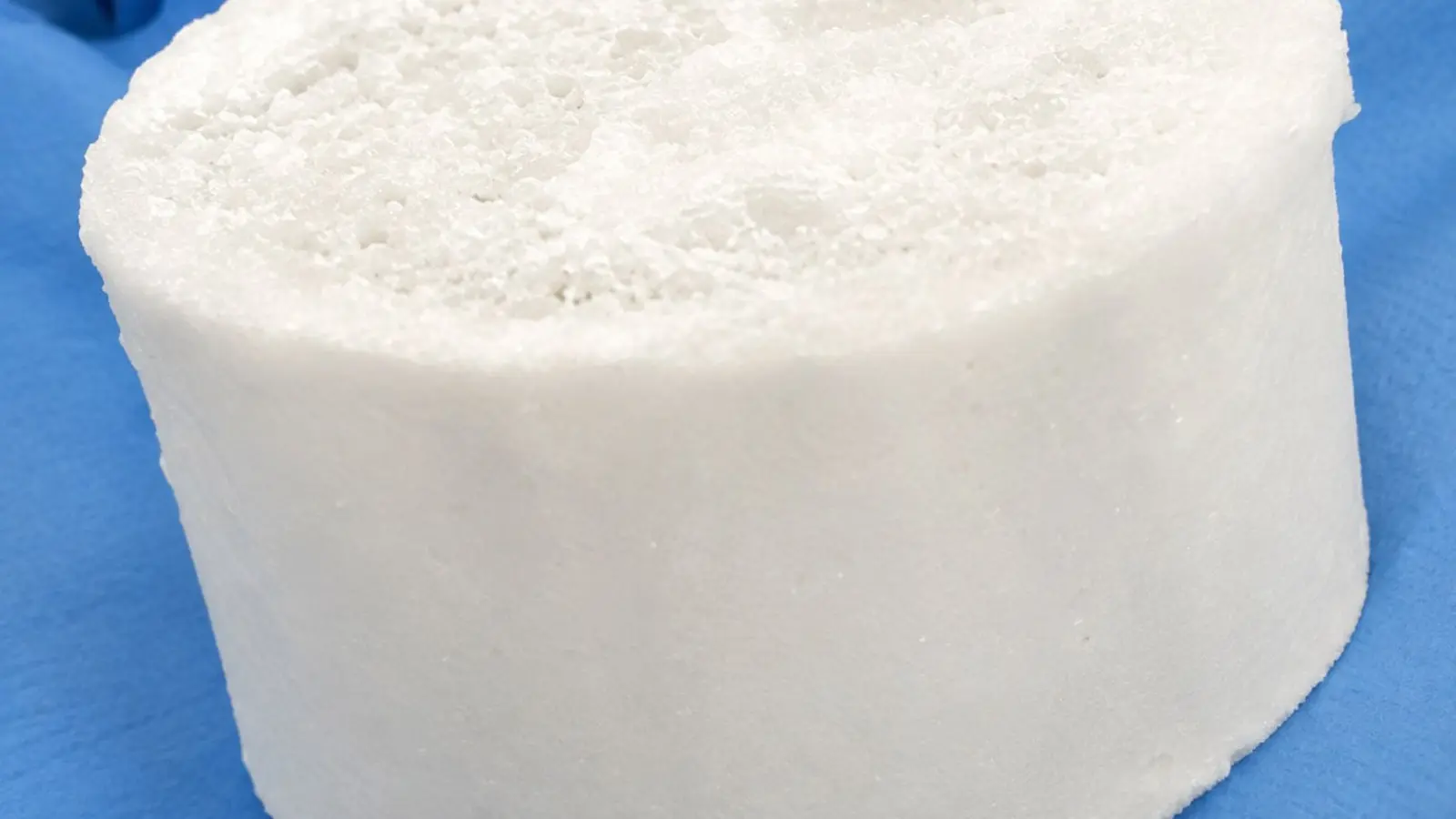
Imagine throwing a chunk of ice across a room and watching it bend instead of shatter. Strange image? That’s the kind of behavior researchers are coaxing out of ice in a new study from the Hebrew University of Jerusalem.
Called BioPykrete, this engineered ice blends tiny plant-derived crystals with carefully designed proteins to produce a frozen material that is roughly ten times stronger under compression than ordinary ice and can soak up about 70 times more energy before failing. In plain terms: it resists the snap-and-shatter drama we expect from ice, instead deforming and breaking slowly—more like a ductile engineered composite than brittle frost.
How do you make ice behave like that? The trick happens at microscopic scales. Cellulose nanocrystals—rigid, rod-like particles extracted from plant cell walls—assemble into a three-dimensional scaffold around tiny pockets of ice as the mixture freezes. On their own, these fibers help, but the real leap comes from a synthetic protein the team engineered to act as a molecular bridge, with one end that grips ice and another that latches onto cellulose. That bridge anchors the nanocrystal web to the ice lattice, creating a tightly integrated network that resists fracture.
Simple addition, big effect. When the researchers included the binding protein alongside the cellulose nanocrystals, both compressive strength and energy absorption roughly doubled compared with a mixture containing the nanocrystals alone. Scanning electron microscopy of freeze-dried samples reveals the porous, fibrous architecture that gives BioPykrete its toughness—an internal landscape that forces cracks to twist, stall, or run around obstacles instead of tearing straight through.
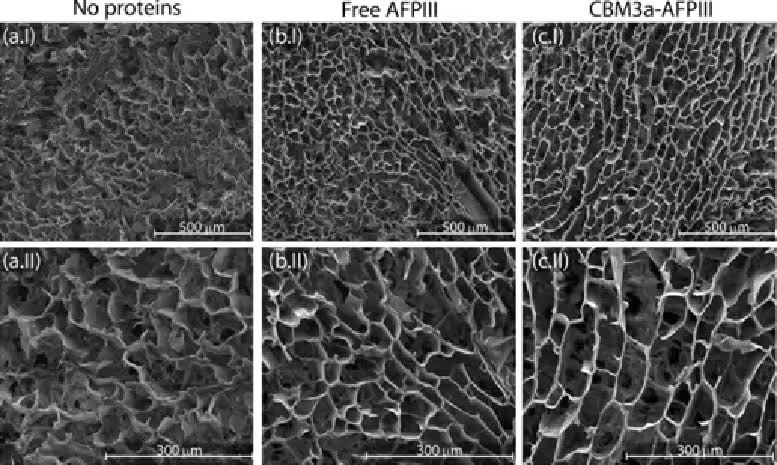
Inside the “super ice”: (a–c) Scanning Electron Microscope images of freeze-dried samples reveal the network formed by tiny cellulose crystals. The top row shows the material magnified 40 times, and the bottom row 90 times. (d) The graph compares the size of the network’s pores when the antifreeze protein AFPIII was added alone and when it was joined to the cellulose-binding protein CBM3a. Eight sample sections were analyzed for each material.
There’s a historical echo here. During World War II, engineers experimented with Pykrete—ice reinforced with wood pulp—to build floating structures that melted and broke more slowly than plain ice. BioPykrete is the modern, molecular cousin of that idea: it replaces coarse wood fibers with nanoscale reinforcement and intentionally designed protein links to tune mechanical performance from the bottom up.
Practical use is the dream. Transporting concrete and steel into polar regions is costly and environmentally fraught. A material made largely of water and plant-derived cellulose could, in principle, offer a lower-carbon, biodegradable building option for temporary or semi-permanent structures in extreme cold. Think airstrips, shelters, or scientific platforms assembled from locally frozen materials instead of trucked-in concrete.
But laboratory promise is not the same as field reliability. The experiments so far are proof-of-concept: controlled compression tests on centimeter-scale samples and microscopic imaging of the internal network. What remains unknown—and crucial—are the long-term responses of BioPykrete to the real stresses of use. How will it cope with repeated freeze-thaw cycles, constant loads that cause slow deformation (creep), or the way tiny flaws evolve over years? Will different proteins or freezing regimens make it tougher or more durable?
The next steps are clear: map how fractures nucleate and propagate inside the reinforced ice, test variants of the protein bridge, and scale up to larger specimens and environmental trials. If those tests hold up, the idea of building with engineered ice could shift from laboratory curiosity to a practical strategy for working in the coldest places on Earth.

Whatever happens next, BioPykrete is a reminder that sometimes the most familiar materials—water and plant fibers—can be coaxed into unexpected performance when designers look closely at the molecular handshake between components.

Leave a Comment
Comments
No comments yet. Be the first.