
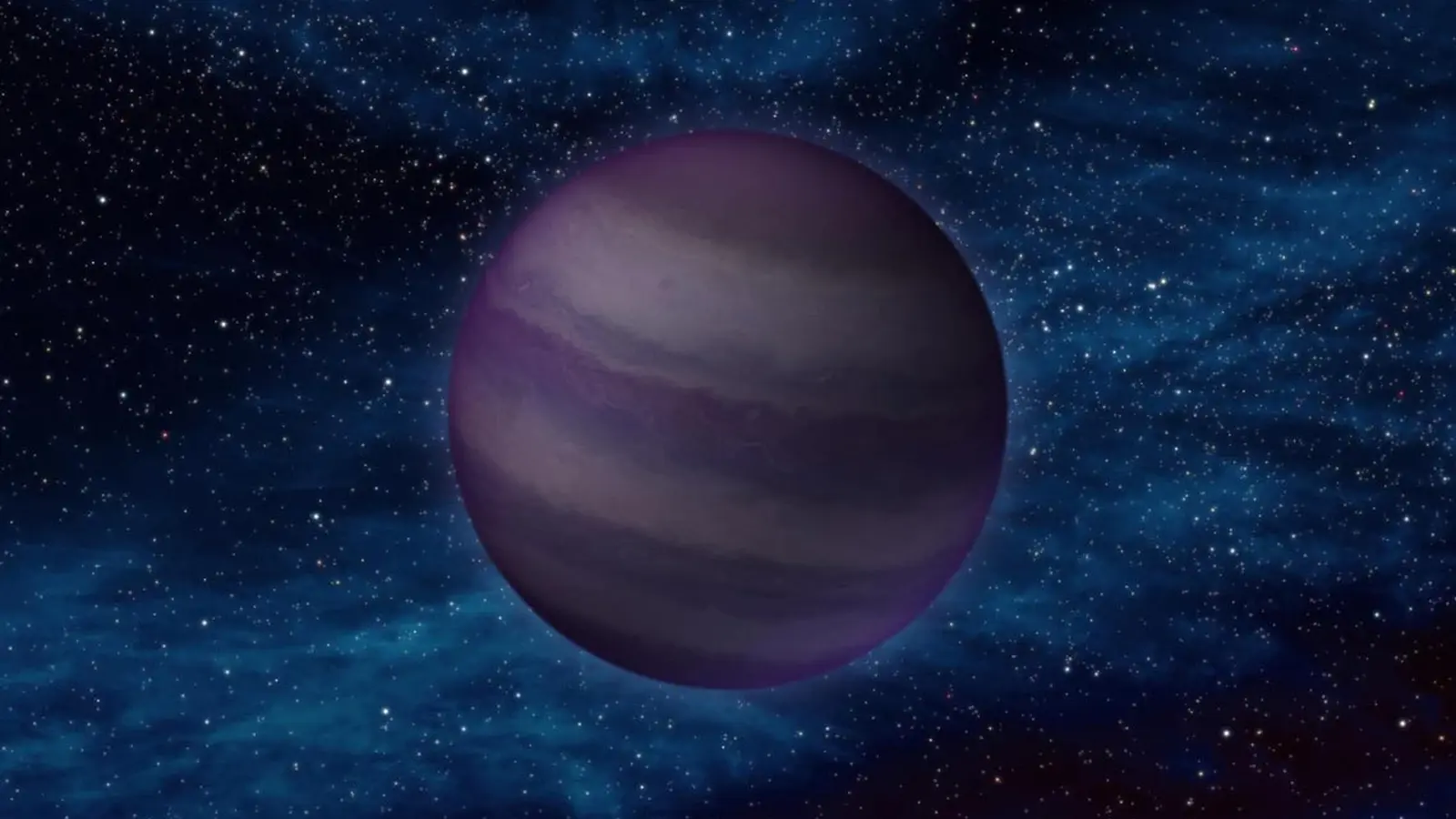
No sunrise. Still, the sky moves. WISE 0855 — a cold, free-floating world 7.5 light-years from Earth — shows weather in real time, and Webb caught it changing.
For 11 hours the James Webb Space Telescope kept an eye on this faint, Jupiter-sized brown dwarf, taking a spectrum every 15 minutes. Those repeated snapshots separated light into telltale wavelengths and let astronomers watch clouds thicken and thin while different gases rose and fell through the atmosphere.
WISE 0855 sits on the fuzzy border between planet and star: roughly twice Jupiter’s mass but nearly the same size, and living off leftover heat rather than a nearby sun. Its thermometer reads roughly 265 kelvin (about 17°F). No sunlight means interior heat drives the weather. Convection churns the atmosphere, lifting warm material from depth and painting the visible disk with patchy clouds and chemical signatures.
The breakthrough here is not just seeing brightness oscillate. Photometry had hinted at variability before, but brightness alone blurs cause and effect. Webb’s medium-resolution spectra isolate molecular fingerprints. That let researchers tease apart water clouds at high altitude from gases like carbon monoxide and phosphine that are being dredged up from hotter layers below.
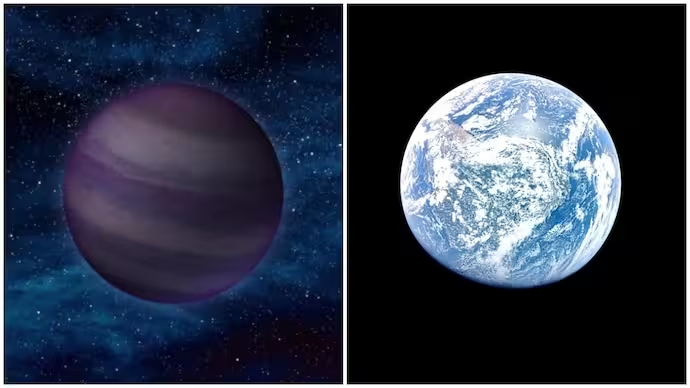
This is the first direct confirmation that water clouds on another world change thickness over time. The data show water ice veiling some regions one moment and thinning the next, while a separate, repeating pattern in CO and phosphine lines points to vertical mixing—a sort of atmospheric plumbing moving material from the deep into cooler zones where chemistry is out of balance.
Sound familiar? Jupiter behaves much the same way. Deep convection there pumps gases upward and creates patchy cloud decks. But WISE 0855 is colder and windier in ways we are only beginning to grasp. Watching molecular features evolve, rather than just total light, opens a new door to comparing brown dwarfs with gas-giant exoplanets and with the planets in our own solar system.
The team, led by Brittany Miles at the University of Arizona, used models built on decades of planetary science to read the signals. Interpreting a spectrum is like peering through a screen: you must understand the object you want to see and the veil that modifies the view. Webb’s sensitivity finally makes both readable for an object this faint.
These observations also highlight a practical point for future exoplanet studies. If clouds and chemistry can shift on an isolated brown dwarf over hours, what complexity will we find when Webb peers at gas giants around distant stars? Time-resolved spectroscopy will be key to separating clouds, temperature, and chemical transport on those worlds.
The next step, researchers say, is to watch longer and map how rotation and three-dimensional flows sculpt WISE 0855’s atmosphere. The telescope gave us a first act. The rest of the story is waiting in the changing light.


Leave a Comment
Comments
No comments yet. Be the first.