
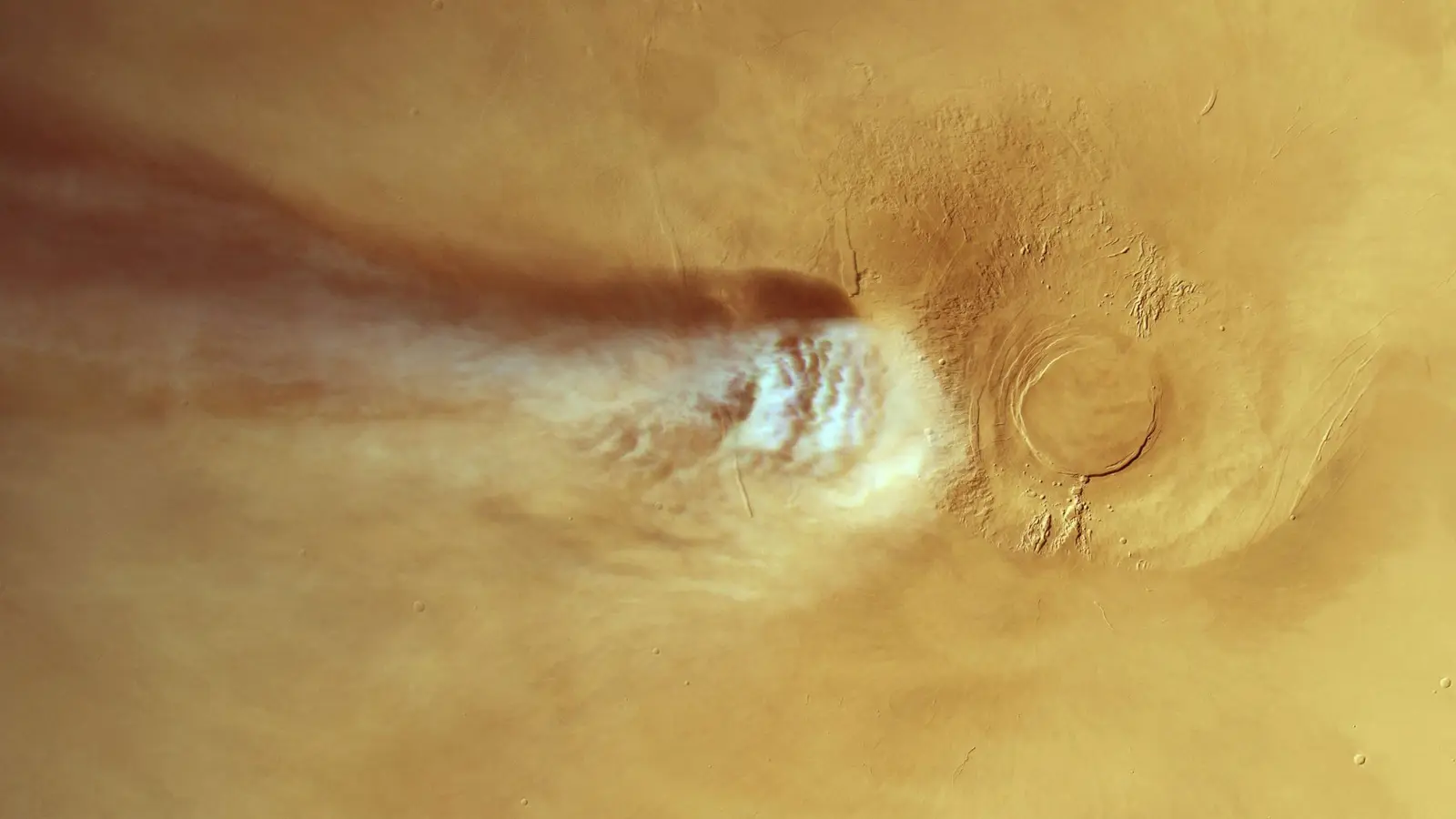
Every Martian morning, a ghostly white ribbon unfurls from the flank of Arsia Mons and then vanishes. It can span nearly 1,800 kilometers—longer than many countries—and yet it only lives for hours before the sun takes it apart. Why does it form, and how can such a fragile thing repeat itself so reliably?
Scientists have long called this phenomenon the Arsia Mons Elongated Cloud, or AMEC. It’s an orographic cloud: wind hits the volcano’s immense slopes, air is forced upward, and condensation follows. But when researchers tried to reproduce the cloud with standard atmospheric physics, the simulations came up short. The images from ESA’s Mars Express simply didn’t match the models.
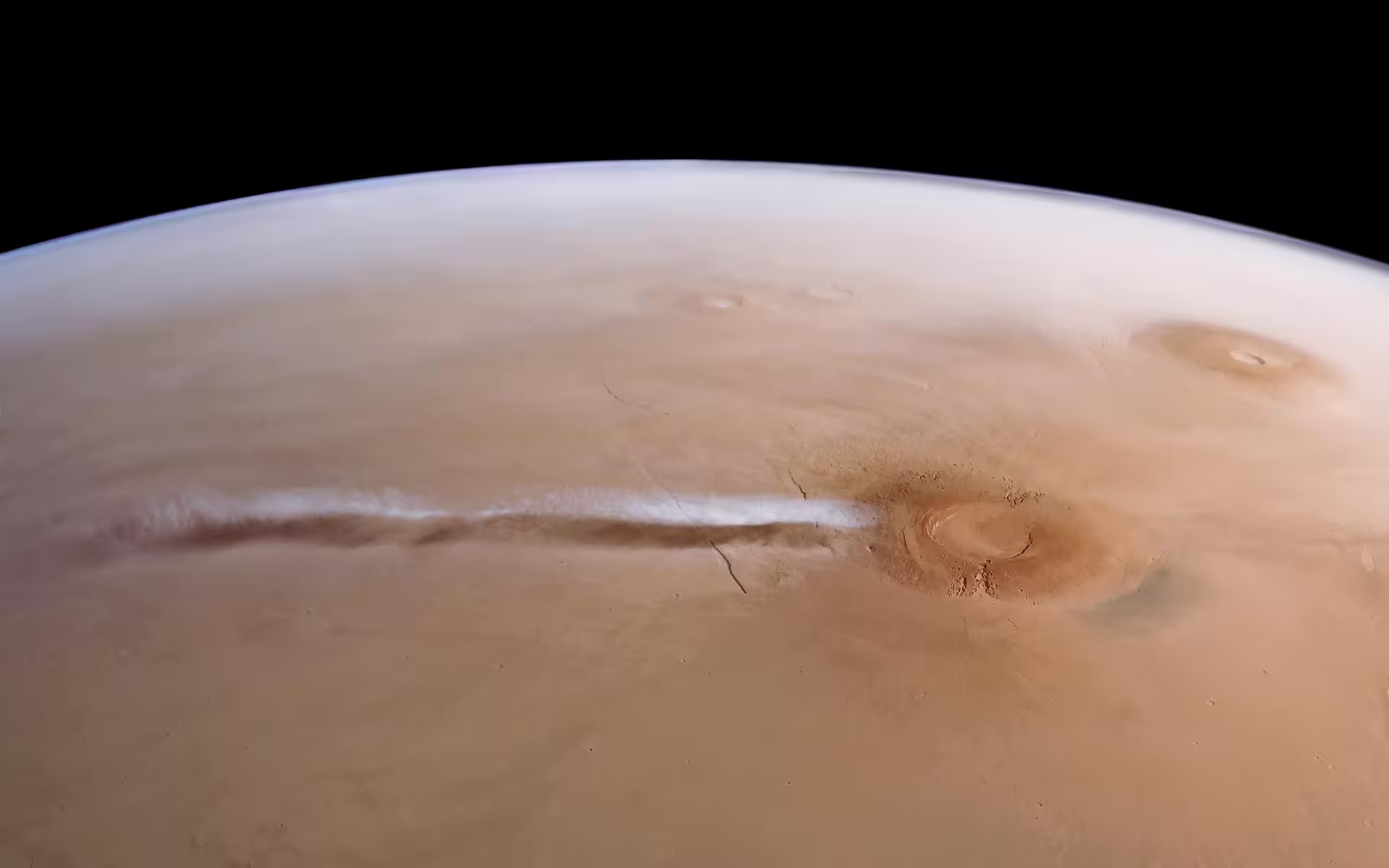
Image of the Arsia Mons Elongated Cloud from the European Space Agency’s Mars Express spacecraft.
Something had to give. The breakthrough came when modelers allowed a rarely used—but real—type of cloud formation to enter the experiment: homogeneous nucleation. Instead of water vapor finding a dust particle or speck and building ice around it, the vapor turns directly into ice crystals on its own. No dust seeds. No middle step. Pure ice appearing out of thin air. It’s a behavior textbook physicists mention as possible, but one that planetary atmospheres had never shown in practice.
How does Mars do it? The recipe reads like an unlikely mash-up: a 20-kilometer-high volcano, a thin atmosphere, and a wind-driven wave that can lift parcels of moist air several kilometers in minutes. As that air rises, temperatures plunge—about 30 degrees within ten minutes in the simulations—and relative humidity rockets upward. Under those extremes, homogeneous nucleation becomes possible. The AMEC is born on the wave’s crest and is gone when the wave subsides.
These ideas weren’t plucked from thin air. Mars Express first spotted the elongated ribbon in 2018 and has returned to it repeatedly. Researchers combined years of imagery from the orbiter’s Visual Monitoring Camera, High-Resolution Stereo Camera and OMEGA instrument with the new meteorological modeling. Mars Express’s unique ability to image the planet at morning local times proved crucial; the cloud is a breakfast-only phenomenon on Mars.
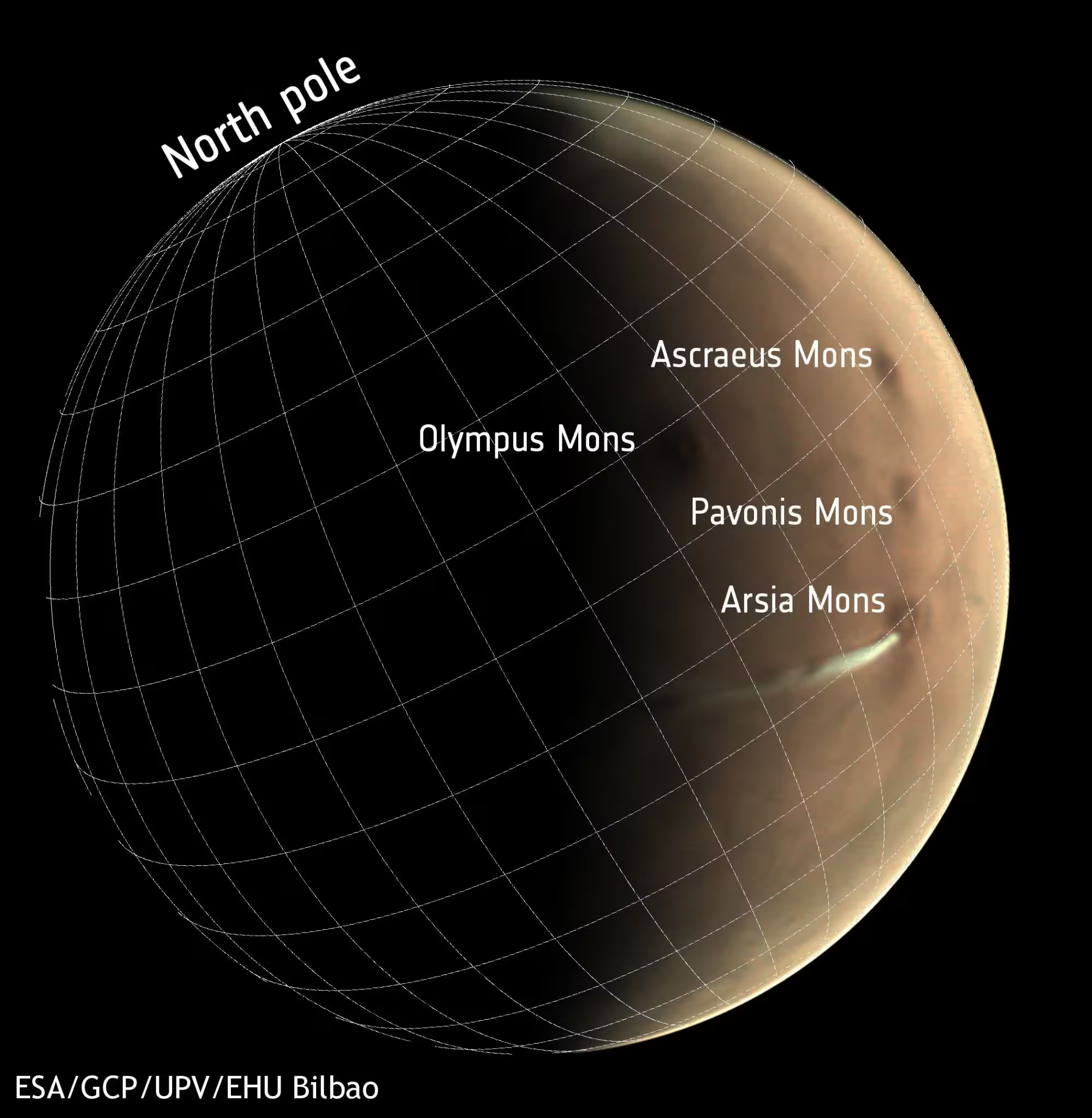
Image of Mars from the Visual Monitoring Camera (VMC) onboard the European Space Agency’s Mars Express spacecraft, taken on 10 October 2018.
The model had to include physics that many planetary models usually treat as theoretical or negligible. Once those processes were allowed to play out, the simulations produced a cloud with many of the same traits seen from orbit. Not every detail lines up yet—some mismatches remain—but the fit is much tighter than before. That means Mars can, at least transiently, reach humidity regimes far beyond what we normally observe on Earth.
This discovery nudges open a wider door. If a common-sense rule like “clouds need dust” can fail on Mars, what else might different atmospheres do under stranger conditions? Exoplanet researchers take note: atmospheres that seem to follow Earth’s rules may still surprise us when temperature, pressure, and chemistry push processes into exotic regimes.
Arsia Mons’s morning cloud is not just a local oddity; it’s a reminder that planetary weather can break our assumptions—and that careful observation plus bold modeling still have the power to reveal the unexpected.


Leave a Comment
Comments
No comments yet. Be the first.