

Think you can get by on five hours of sleep and a coffee. Think again. A large new analysis of nearly 100,000 adults suggests that chronic short sleep isn’t just an irritant; it may be tied to a broad spectrum of illnesses, from heart trouble to neurodegenerative disorders.
The team behind the study tapped the UK Biobank and used wrist-worn accelerometers to monitor sleep continuously for seven days. Then a deep-learning algorithm parsed those motion traces into total sleep time, REM sleep, deep sleep, light sleep, wake after sleep onset, and how variable sleep was from night to night. Participants were followed for a median of 8.9 years, and researchers linked those objective sleep measures with more than 1,000 possible disease outcomes recorded in medical data.
What jumped out immediately was the danger zone below five hours. People who slept less than five hours per night had higher risks for 37 distinct conditions. The study tallied 156 statistically significant associations between sleep metrics and newly diagnosed diseases after rigorous correction for multiple comparisons. In plain terms: the patterns were too consistent to ignore.
Not all sleep is created equal. The amount of REM sleep — the stage marked by vivid dreams and high brain activity — showed a striking relationship with long-term health. Each extra 47.6 minutes of REM was associated with a 26% lower rate of heart failure, a 46% lower rate of dementia, and an 80% lower rate of Parkinson’s disease during follow-up. Deep sleep also mattered: more slow-wave sleep correlated with reduced risk for conditions including type 2 diabetes and major depressive disorder.
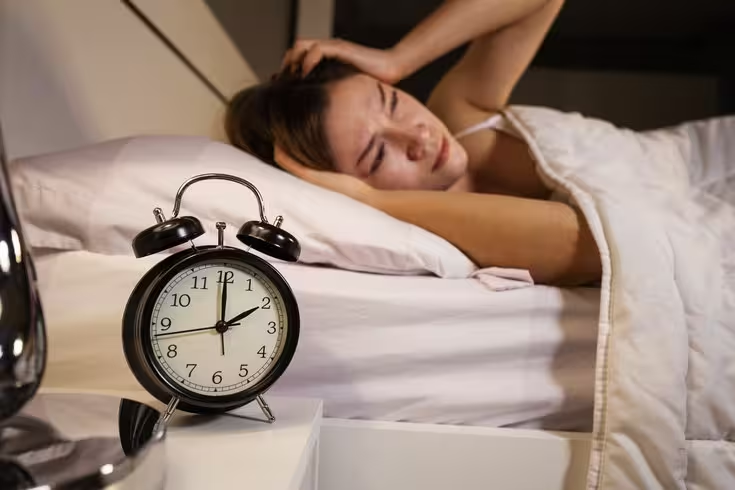
On the other side of the ledger, restless nights carried penalties. Greater night-to-night variability in sleep timing and more minutes awake after first falling asleep were linked to increased risk for several disorders, notably anxiety and substance use problems. In short, both how much you sleep and how that sleep is structured appear to matter.

Sleep duration itself didn’t relate to disease risk in a simple straight line. Instead, the researchers saw nonlinear relationships: for many outcomes the lowest risk clustered in a roughly six- to eight-hour window. Of 86 disease phenotypes with significant nonlinear associations, 69 had a minimum-risk duration concentrated in that 6–8 hour span.
Aiming for about six to eight hours of sleep emerged as the most consistent signal for lower disease risk in middle-aged and older adults.
Before you rearrange your schedule, remember this study is observational. Associations are not proof of cause and effect. Poor sleep might contribute to illness; illness might degrade sleep. Or a third set of factors — genetics, lifestyle, or undiagnosed conditions — could underlie both. The authors are careful about that nuance, but the scale of the data and the objective sleep measures add weight to their findings.
One important methodological advance here is the use of wearables and machine learning to estimate sleep stages at population scale. Prior work has often relied on self-reported sleep, which can diverge substantially from measured sleep. By combining continuous wearable data with nearly nine years of clinical follow-up, the researchers could examine not just sleep length but the distribution of sleep stages and nightly consistency — and how each dimension maps onto real-world health outcomes.
So what practical takeaway should a reader carry forward? For most middle-aged and older adults, the safest zone appears to be roughly six to eight hours of nightly sleep, paired with more REM and deep sleep and steadier sleep timing. That doesn’t answer every question: how to boost REM without side effects, or whether interventions to regularize sleep will reduce disease risk remain open. Still, the results add urgency to treating sleep as a public-health issue, not merely a personal preference.
Science rarely hands down simple commandments, but here’s a clear piece of advice grounded in large-scale evidence: value your sleep. It may protect more than your mood; it might help shield your heart, your brain, and much more.


Leave a Comment
Comments
No comments yet. Be the first.