
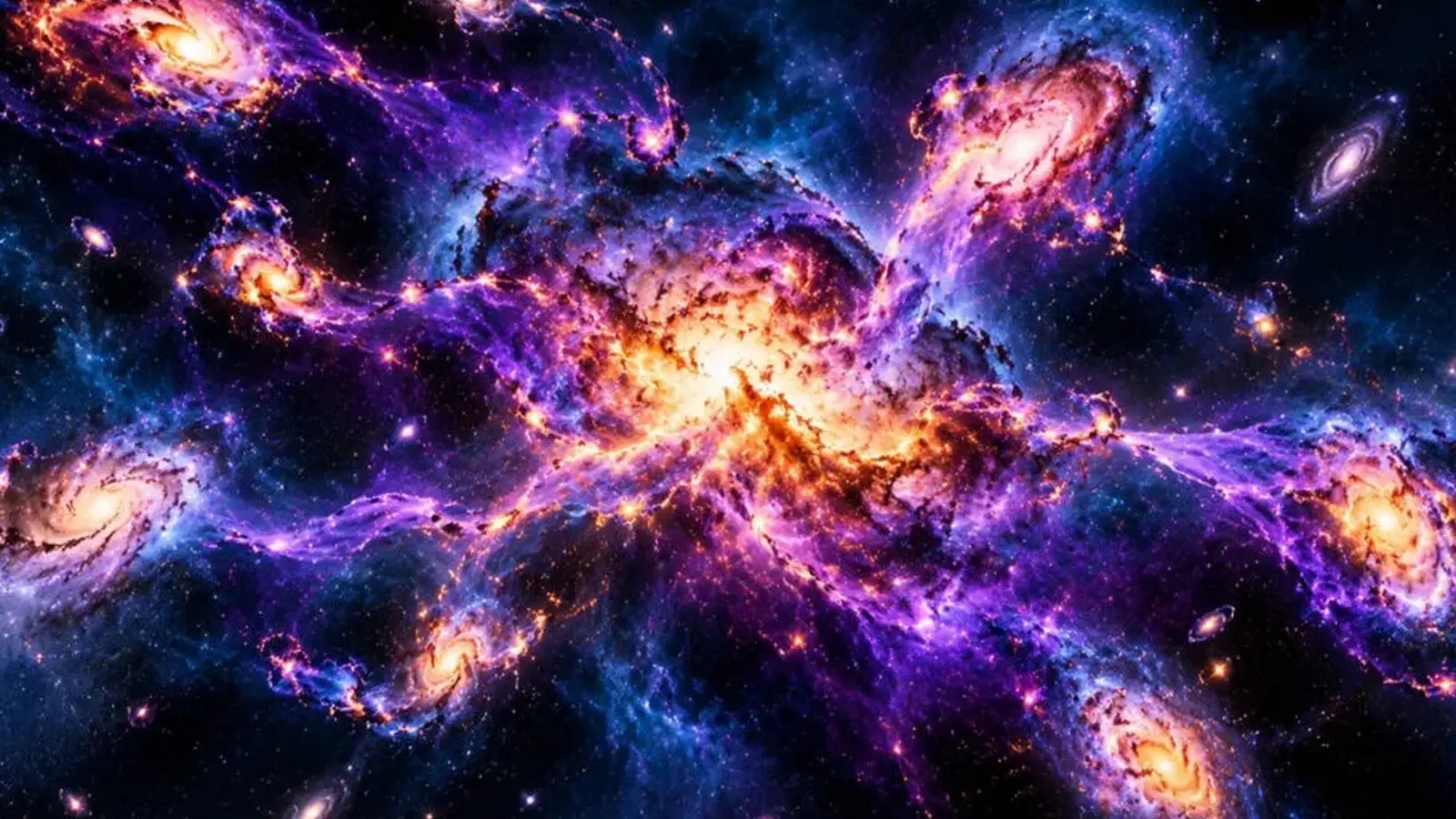
Picture the Milky Way not as a neat spiral, but as a turbulent pileup of countless smaller galaxies—rubbing shoulders, colliding, and slowly knitting together. Strange to imagine? Yes. But new simulations suggest that our home galaxy began life as precisely that chaotic thicket.
Over three years, an international team ran an ultra-high-resolution simulation called Megatron that rewinds cosmic time to the first few hundred million years after the Big Bang. Starting at about 180 million years and tracing evolution up to roughly 2 billion years, the model follows ancient gas, the faint glow of newborn stars, and the chemistry born in stellar deaths. The result is the most detailed digital tracing yet of how a Milky Way-like galaxy could assemble from thousands of tiny progenitors.
Why does this matter now? Because observations from the James Webb Space Telescope are exposing unexpectedly bright and compact infant galaxies in the early universe, features older models struggled to reproduce. Megatron was built to bridge that gap, predicting spectral signatures and luminous fingerprints that match the kinds of data Webb is collecting in the same epoch.
Harley Katz, an assistant professor of astronomy and astrophysics at the University of Chicago and a coauthor on the study, points out that the laws of physics operating in those first moments left fingerprints still visible in our local cosmos today. The simulation does not just trace motion; it encodes radiative physics, gas cooling, and the messy chemistry that follows the first supernovae.
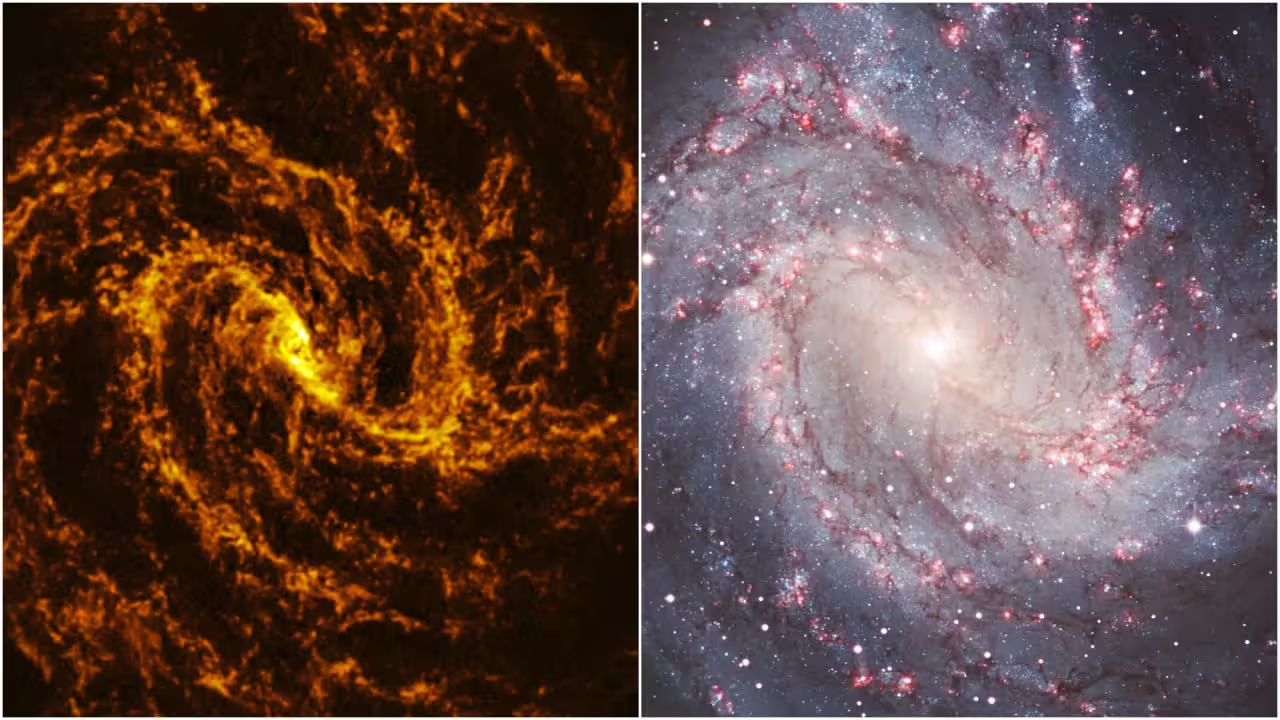
The story of first stars appears like a sequence of sudden events. At first there were only pristine gases. Then the first stars ignited and the universe experienced its cosmic dawn. They lived fast and died young, seeding their surroundings with carbon, oxygen, iron, and other heavy elements. Those elements became the raw material for subsequent generations of stars and for the planets that would later form around them.
Megatron tracks that life cycle: birth, evolution, and death of the earliest stars, painting a direct line from primordial gas to the building blocks of life.
Martin Re, a theoretical astrophysicist at the University of Bath, emphasizes that combining such detailed simulations with Webb observations opens an unprecedented laboratory to test models of the first stars. Instead of tweaking parameters to fit a single snapshot, researchers can now check whether a simulated universe reproduces spectral and structural patterns across time.
The simulation also implies that the Milky Way remained a busy construction site long after the first two billion years. Galactic mergers persisted; for instance, the ongoing assimilation of the Sagittarius dwarf galaxy likely began billions of years later and continues to sculpt our halo and stellar streams today.
Published in The Open Journal of Astrophysics, the Megatron results provide a robust framework against which current and future observations can be compared. The team is already developing the next generation of models to include additional phenomena, most notably the role of active black holes and their feedback in the infant cosmos.
So the next time you look up at the band of stars arcing across a dark sky, consider this: our serene spiral is the heir to a chaotic childhood, an ancient patchwork stitched from thousands of smaller worlds—and we are only starting to unravel how that tapestry was woven.

Leave a Comment
Comments
No comments yet. Be the first.