
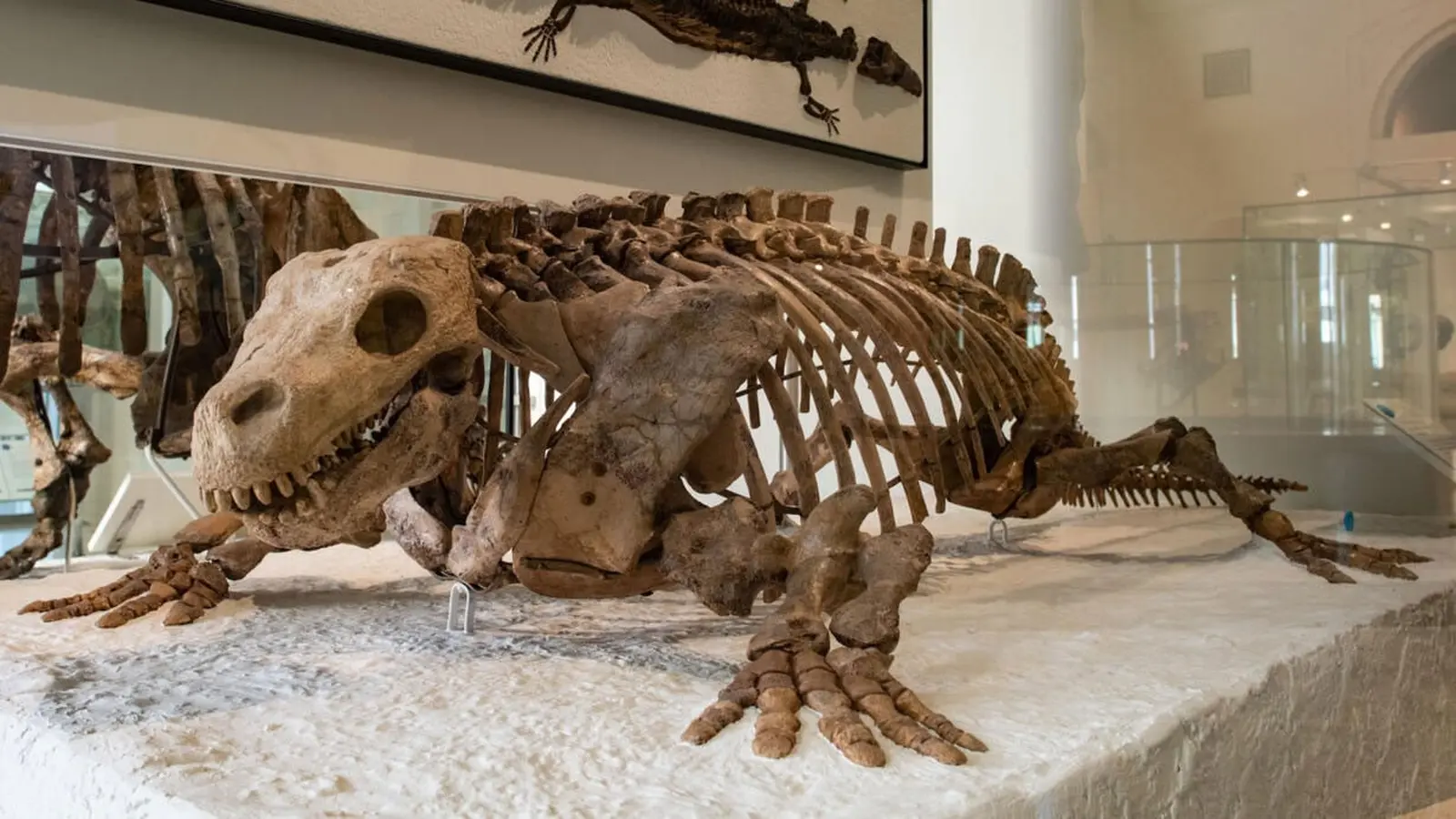
Stone can lie. It did so for decades in a slab from Scotland that held a nearly complete skeleton nicknamed "Lizzie." At first glance the fossil looked like proof that vertebrates had already fashioned reptile-like feet and fled the water. Five toes. Clawlike tips. Everything seemed to point to a decisive step onto dry land.
That confident story began to wobble when scientists trained powerful X-rays on the fossil. Using high-energy synchrotron imaging at the European Synchrotron Radiation Facility, researchers from the American Museum of Natural History and the University of Oxford peeled back layers that had been invisible for 35 years. What emerged was not a land champion but something stranger: a primitive skull, internal gill supports, and a mouth packed with tiny, fishlike teeth.
The revelation rewrites Lizzie's place on the tetrapod family tree. Rather than sitting near the origins of amniotes—the lineage that gave rise to reptiles, birds, and mammals—Westlothiana belongs to an older, more aquatic branch. In short, it was amphibious, not fully terrestrial.
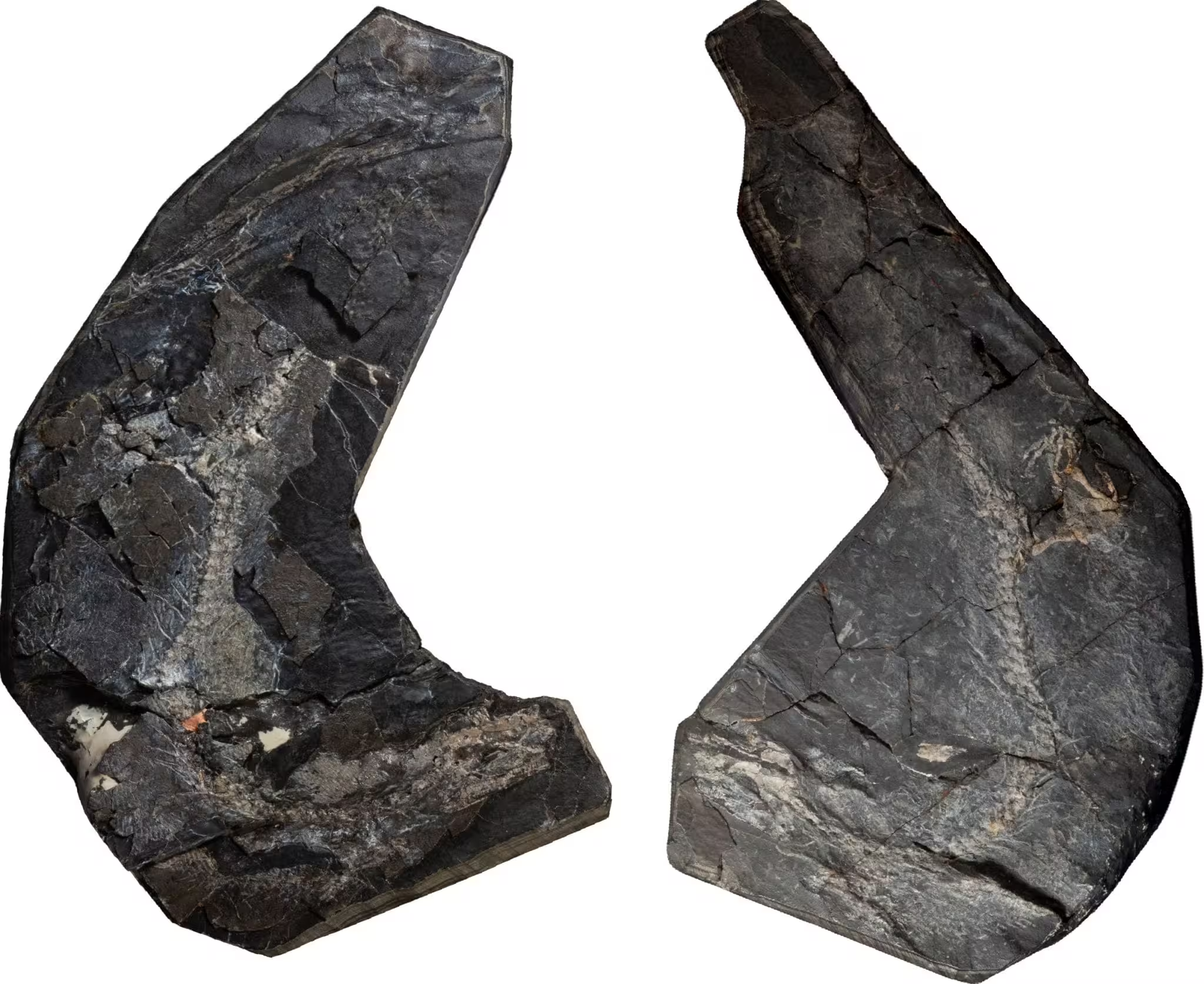
The two slabs of NSM G.1990.72.1, the Westlothiana fossil studied in the new work.
Why does that matter? Because the fossil had been treated as a touchstone for when truly land-adapted anatomy appeared. Those visible, weight-bearing limbs and five-toed feet had been read as a signal: amniotes were already here. But the scans show that pieces of the land-animal blueprint — claws, digits, sturdy limb bones — were already evolving in water-loving relatives. Evolution was assembling the toolkit slowly, in bits and pieces, long before its owners abandoned the swim.
Some hallmark 'land' features evolved before animals truly left the water.
That insight ripples outward. Paleontologists have used claw-shaped impressions in ancient trackways as a fingerprint for early amniotes. Now those prints are ambiguous. If amphibious relatives could sport clawlike phalanges, then some Devonian and Carboniferous trackmakers might not have been fully terrestrial after all. What looked like a straight line from water to land now looks more like a braided stream.
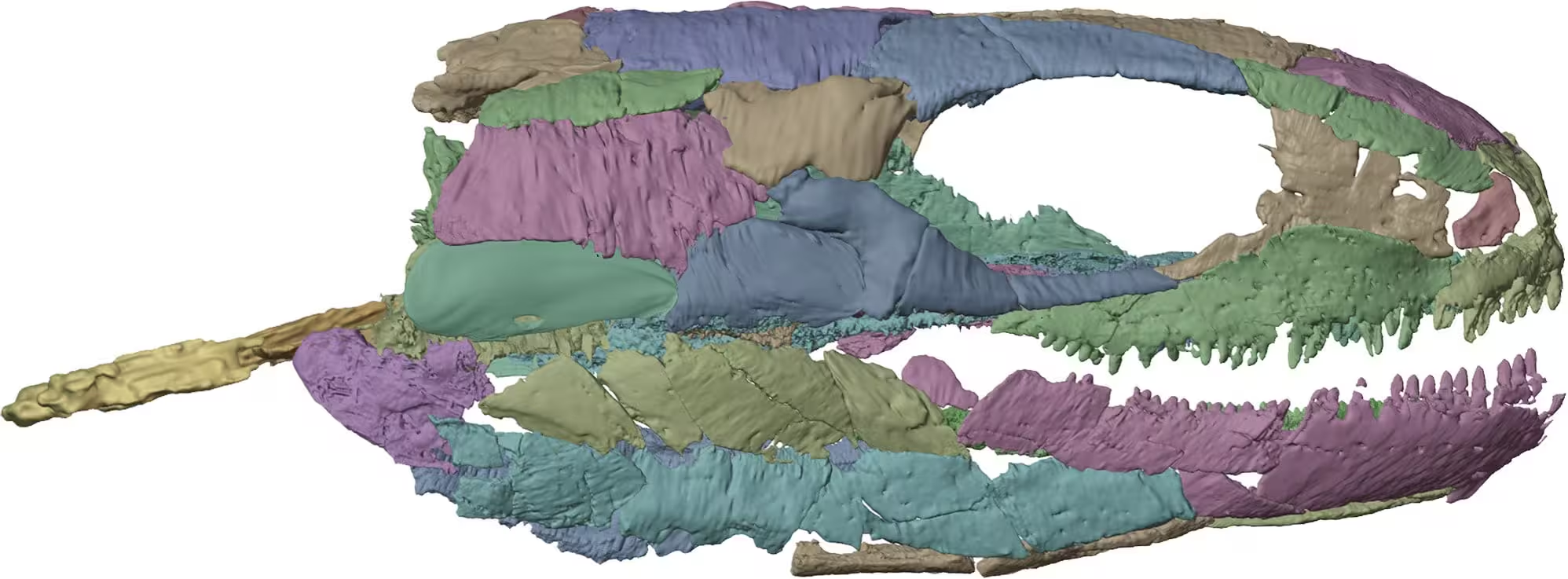
A reconstruction of Westlothiana based on x-ray scans of the fossil.
There is a larger lesson here about inference and context. Bones exposed on a slab tell only part of a story. So do footprints. New imaging technologies let us peek below surfaces and sometimes force us to rethink long-held assumptions. The past is messier than tidy evolutionary charts would suggest.
And for anyone who digs the drama of deep time: fossils still have surprises. The next claw mark we find may not be proof of conquest but a hint of an experiment—an evolutionary attempt whose full story hides inside stone, waiting to be revealed.


Leave a Comment
Comments
No comments yet. Be the first.