
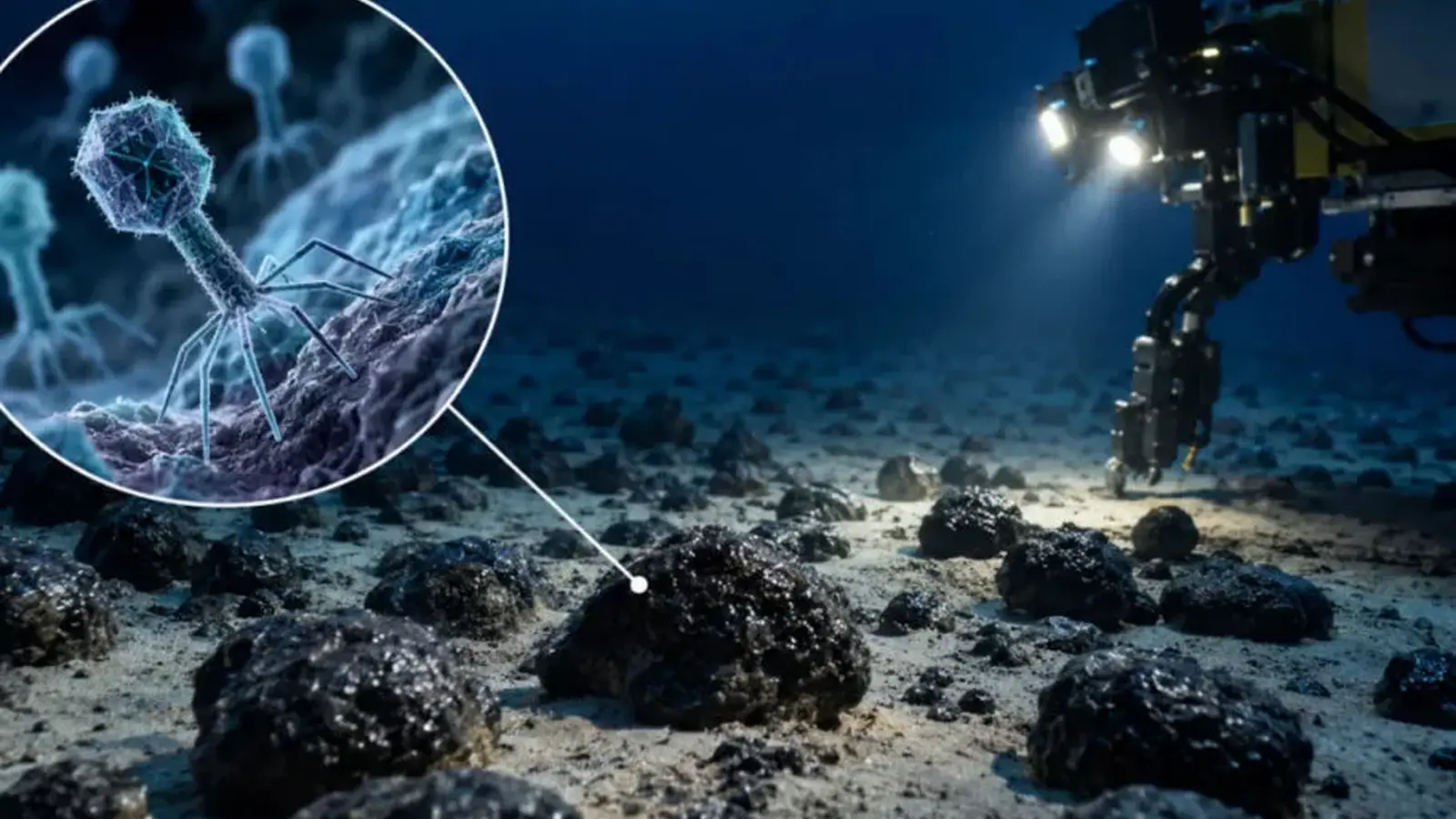
Imagine a desert of metal on the ocean floor, peppered with potato-sized rocks and invisible armies of viruses—this is the Clarion-Clipperton Fracture Zone (CCFZ), between Mexico and Hawaii, where researchers have just pulled back the curtain on a staggering microbial underworld.
Scientists from Chongqing University analyzed sediment samples from the CCFZ and identified 11,742 distinct viral genomes. More than 11,662 of those—over 99 percent—appear to be entirely new to science. These viruses live among polymetallic nodules: rounded deposits rich in cobalt, nickel and manganese that industry covets for electric-vehicle supply chains. The contrast is striking. A landscape that looks barren by human standards actually hosts dense, intricate networks of microscopic life.
So what do these newly cataloged viruses actually do? They mainly infect prokaryotes—bacteria and archaea—that drive the deep sea’s biogeochemical engines. Through infections, viral genes can alter host metabolism, tweak nutrient cycles and even shuttle traits that help microbes tolerate toxic metal exposure. In short, these viruses act as recyclers, regulators and genetic matchmakers in an ecosystem starved of nutrients and burdened by heavy metals.
Some viruses carry so-called auxiliary metabolic genes. These snippets of DNA are not about viral replication alone; they modify host chemistry during infection to influence carbon, nitrogen, phosphorus, sulfur and metal transformations. Other viral exchanges appear to equip bacteria with mechanisms to survive metal toxicity. The result is a web of interactions that stabilizes local microbial communities and keeps essential nutrient recycling humming along, however slowly, in the abyss.
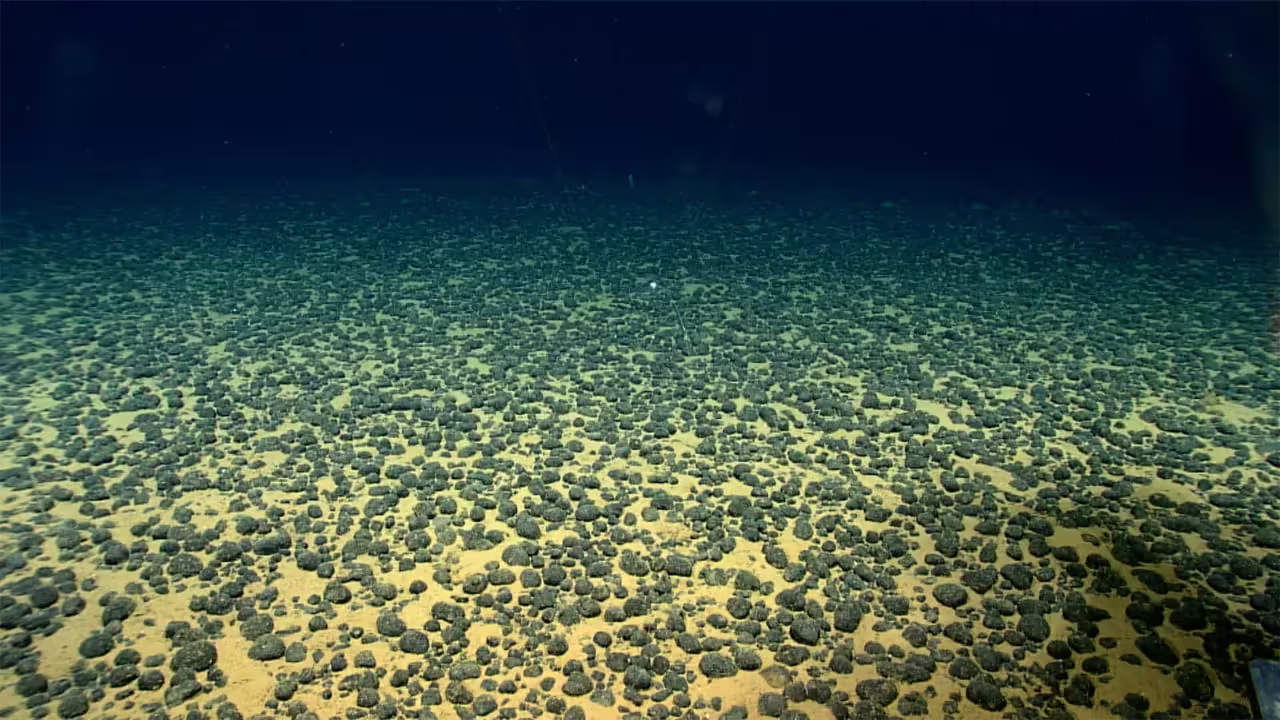
Most of the viral sequences fall into the class Caudoviricetes, a group of bacteriophages that prey on bacteria rather than animals. That’s an important reassurance: by current understanding, these deep-sea viruses pose little direct threat to human health. Their significance lies in ecosystem functioning, not contagion across higher life forms.
Yet the human footprint looms large. Polymetallic nodules are targeted by companies eyeing minerals for batteries and electronics. Future mining operations would indiscriminately displace or pulverize sediments, creating massive plumes and wiping out the microbial hosts these viruses depend on. When host populations collapse, the viral networks that channel nutrients and transfer adaptive genes could vanish or rewire in unpredictable ways.
Think of it like tearing out the plumbing of a remote treatment plant. The pipes are invisible, but the flows they sustain—nutrient release, metal detoxification, genetic exchange—keep the entire system functioning. Disturb the plumbing and the consequences ripple upward, altering chemistry, microbial community composition, and the long-term resilience of the seafloor ecosystem.
The authors of the study emphasize an urgent need for detailed baseline maps of viral and microbial networks before any commercial extraction begins. Why rush into industrial-scale disturbance when we barely know who lives there or how the parts fit together? Scientific mapping would not only inform conservation and regulation but also reveal fundamental biology that might otherwise be lost beneath sediment plumes and mining scars.
The discovery of nearly 12,000 viruses—most never seen before—underscores how much of Earth’s biodiversity remains hidden in places we rarely visit. It also poses a practical dilemma: extract critical metals to build a cleaner transport sector, or preserve a fragile, ancient ecosystem whose microscopic inhabitants perform services we are only beginning to understand. The deep sea is silently answering; do we have the patience to listen?


Leave a Comment
Comments
No comments yet. Be the first.