

Clip it on. Wait thirty minutes. Put it away. Repeat next week. It sounds almost too simple to be part of modern medicine, and that ordinary ritual is precisely what researchers are testing as a new approach to blood pressure that stubbornly refuses to budge under pills.
Scientists at Queen Mary University of London enrolled 63 people whose hypertension stayed high despite taking one or more medications. The intervention is called transcutaneous autonomic neuromodulation, or tAN, and it delivers a gentle electrical pulse through two tiny clips that grip the tragus — the little flap at the front of the ear. The device, developed by Afferent Medical Solutions, is handheld and meant for home use.
Why the ear? Because it gives access to branches of the autonomic nervous system — the circuits that quietly steer blood pressure, digestion and heart rate without asking our permission. Stimulate those nerves and you may nudge the body toward steadier pressure. Sounds neat. But does it work?
The NIHR-funded SCRATCH-HTN trial, published in the American Heart Association journal Hypertension, set out to find answers. Participants were randomized to active stimulation or a sham device. The schedule was front-loaded: daily 30-minute sessions for the first two weeks, then maintenance treatments once a week for another ten weeks. Across the full group, the active treatment did not significantly outperform the sham when it came to overall blood pressure reduction. Safety and tolerability, however, were clear. People could use the device at home, and side effects were minimal.
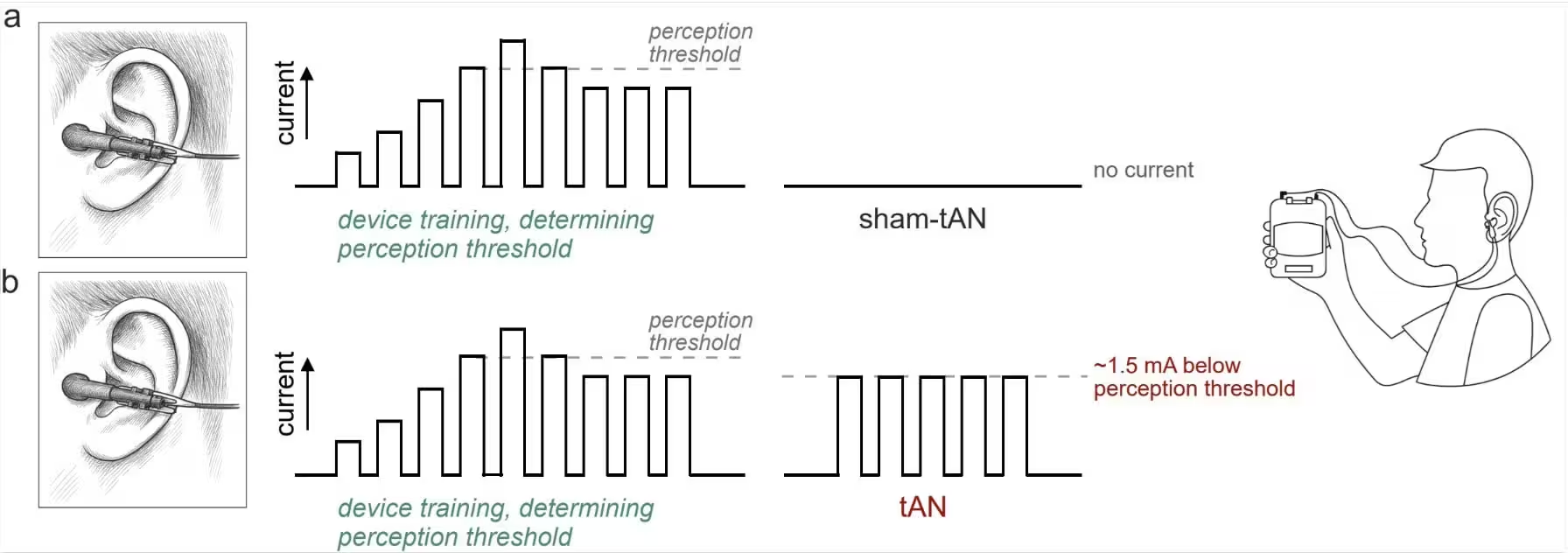
Illustration of the SCRATCH-HTN treatment for hypertension.
There is a twist. A preplanned subgroup analysis revealed that participants who began the trial with more severe hypertension experienced a larger drop in blood pressure with active tAN than with the sham. That finding doesn’t close the case. It opens a door. Larger, targeted trials are needed to see whether specific patients — not everyone with high blood pressure — might actually benefit from ear-based neuromodulation.
Dr Ajay Gupta, the study's chief investigator and a consultant physician at Barts Health NHS Trust, describes the technology as 'highly patient-acceptable' and potentially cheap and scalable. He cautions that while the trial is the first of its type and the most thorough to date, the overall results stop short of proving benefit across the board. Still, the signal among those with worse baseline blood pressure points researchers toward pressing questions: who gains, and why?
Translating this into clinical practice would require stronger proof. Researchers will need to map responders, refine stimulation parameters and run bigger, longer trials — ideally ones that follow people for months or years to understand sustained effects and safety. The promise is compelling: a noninvasive, self-administered therapy that could complement pills, especially for people who have exhausted other options.
It’s easy to imagine both excitement and skepticism in the cardiology community. After all, medicine has seen alluring small-device fixes before that faded when tested in larger groups. Yet the simplicity of an ear clip is its strength as much as its vulnerability: low cost and ease of use are powerful, but so is robust evidence.
The device proved safe and user-friendly in this trial, but whether it meaningfully lowers blood pressure for certain patients remains a question for further study.
For now, the ear clip is an intriguing footnote in the long fight against resistant hypertension — a reminder that sometimes the next medical idea arrives from an unexpected angle, literally at the edge of the ear.

Leave a Comment
Comments
No comments yet. Be the first.