
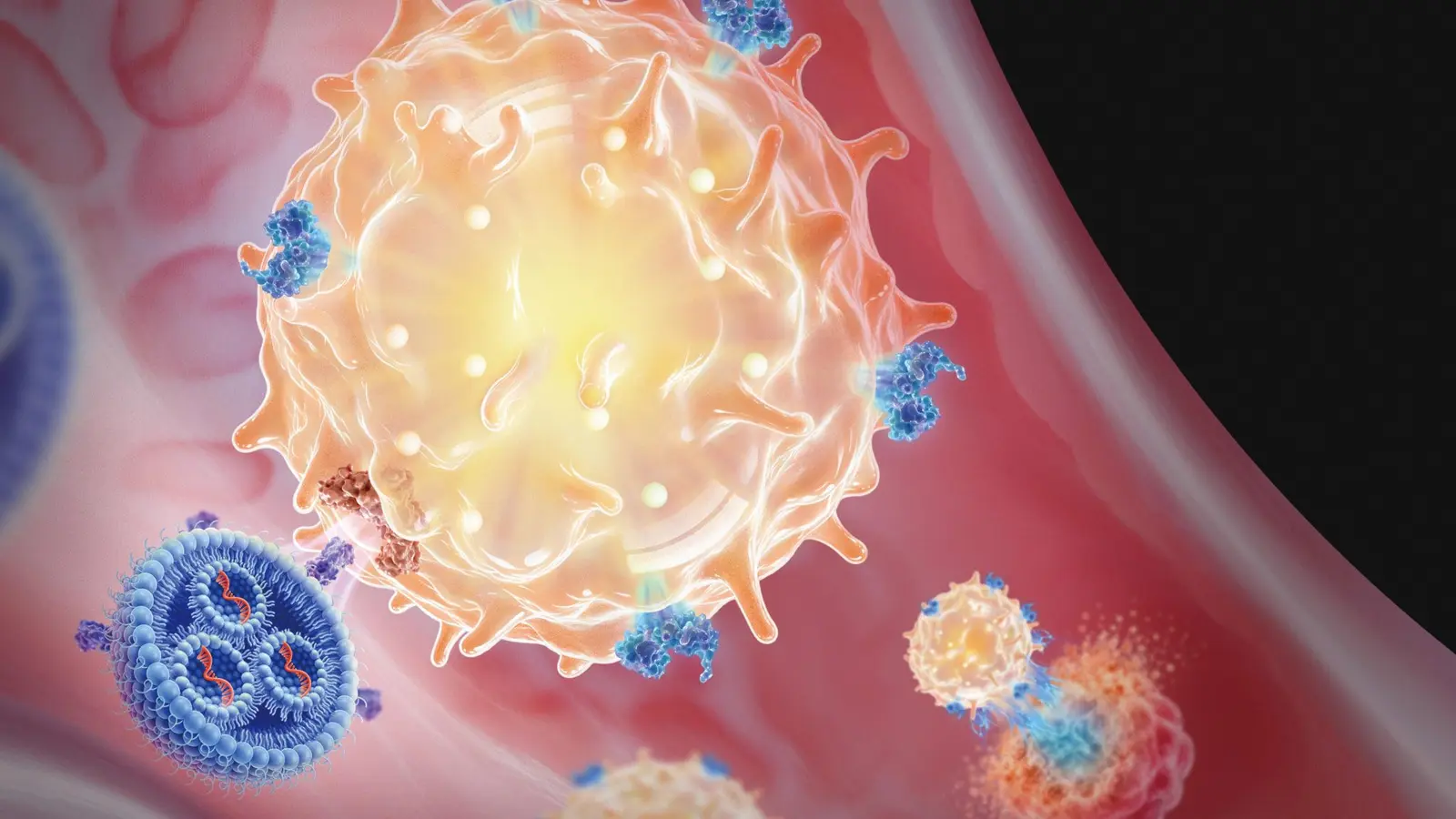
Imagine a microscopic courier slipping instructions into immune cells, teaching them to hunt cancer from the inside. That’s the image MIT researchers are selling — and in mice, it worked.
Current CAR therapies require a round trip to the factory: doctors draw blood, engineers extract T or NK cells, add a synthetic receptor, grow the cells, and then reinfuse them. It’s effective for some blood cancers, but slow, costly, and complex. MIT’s team flipped that script. Instead of shipping cells out, they packed messenger RNA into lipid nanoparticles and sent the instructions straight to natural killer (NK) cells inside the body.
These nanoparticles are tiny, fatty shells carrying mRNA blueprints for chimeric antigen receptors — the same kind of targeting devices used in CAR-T therapies. Antibody fragments on the particle surface act like address labels, binding to receptors on NK cells so the payload lands where it matters. Once inside, the cells translate the mRNA and display the new receptor on their surface. Simple in concept. Powerful in practice.
The team reports that this in vivo reprogramming reached roughly 80 percent of targeted NK cells in mice. That’s not a marginal effect. It’s a wholesale retooling of an immune population without drawing a single vial of blood out of the animal. And when those newly armed NK cells encountered tumors, they acted decisively.
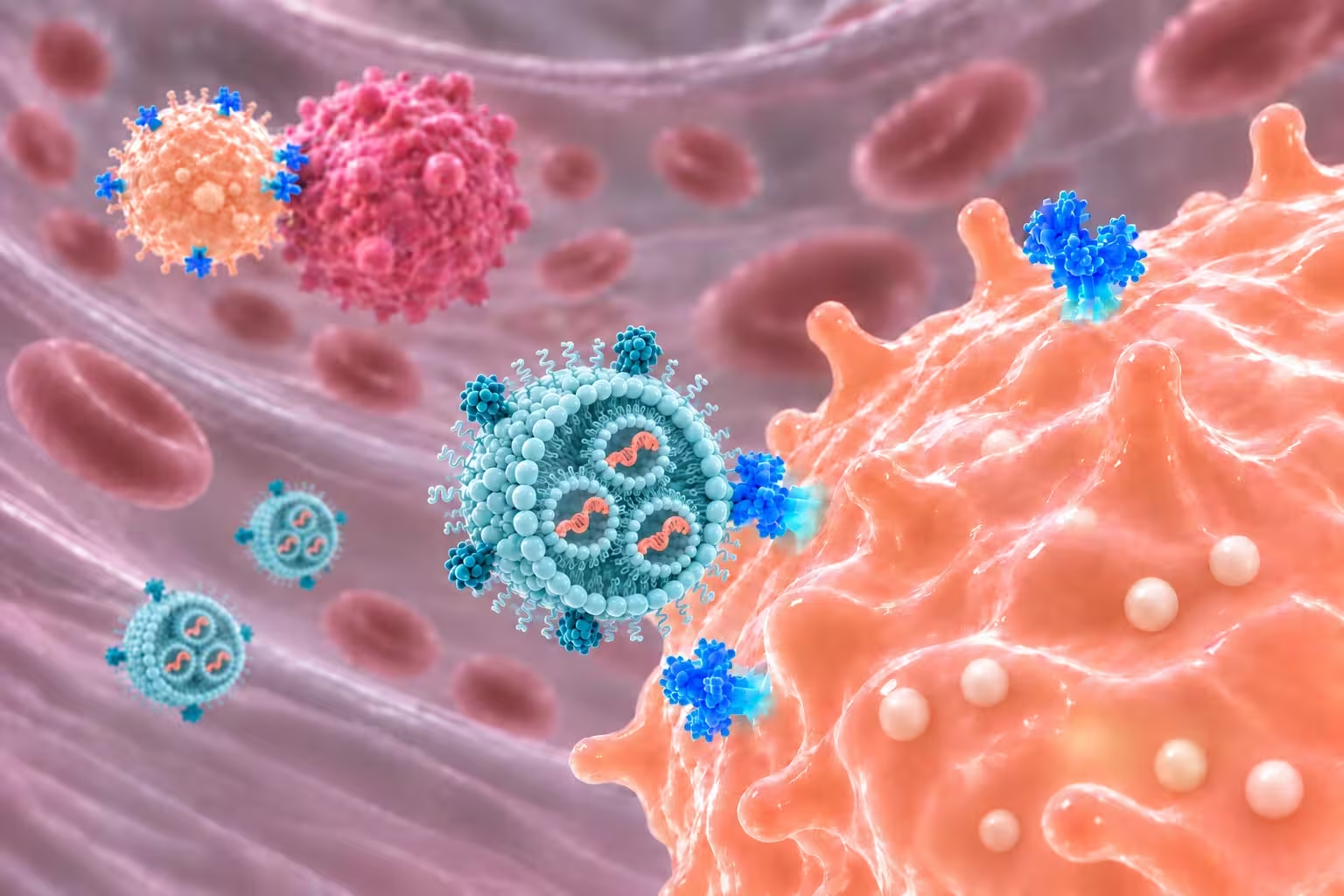
Targeted lipid nanoparticles (teal) deliver mRNA (coral) to NK cells (orange) to enable tumor targeting; blue structures depict surface proteins, the pink cell represents a tumor cell, and red discs are red blood cells.
In humanized mice bearing T-cell lymphoma, five injections of the nanoparticles cleared tumors entirely — a result comparable to conventional CAR-NK cells engineered outside the body and reinfused. In a separate experiment, a single dose wiped out autoreactive T cells that were attacking hepatocytes in a model of autoimmune hepatitis, allowing the liver to recover. Even in an aggressive melanoma model three of five mice went into full remission after NK cells were retargeted to the cancer.
Why focus on NK cells rather than T cells? Because when engineered T cells are programmed to recognize T-cell markers, they can turn on each other — a phenomenon called fratricide. NK cells sidestep that problem. They can be directed to eliminate malignant or autoreactive T cells while avoiding mutual destruction, opening possibilities for treating T-cell cancers and autoimmune diseases alike.
There are other practical perks. If a patient could receive an infusion of targeted nanoparticles instead of undergoing ex vivo manufacturing, the process would be faster and cheaper. That could broaden access. It might also accelerate the pace of personalization: swap the mRNA sequence, and the same delivery system could target CD19 on B cells, CD3 on T cells, or other disease-specific markers.
Published in Nature Biotechnology, the study blends nanotechnology, mRNA delivery, and immunotherapy into a single, elegant strategy. Daniel Anderson leads the work at MIT’s Department of Chemical Engineering, with contributions from colleagues across the Koch Institute and other labs. Robert Langer, a long-time voice in drug delivery, calls the approach a striking example of what nanoscale systems can do for cancer and immune disease.
Caveats remain. These experiments were performed in mice, including humanized models that approximate—but do not fully replicate—human immunity. No CAR-NK therapies are yet FDA-approved, even though several CAR-T treatments have cleared that bar. Safety, durability of the engineered response, off-target effects, and scalability will all need careful testing in human trials.
Still, the work points to a future where the immune system can be reprogrammed inside the body as easily as loading software onto a device — and where a single infusion might be enough to redirect our natural defenses toward cancer or destructive autoimmunity.

Leave a Comment
Comments
No comments yet. Be the first.