
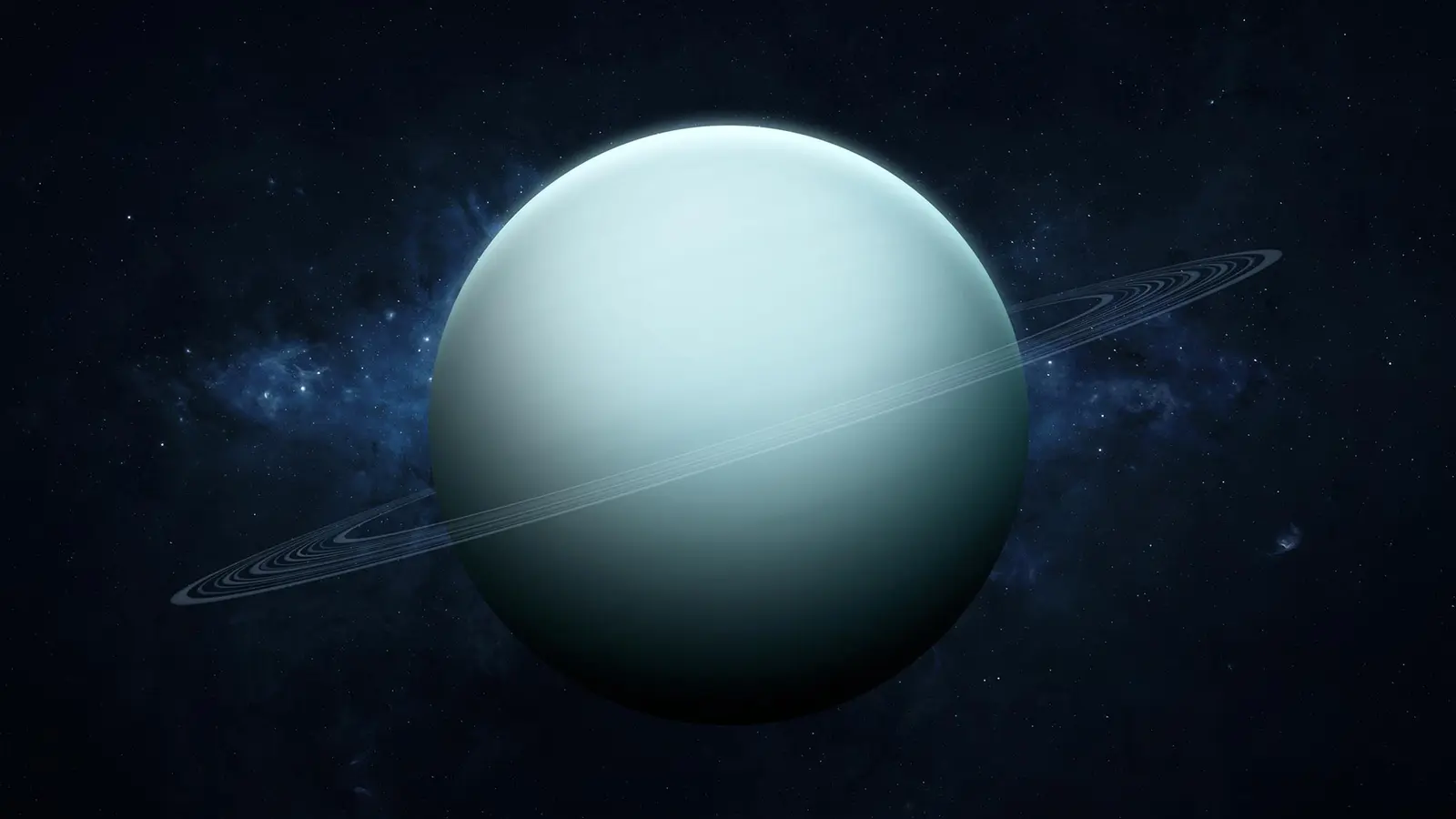
They look like twins from a distance: similar sizes, a blue-green glow, and thick envelopes of gas that plunge into hidden interiors. Up close, though, the story shifts. New research argues that Neptune and Uranus—long lumped together as the Solar System’s ice giants—may be siblings with very different childhoods.
Astrophysicists from an international team, including scientists at the Southwest Research Institute, analyzed the chemical clues locked in the planets’ upper atmospheres and found a striking contrast: Neptune’s deep layers appear to contain far more oxygen than those of Uranus. This inference comes from careful measurements of carbon monoxide in the planets’ upper tropospheres and computer simulations that translate those signals into plausible interior chemistries.
Why carbon monoxide? Because CO is one of the best tracers we have for what's happening below the visible clouds. It survives in the upper atmosphere long enough for telescopes like ALMA to detect it. From those observations, and by modeling how molecules mix and react as they sink or rise, researchers can backtrack to the likely carbon-to-oxygen ratios buried thousands of kilometers down.
The result is more than a subtle nuance. Neptune’s inferred oxygen enrichment suggests it incorporated a different mix of solids and ices during formation—materials richer in water or other oxygen-bearing compounds—compared with Uranus. In short: the two planets may have assembled from distinct reservoirs in the protoplanetary disk that swirled around the infant Sun.
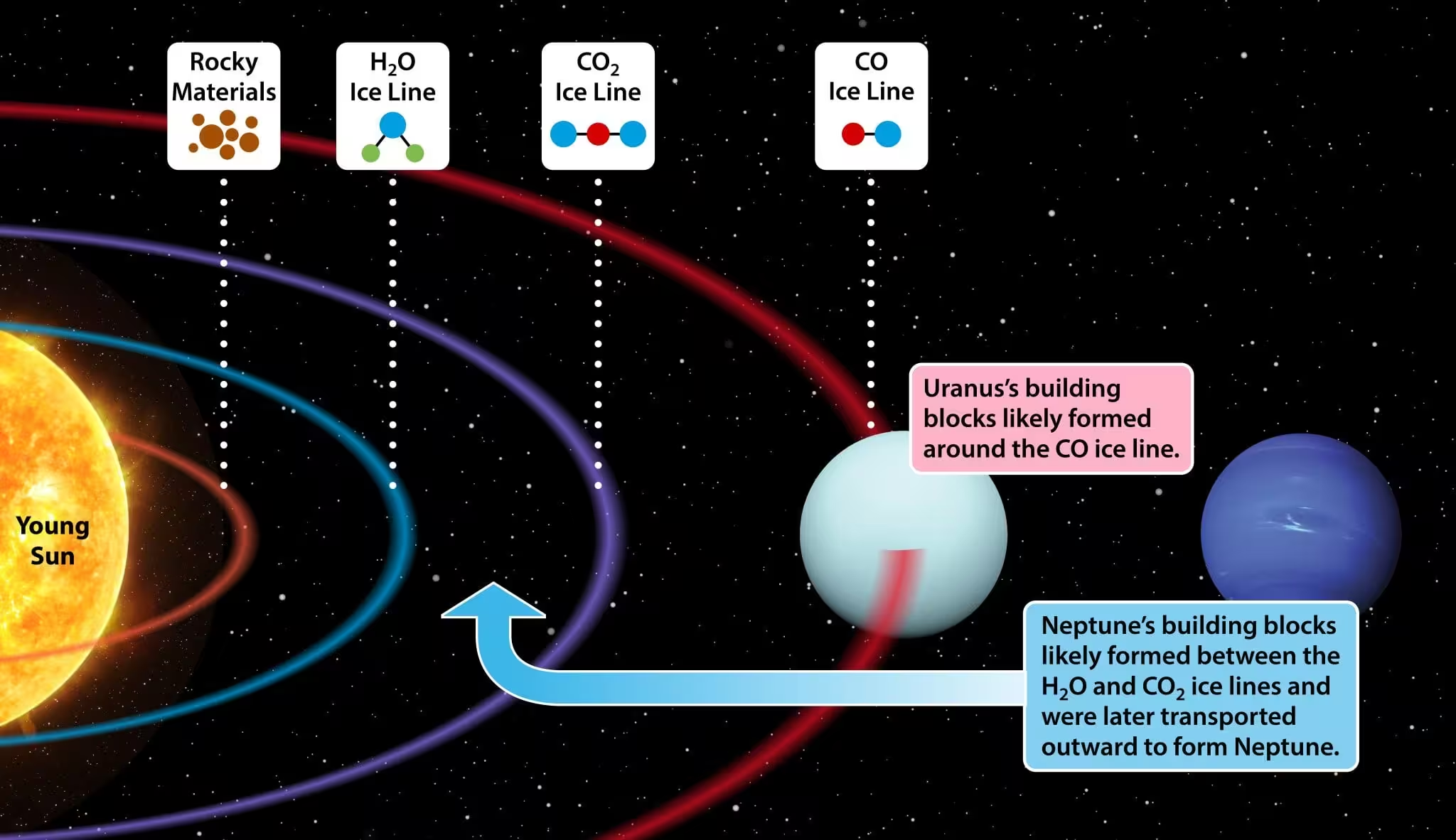
The scientific community has traditionally considered the ice giants Neptune and Uranus as twins that pulled from the same reservoir of materials when forming. A Southwest Research Institute scientist contributed to a new study detailing how Neptune’s deep atmosphere appears substantially richer in oxygen than Uranus’s, hinting that the materials that make up the two planets came from different regions in the protoplanetary disk. Pictured: an artist’s rendition of Uranus, Neptune, the young Sun and the protoplanetary disk.

Planetary formation is not a tidy process. Temperatures in the early disk dropped with distance from the Sun, causing volatile species to condense into solids at different radii. That created chemical neighborhoods: regions dominated by water ice, regions rich in carbon-bearing ices, and so on. If a planet gathers most of its mass in one neighborhood, its elemental fingerprint will reflect that origin. If it migrates or accretes material that traveled far, the fingerprint changes.
The team’s disk-evolution models paint exactly that picture for Neptune. Rather than assembling solely from local material near its present orbit, Neptune may have accreted building blocks that formed closer to the Sun and later migrated outward—carriage by icy planetesimals or sweeping gas flows. The consequence: two planets that look superficially similar but carry different chemical résumés.
“Surface likenesses can be deceiving,” observed one of the study’s authors, who points out that our inability to probe the deep interiors directly forces scientists to rely on tracers and models. The inference is tentative, and the models have assumptions. But the chemistry lines up in a way that is hard to dismiss.
Neptune and Uranus may share a size and hue, but their chemical fingerprints suggest they grew from different stores of the early Solar System’s raw materials.
That matters beyond a debate about two distant planets. Worlds the size of Uranus and Neptune are abundant around other stars. Understanding whether such planets form in place or migrate across the disk helps explain the variety of exoplanet systems astronomers now observe. If migration of solids was common, many supposedly local planets might actually be patchworks of materials from far-flung regions.
Still, uncertainty remains. Models are only as good as the data that feed them, and we have not yet sampled the deep atmospheres directly. That is why mission planners are pushing for dedicated probes to Uranus and Neptune—landers that could plunge through the clouds and return ground-truth measurements of composition and structure. Those data would test the migration hypothesis and refine our picture of how planetary neighborhoods formed.

For now, telescopes like ALMA give us a chemical keyhole view. The opening we see suggests a more complex family tree for the ice giants than previously imagined. And if two planets in one system can trace such different origin stories, what does that tell us about the billions of other worlds orbiting other stars? The question hangs in the vacuum, waiting for the next probe to drop through the clouds.

Leave a Comment
Comments
No comments yet. Be the first.