
4 Minutes
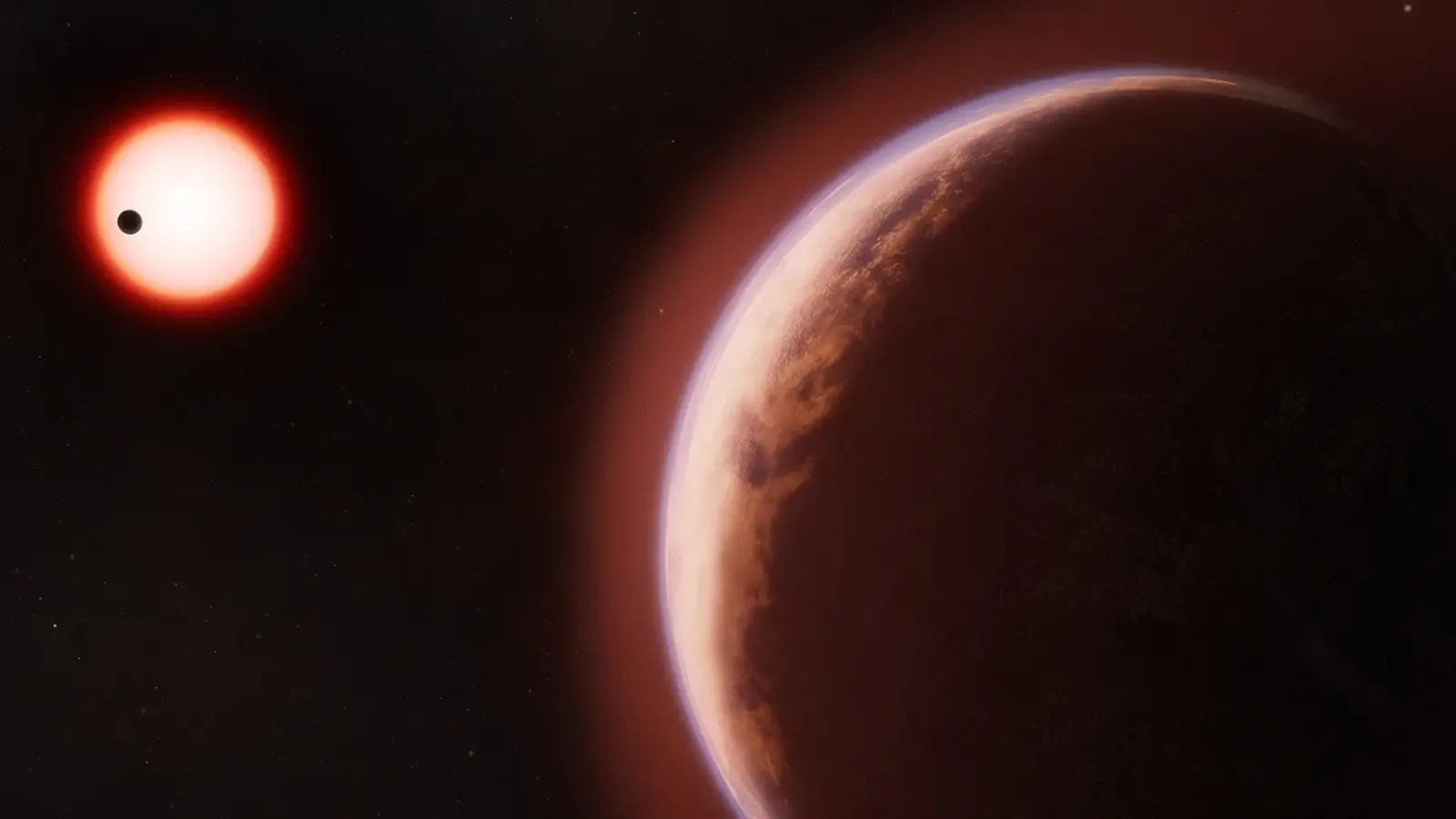
Imagine a small world 50 light-years away holding on to a whisper of its birth: a thin, helium-rich envelope clinging to a rocky planet that sits where liquid water could exist. It sounds like science fiction, but this is exactly what a team of astronomers reported after watching LHS 1140 b cross its star.
LHS 1140 b is not a gas giant. It is a dense super-Earth — about 5.2 times Earth's mass and roughly 1.7 times its radius — orbiting a cool red dwarf. That combination places it squarely in its star’s habitable zone, where temperatures might allow oceans. Until now, atmospheres had been convincingly seen only on bloated, searingly hot exoplanets; detecting one around a rocky, temperate world is a first.
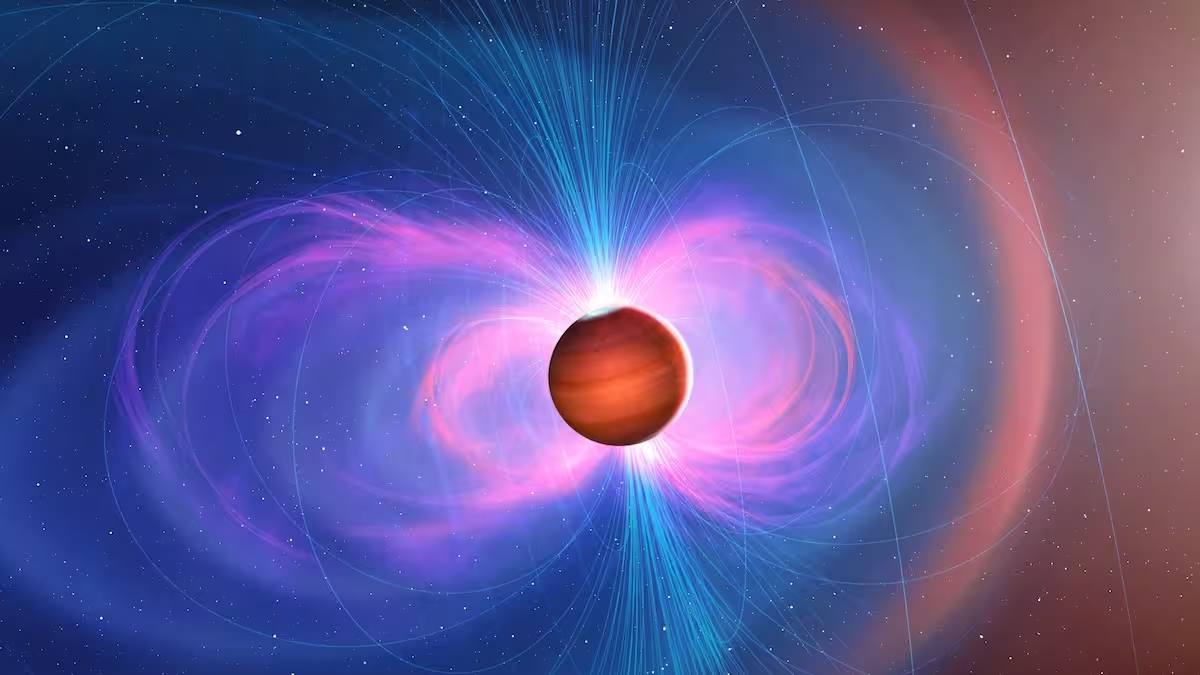
An illustration of a windy hot-Jupiter-style planet and its magnetic field.
How did they do it? By catching the planet in transit and reading the fingerprint of starlight filtered through any surrounding gas. Using the WINERED spectrograph at Las Campanas Observatory in Chile, the team targeted helium lines during a rare night in September 2024 when LHS 1140 b and its sibling planet both slid in front of their star. Light filtered through that faint veil told the tale: helium absorption was present for LHS 1140 b but absent for its neighbor.
That absorption isn’t static. The observations imply a stream of helium escaping at rates on the order of hundreds of thousands of kilograms per second, heated to temperatures exceeding 4,700 °C by stellar radiation. The flow likely owes its vigor to interactions with the star — from winds to magnetic fields — and appears to vary over time, since follow-up observations in 2025 did not detect the same signal.

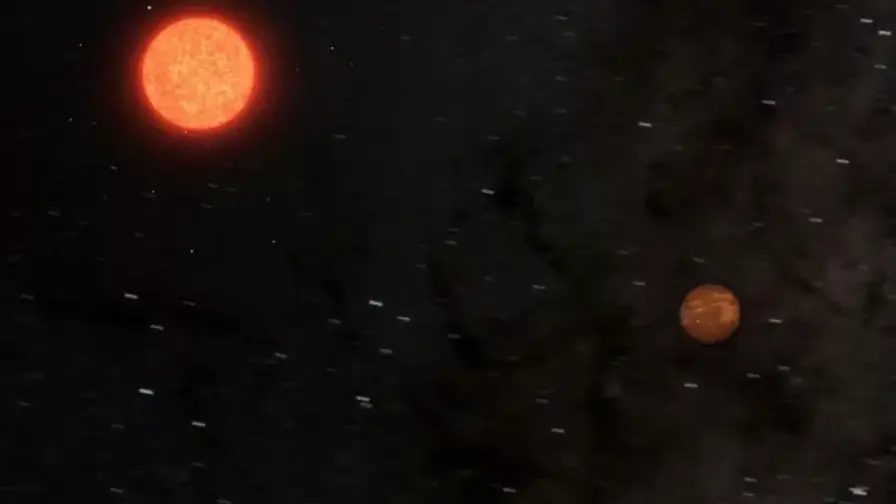
An overview of the transit method commonly used to detect exoplanets.
Why is helium there at all? The discovery supports a model developed by lead author Collin Cherubim, with guidance from Robin Wordsworth, showing how some small planets can lose their light hydrogen but retain heavier helium — a process called mass fractionation. The result is a helium-dominated atmosphere, a class of worlds Cherubim dubs "helium worlds." According to the team’s calculations, LHS 1140 b sits at a sweet spot far enough from its star to avoid complete atmospheric stripping, yet close enough that some primordial helium would remain.
There are surprising longevity notes in this story. Despite red dwarfs’ reputations for energetic flares and intense ultraviolet bombardment earlier in their lives, LHS 1140 b appears to have kept part of its primordial atmosphere for over three billion years. It receives only about 42 percent of the stellar energy Earth gets from the Sun, a factor that likely helped preserve that tenuous envelope.
The implications are twofold. First, this is the first robust detection of an atmosphere around a rocky planet located in another star’s habitable zone — a milestone that shifts the needle in exoplanet studies from mere cataloguing to real atmospheric characterization of temperate rocky worlds. Second, the finding underscores that ground-based instruments remain essential partners to space telescopes like JWST. With careful technique and stable nights, terrestrial observatories can sniff out the spectral traces of alien gases.

An unrelated exoplanet with two helium tails, discovered by the James Webb Space Telescope.
What comes next? More spectra. Different wavelengths. Deep, patient looks to see whether LHS 1140 b carries water vapor, heavier molecules, or surface conditions compatible with oceans. If helium is a relic of formation, it may also mask or mimic other signatures; disentangling those signals will require follow-up from both ground and space.
The paper, published in Science, reads like the opening chapter of a new era in which not only gas giants but also modest, potentially habitable worlds are subject to atmospheric forensics. It raises a new question with urgency: how many more quiet, rocky planets are hiding faint atmospheres we can detect if we know where and how to look?

Leave a Comment
Comments (2)
Is the helium really primordial or just a transient puff from a flare? follow-ups need to nail this, instruments can lie.. or maybe I'm overcautious
wow a helium world? mind blown. 50 light years feels both close and impossibly far. imagine oceans under a thin veil... if true, wild