
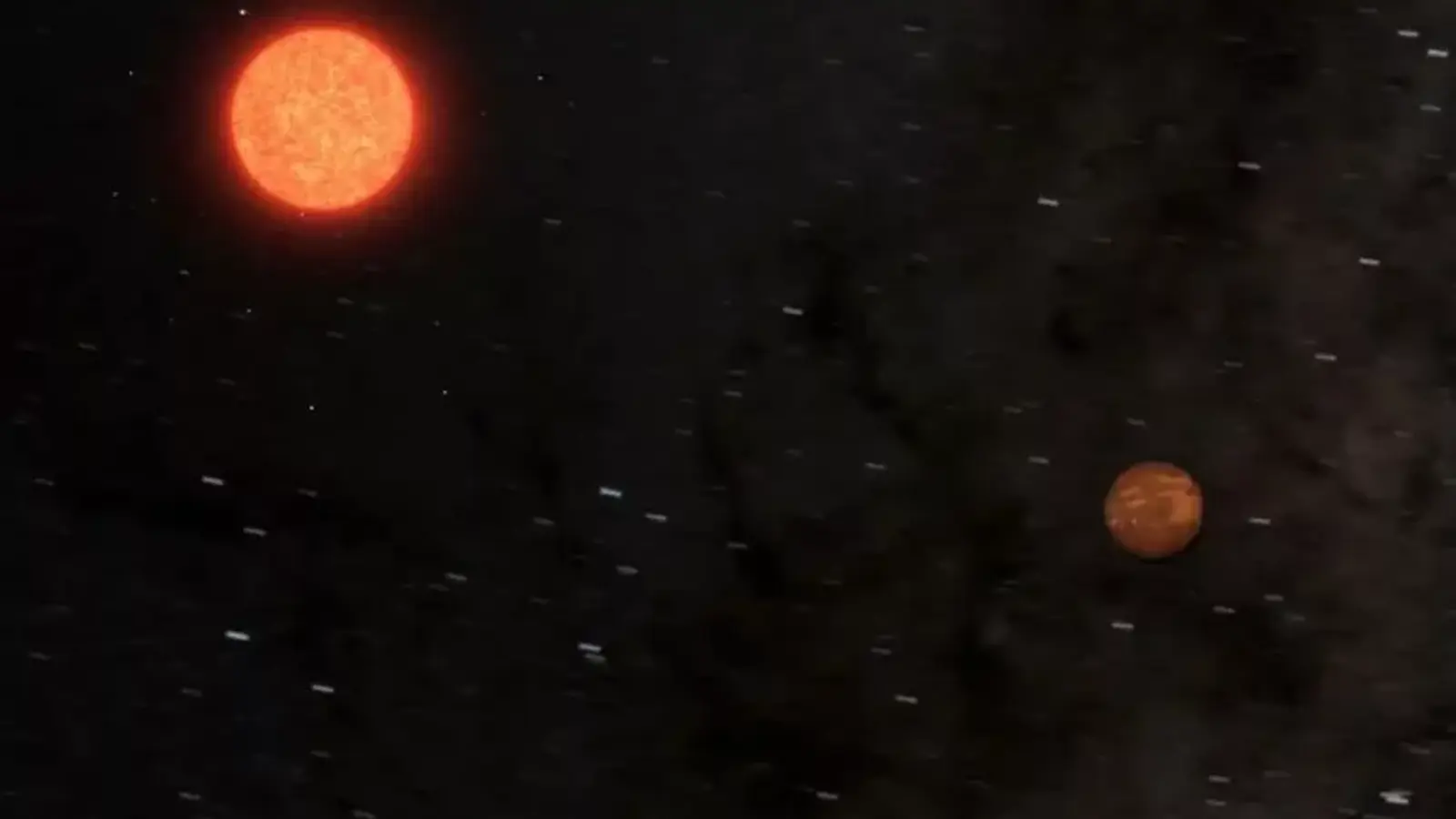
Imagine finding a world next door that looks a lot more promising for life than it first seemed. GJ 3378b was written off at first as a sizzling, uninhabitable rock—too close to its star, too hot. Then astronomers measured it again and the story shifted.
Discovered in 2024, GJ 3378b orbits a red dwarf roughly 25 light-years from Earth. Its year lasts only about 21.5 days because it circles very close to its star—around ten times closer than Earth orbits the Sun. That sounds dangerous until you remember red dwarfs are faint. This host star emits roughly 90% less light than the Sun, which places GJ 3378b squarely in the system’s temperate band where liquid water could, in principle, exist.
Mass matters. Early estimates pegged the planet at about five Earth masses, nudging it into the so-called “super-Earth” category. But a fresh campaign using the Habitable-zone Planet Finder on the McDonald Observatory’s telescope in Texas has revised that number down. The instrument watches tiny wobbles in the star caused by an orbiting planet’s gravity, and the new data point to a mass closer to 2.3 times Earth’s.
That’s a game-changer. A mass near two Earths is far more consistent with a rocky world than with a mini-Neptune wrapped in a thick gas envelope. A solid surface raises the odds for a stable, Earth-like atmosphere and surface pressures where liquid water could persist. If GJ 3378b has retained an atmosphere, it instantly becomes one of the highest-priority nearby planets for follow-up study.

Of course, caution is due. Proximity to a red dwarf can be a double-edged sword. Strong stellar winds and flares—common in many red dwarfs—can strip atmospheres away over time. Mars may be a warning; once it lost its protective shield it could not hold on to oceans it may once have had. We have no direct signs yet of an atmosphere or oceans on GJ 3378b, only a promising mass and location.
Why does distance matter so much? Because a planet 25 light-years away is close enough for more detailed observations with current and upcoming telescopes. Confirming an atmosphere—or detecting biosignatures—becomes far easier when the target is in our cosmic backyard rather than on the other side of the galaxy. That accessibility is precisely why researchers are excited.
Researchers involved in the study emphasize the need for more data: repeated spectral observations, searches for atmospheric tracers, and long-term monitoring of the host star’s activity. Red dwarfs are the most common stars in the Milky Way, so understanding whether their planets can keep atmospheres and support life has broad implications for the galaxy’s habitability.
GJ 3378b has moved from an oddball data point to a front-runner for careful scrutiny. The next few years of observations will tell us whether this nearby world is merely interesting—or whether it might host conditions where life, in some form, could take hold.

Leave a Comment
Comments
No comments yet. Be the first.