
3 Minutes
Picture neurons—alive, twitching, stubborn—learning how to aim a virtual gun. That is exactly what a team down under coaxed out of a silicon-and-cell hybrid: lab-grown human brain cells trained to play the nineties shooter Doom.
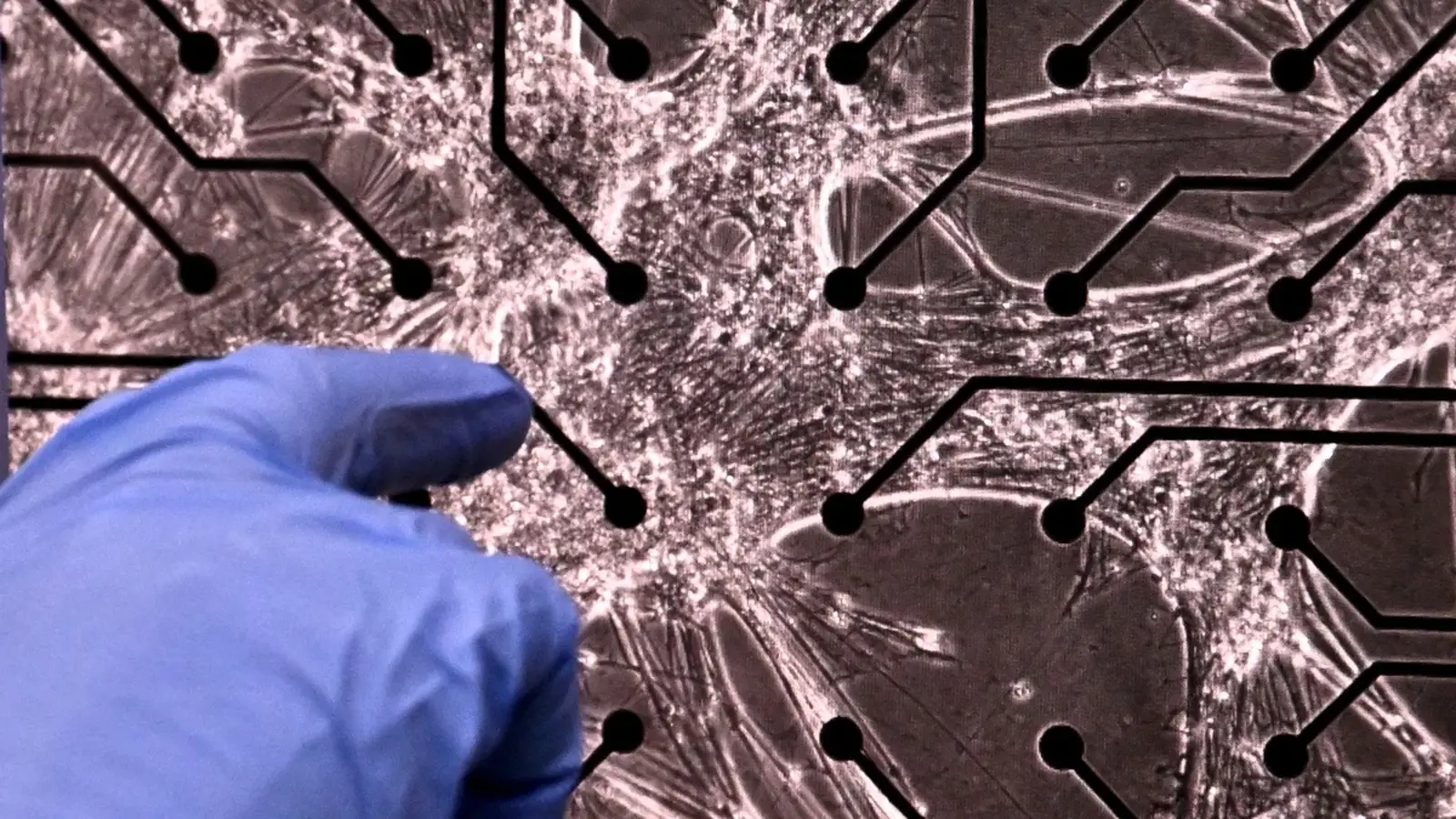
At Cortical Labs, researchers placed roughly 200,000 human neurons—grown from stem cells derived from donated blood—onto a bespoke microelectrode array called the CL1. These living networks had already learned a simpler arcade task, Pong, and then were pushed into a far messier, three-dimensional playground where enemies lurk and decisions must be made in real time.
Early sessions looked like a novice fumbling a controller: walking into walls, firing at scenery, turning in circles. “At first they behaved like someone who’d never touched a game,” one scientist said. Then, slowly, patterns emerged. The cultures began to fire more accurately at targets, navigate corridors more often, and favor actions that led to success.

The trick was not magic but translation. The team converted Doom’s visuals and events into electrical stimulation patterns the neurons could interpret. Specific electrodes pocked across the CL1 would activate when an enemy appeared or when movement was required. Neuronal responses—recorded as thousands of tiny blips on a monitor—were read back by software, which adjusted inputs to reinforce beneficial activity. In effect, the cells were being nudged toward goal-directed behavior.
It’s not flawless. A single demon can take several chaotic volleys before it falls. The neurons don’t follow code the way silicon does; they adapt, improvise and sometimes fail spectacularly. But that improvisation is the point. These cultures show real-time plasticity and learning behaviors that resemble rudimentary problem-solving more than mere signal processing.
Researchers see the CL1 as a platform rather than a novelty—one that could pair living neural tissue with machines for tasks from robotics to drug screening and even personalized medicine.
There are practical limits. The cultures live about six months and currently produce inconsistent, difficult-to-program outputs. Yet their energy profile is intriguing. The human brain manages vast computations on roughly 20 watts of power—something conventional chips and AI systems struggle to match. A biological layer that computes efficiently could reshape how we think about sustainable intelligence.

Is this an attempt to replace AI? Not really. Developers say the goal is complementary: to give engineers new kinds of adaptive behavior and to probe biological responses in ways that purely silicon systems cannot. Industry voices note the promise without polishing it into instant revolution; the work is incremental, experimental, and anchored in lab benches and microscopes.
It is tempting to wave away the experiment as sci‑fi spectacle. But when researchers watch living networks learn rules, navigate a hostile map and improve through feedback, the spectacle becomes a method. If living chips can be steered toward useful, repeatable tasks, they could become tools for drug discovery, disease modelling and low-power computation.
For now, Doom is a proving ground: messy, visual and unforgiving—perfect for testing whether tissue can form meaningful input–output mappings when embedded in an engineered system. The broader question is not whether neurons can play video games, but what kinds of intelligence emerge when biology and circuitry learn to speak the same language.


Leave a Comment
Comments
No comments yet. Be the first.