
3 Minutes
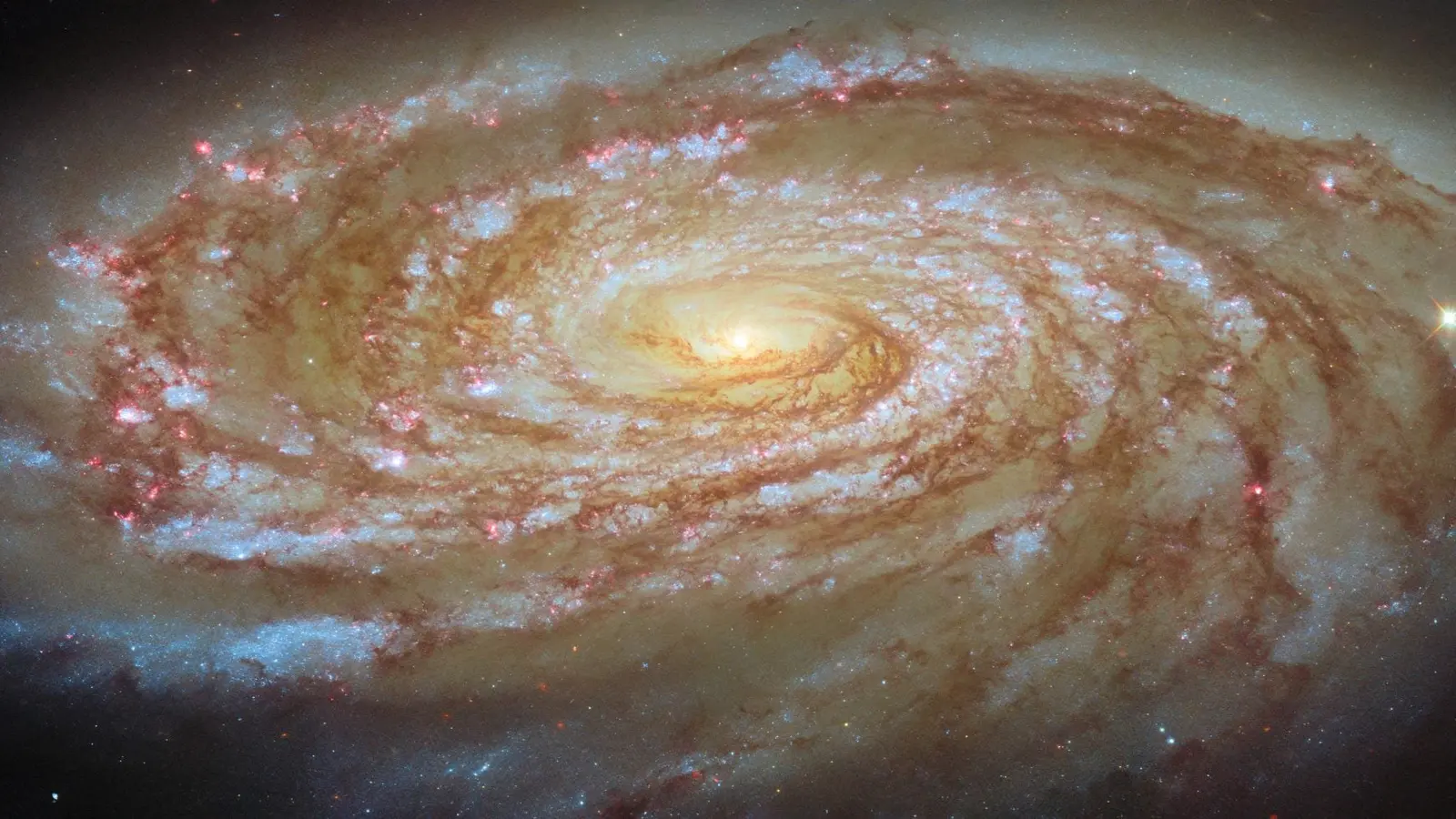
Look at that curl of starlight. Messier 88 — a graceful spiral some 63 million light-years away — is not just drifting through space. It is on a collision course with a denser, hungrier neighborhood: the Virgo Cluster, and the forces waiting there are already reshaping its fate.
At the galaxy’s bright core, a supermassive black hole, roughly a hundred million times the mass of our Sun, gobbles gas and dust while driving energetic outflows. Around that tumultuous center sits an older, reddish stellar population that gives the bulge a warm, steady glow. Sweep outward from the nucleus and you find tightly wound spiral arms, stitched with blue star clusters and dusty lanes. Viewed at an angle from Earth, the full pattern fans across Hubble’s frame like a pinwheel frozen mid-turn.
But beauty can be deceptive. M88 is plunging toward the cluster’s interior — a journey measured in hundreds of millions of years and punctuated by encounters with hot, diffuse gas that fills the space between galaxies. Think of the galaxy moving through a thin but extremely fast wind. That motion produces ram pressure: an invisible force that can pry gas loose from a galaxy the way wind strips leaves from a branch.

Signs of that stripping are already visible. Observations show M88’s rotating gas disk is truncated and compressed on the leading side, as if snow were piling up against a plow. The outer regions contain far less cold gas than expected for a spiral of this size — and cold gas is the essential ingredient for new stars. Lose that, and the galaxy’s future of star formation begins to dim.
In short: M88 is being robbed of the raw material for future stars as it barrels into the Virgo Cluster.
Ahead lies a more dramatic encounter. Astronomers estimate that in roughly 200–300 million years, M88 will swing closest to Messier 87, the giant elliptical that dominates Virgo. Close passages like that can amplify stripping, stir up gas, and even change a spiral’s very morphology. The result? A galaxy that may look and behave very differently after the passage than it does now.
These changes are not theoretical footnotes. Hubble’s Wide Field Camera 3 resolves individual star clusters and nebulae in galaxies tens of millions of light-years away, letting researchers map where stars are forming and where gas has been evacuated. M88 was observed as part of Hubble program #18103 (PI: D. Thilker), a targeted effort to understand how spiral galaxies evolve inside crowded clusters.
Watching M88 is like observing a slow-motion crime scene. The evidence accumulates over millions of years: compressed gas, truncated disks, decreased cold-gas reservoirs. Each data point tells a story about how environment shapes galaxies. And if you love cosmic drama, you can’t ask for a better show.
As telescopes sharpen and simulations improve, the question becomes less about whether dense environments change galaxies and more about the details — when, how fast, and by what mechanisms — that determine a galaxy’s destiny.

Leave a Comment
Comments
No comments yet. Be the first.