
3 Minutes
It begins quietly — neurons that talk too much. Not loud in the way we notice, but louder than they should be, like an orchestra warming up out of tune. Scientists at Gladstone Institutes have traced that off-key chatter to a molecular culprit: the APOE4 gene nudges brain cells to raise levels of a protein called Nell2, shrinking neurons and making them prone to hyperactivity long before memory slips into view.
Researchers used mouse models to watch the cascade unfold. Young animals carrying APOE4 showed increased firing in specific hippocampal circuits, the same memory-related regions where human APOE4 carriers often show abnormal activity. On a cellular level, those hyperactive neurons were smaller — and smaller cells are easier to trip into excessive firing. The extent of early hyperactivity predicted how badly the mice would struggle with spatial learning and memory months later.
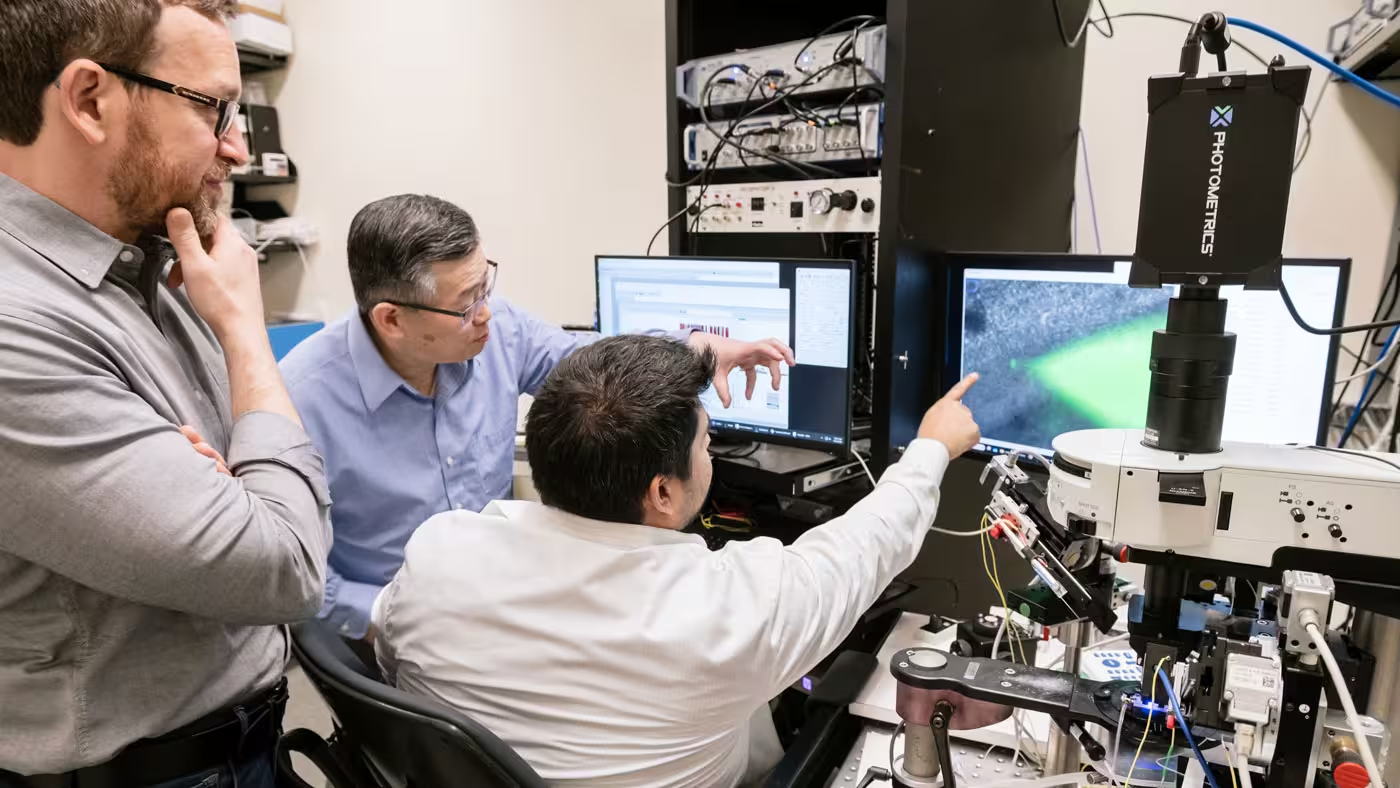
There’s an important twist. For years, scientists pointed the finger at astrocytes, the brain’s support cells, as the main source of harmful APOE4 effects. Gladstone’s team flipped that assumption. Deleting APOE4 from astrocytes did almost nothing. Remove it from neurons, and those cells grew larger and settled back into healthier firing patterns. Neuron-produced APOE4, it appears, is the one that rewires excitability.
How does Nell2 fit into the picture? Single-cell gene analyses found Nell2 unusually high in APOE4 neurons. When investigators dialed down Nell2 using CRISPRi — a reversible way to suppress gene activity without cutting DNA — the neurons in adult APOE4 mice returned toward normal size and became less excitable. Memory outcomes improved too. In short: lowering Nell2 pushed back against the neural changes that foreshadowed cognitive decline.
Lowering Nell2 reversed neuron shrinkage and hyperactivity in adult mice, suggesting a possible window to intervene after harmful processes have already begun.
This discovery has two practical consequences. First, it provides a plausible molecular link between carrying APOE4 and the early brain hyperactivity that precedes Alzheimer’s symptoms by years or decades. Second, it points to Nell2 as a druggable target. If the protein drives vulnerability, then therapies that tame Nell2 — or that block the pathway from neuron-made APOE4 to Nell2 overproduction — could delay or lower Alzheimer’s risk in genetically predisposed people.
Context matters. APOE comes in a few common variants: APOE3 is the neutral sort, while APOE4 raises Alzheimer’s odds and is enriched among patients. The Gladstone study showed that APOE3 mice exhibit similar excitability changes only later in life, hinting that APOE4 accelerates natural aging processes in neural circuits, effectively flipping the calendar forward.

The team’s use of CRISPRi is telling. It’s not gene editing in the permanent sense; it’s more like turning down a volume knob. That characteristic matters for translational prospects because it suggests modulation rather than irreversible alteration might be sufficient to restore healthier brain function.
There are caveats. Mouse models don’t perfectly mirror human biology, and many promising leads in rodents have not translated into effective human treatments. Still, the match between the regions affected in mice and those known to show early hyperactivity in human APOE4 carriers strengthens the case that this pathway is relevant beyond the lab bench.
For clinicians and researchers hunting early biomarkers and interventions, Nell2 now joins a short list of molecular candidates that could reveal risk long before dementia sets in. For people who carry APOE4, the finding is both sobering and oddly hopeful: sobering because risk begins much earlier than symptoms; hopeful because the brain’s trajectory may still be changed.

Can we catch Alzheimer’s at a stage when prevention is realistic? This work argues yes — at least in principle — and offers a concrete molecular lever to test next.

Leave a Comment
Comments (2)
Is this even true? mice studies can mislead, and targeting Nell2 sounds promising but risky. need human proof asap.
Wow, that's wild. APOE4 upping Nell2 and shrinking neurons? If true this could change early detection, but how well will it translate to humans...