

2 Minutes
Google has quietly reshuffled the Gemini deck, handing developers and enterprises three new tools that split performance, speed, and domain focus in a way that feels purposeful. Short answer: pick your tradeoff. Long answer: there’s a strategic tiering at work here.
The new lineup splits performance and price in a way that feels deliberate, not accidental.
At the center sits Gemini 3.6 Flash — what Google calls its workhorse. It’s built to be stronger on code, knowledge work, and multimodal tasks than the last generation. Think document parsing that actually understands table structure, chart and data analysis that doesn’t choke on messy inputs, and draft reports that require fewer human edits. The pitch is efficiency plus higher output quality, which matters when businesses need reliable, repeatable results rather than flashy demos.

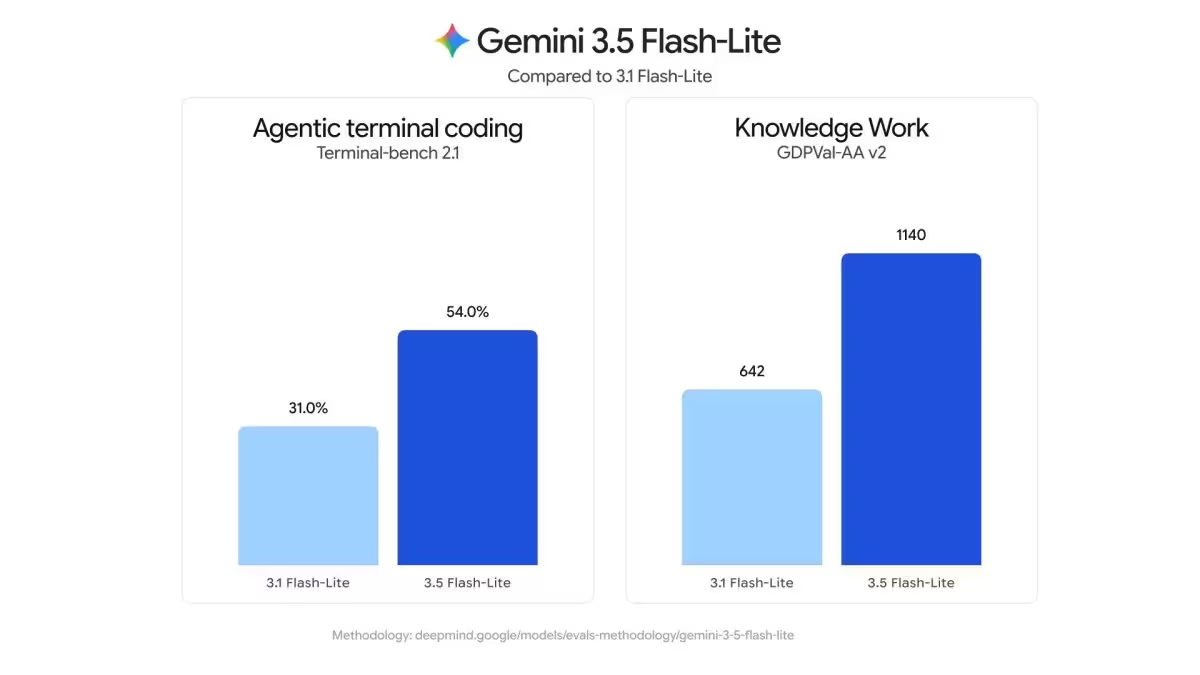
Down a rung is Gemini 3.5 Flash-Lite, optimized for speed and throughput. Low latency and high request volumes are its court. If you run agentic search systems, heavy document processing pipelines, or developer tools that must respond instantly at scale, this is the option Google is steering you toward. It’s the fastest of the 3.5 family and, according to the company, it outpaces its predecessor across multiple reasoning benchmarks.
Then there’s Gemini 3.5 Flash Cyber — a narrower, mission-driven model. Tuned for finding and patching security vulnerabilities, it aims to deliver targeted cybersecurity assistance at a lower cost per token than the larger generalist models. That makes it attractive for security teams that need automated triage and remediation suggestions without the overhead of heavyweight models.
Not everything is for everyone. The Cyber variant will first roll out in a limited-access pilot for governments and trusted partners, a reminder that some AI capabilities are still being parceled out carefully. It’s a move that underscores both the demand for specialized solutions and the caution around how and where advanced models are deployed.

What to watch now: how these models perform in live workloads, whether Flash-Lite’s latency gains translate to measurable UX improvements, and if Flash Cyber can cut time-to-fix for real-world vulnerabilities. Google is betting that splitting the product stack by purpose — workhorse, light-and-fast, and security-focused — will make Gemini more useful across industries.
Expect experimentation. Expect debate. And expect organizations to ask the same old question with renewed urgency: which tool helps me do my job better, faster, and at a sensible cost?


Leave a Comment
Comments
No comments yet. Be the first.