
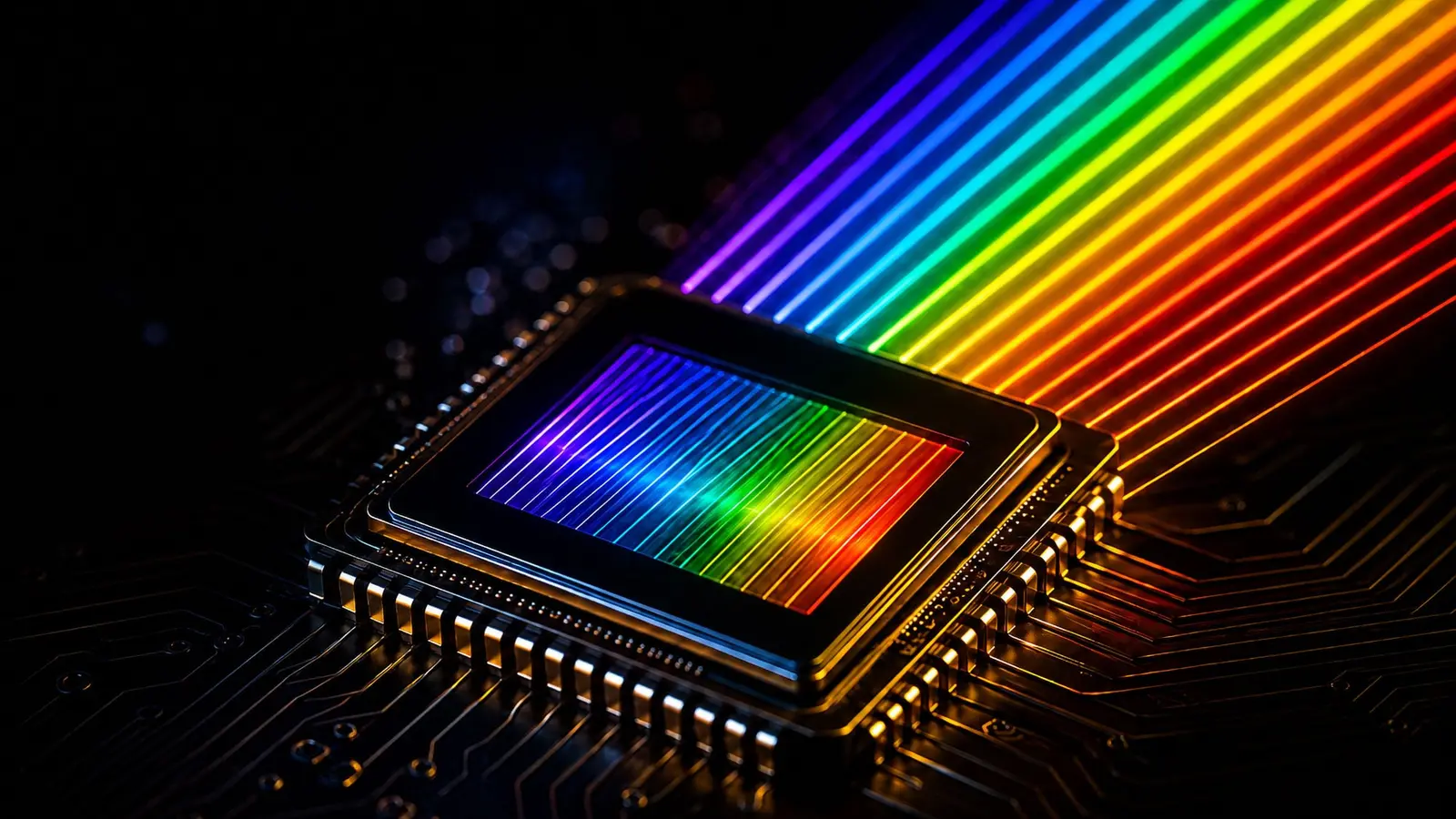
Imagine a rainbow no bigger than a grain of rice. Sounds like science fiction. It’s not.
Researchers at Loughborough University and international partners have built a microchip that produces a tightly ordered spectrum of light — a “microcomb” — and then turns those optical tones into several millimeter-wave signals at once. Why does that matter? Because millimeter waves carry far more data than the microwave bands we rely on today. More channels. More capacity. Faster pipes for tomorrow’s networks.
Traditional approaches push laser light into a tiny microresonator on a chip and hope for a clean comb of frequencies. Messy. Unstable. Hard to scale. The Loughborough team changed the recipe: they paired the chip’s microresonator with a much larger loop of optical fiber so the laser keeps cycling between the two. The loop feeds back, the comb builds up, and — crucially — the whole structure self-starts and remains robust even when bumped or vibrated.

From left to right, Dr. Luana Olivieri, Dr. Luke Peters, and Dr. Antonio Cutrona from Loughborough University’s Emergent Photonics Research Centre examine the precisely organized spectrum of light produced by their system, which can be converted into multiple high-frequency signals known as millimeter waves.
People actually jumped up and down near the rig. The microcomb barely blinked. That anecdote captures the advance: stability under real-world disturbances. Stability is the Achilles’ heel of millimeter-wave sources; you need razor-sharp frequency control for communications, radar, spectroscopy and the exacting timing required by quantum systems. This setup keeps the comb lines tightly spaced and predictable, so when an antenna translates those optical teeth into electromagnetic millimeter-wave channels, the precision survives the conversion.
There’s an extra twist. The team can dial the strength of individual comb lines — turn some notes up, others down — giving engineers control over exactly which frequencies are emphasized. Different applications ask for different recipes. Want more channels for high-capacity data links? Boost these tones. Need ultra-stable timing for quantum clocks or navigation? Keep others pristine. The point is control, paired with endurance.


Why the “rainbow” comparison? Like a rainbow, a microcomb is made up of many different frequencies of light. In a rainbow, these frequencies blend together. In a microcomb, the frequencies are separated and precisely spaced – like the teeth of a comb. The light produced by the microcomb in this study is invisible to the human eye. Illustration generated using artificial intelligence.
The work, reported in Nature Communications, is technical but straight to the point: a compact microcomb architecture that produces multiple, simultaneously stable millimeter-wave signals. Think multiple lanes on a highway instead of a single congested road. It’s not just about raw throughput. It’s about predictable lanes that other systems — from phased-array radar to spectral sensors and quantum timing devices — can rely on.
Right now the core chip is tiny — grain-of-rice tiny — but the whole experimental setup sits on a tabletop. The team says that energy use and footprint can shrink. A shoebox-sized system is feasible. Even more tantalizing: a satellite-ready form factor, where size, weight and power are at a premium. Imagine spaceborne platforms using microcomb-derived millimeter waves for high-bandwidth links or precision timing that complements atomic clocks.
Collaboration is part of the story. Loughborough’s group is working with the UK’s National Physical Laboratory and the Quantum Enabled Position, Navigation and Timing hub to benchmark the microcomb against precision clocks. Early results point toward promising timing and navigation applications — fields that could benefit from bringing atomic-clock-like accuracy into much smaller, deployable technologies.

The ‘rainbow on a chip’: a tiny microchip containing a microresonator that produces a precisely organised ‘rainbow’ of light frequencies, known as a microcomb. The chip is the size of a grain of rice, with a one euro coin pictured for scale.
There are still hurdles. Packaging, thermal control, power consumption and integration with existing RF hardware all need engineering attention. But the core physics — a self-starting, fiber-stabilized microcomb that hands off optical precision to millimeter waves — is a substantial step forward.
For engineers chasing 6G, for scientists probing materials and the cosmos, and for developers building the next generation of timing systems, this tiny rainbow is more than a neat trick. It’s a new tool. The next move is to make it disappear into the background hardware where it belongs: small, reliable, and doing the heavy lifting without fanfare.

Leave a Comment
Comments
No comments yet. Be the first.