
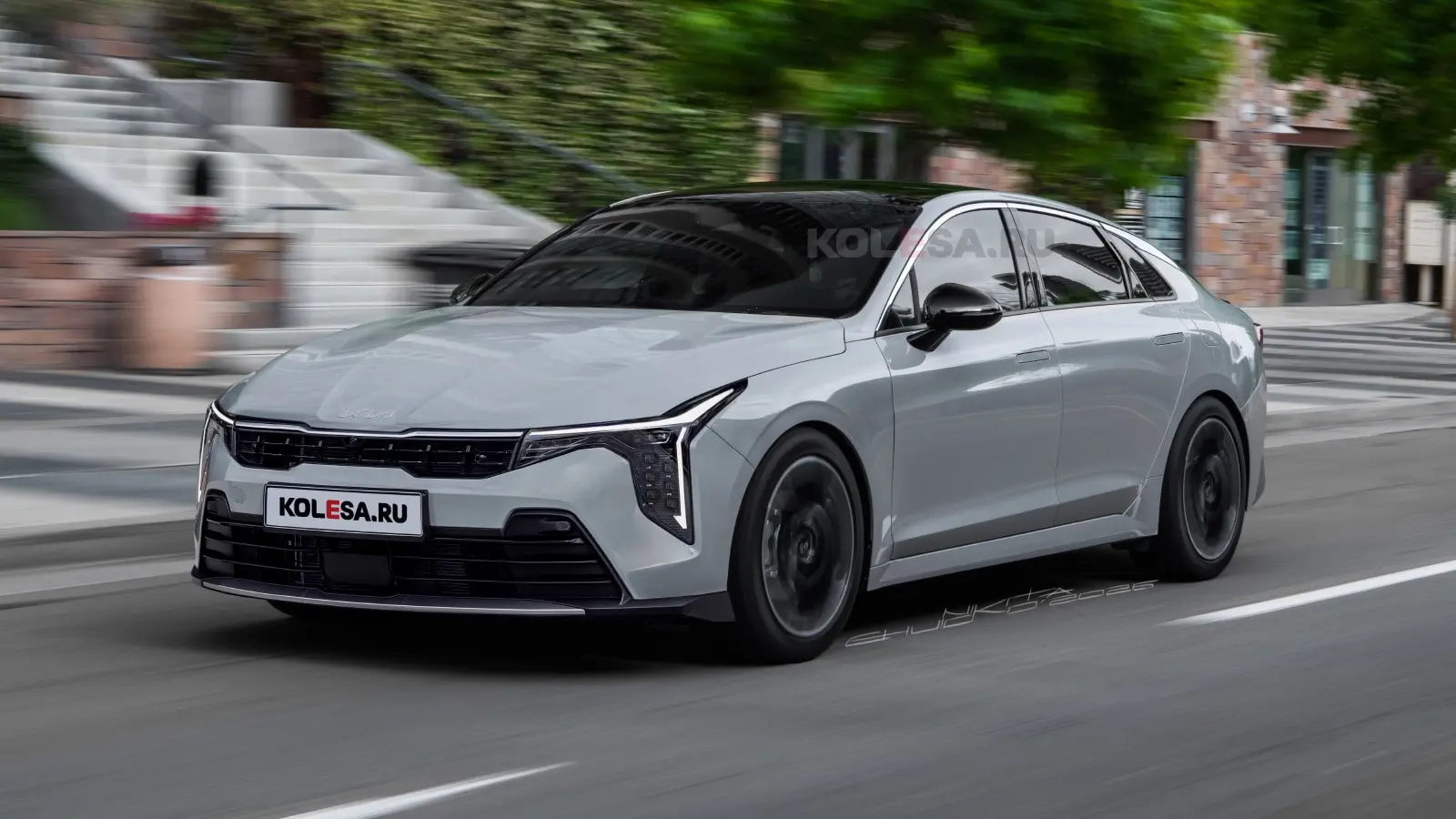

New renderings show an updated K5 but familiar underpinnings
Kia appears poised to roll out another substantial mid-cycle refresh for the K5, one that sharpens the sedan's visual identity while leaving its mechanical foundations largely unchanged. Renderings by Kolesa and designer Nikita Chuyko offer a clear preview of what to expect: a bolder exterior, revised rear styling and a modernized cabin, yet the fifth-generation K5 will likely retain the same N3 platform and many of the mechanical bits already in production.
Why another refresh instead of a full redesign?
The explanation is straightforward and rooted in market reality. Mid-size sedans no longer enjoy the demand they once did, and the economics of a ground-up redesign are hard to justify. By updating styling, interior tech and powertrain options, Kia can keep the K5 competitive while avoiding the massive cost of developing an entirely new model. In short: refresh now, rethink later.
Production and platform details
The K5 first rolled off production lines in 2019 and saw a mid-cycle update for the 2025 model year in North America. It is built in multiple locations, including West Point, Georgia, and plants in South Korea and China. Dimensions remain roughly the same: about 193.1 inches (4,905 mm) long, 73.2 inches (1,860 mm) wide and 56.9 inches (1,445 mm) tall, with a curb weight around 1.5 metric tons (approximately 3,300 pounds) depending on trim. The K5 shares the Hyundai-Kia N3 platform with models such as the K8, Sorento, Sportage, Hyundai Sonata and Santa Fe.

Exterior changes: evolutionary, not revolutionary
The new renderings highlight a refined front end dominated by a Y-shaped daytime running light signature that extends into a reworked bumper. The main headlamp clusters appear updated, while the grille keeps an evolutionary approach with a new pattern. One notable change is the bumper's three air intakes replacing the current single, wide opening.
Along the sides, expect the hood and fenders to remain largely the same, though adjustments will be needed to integrate the refreshed details. The render shows flush door handles, cleaner side skirts and larger wheels — small but impactful touches that polish the overall silhouette. Door mirrors appear carried over from the current model.
At the rear, the K5 gains slimmer, C-shaped taillights that protrude into a redesigned bumper and a new trunk lid. The diffuser treatment is more aggressive and the rendered car shows no visible tailpipe trim, suggesting either hidden exhaust outlets or an emphasis on a cleaner rear appearance. The color palette sticks to familiar tones, including a subdued gray carried over from existing options.
Interior and tech: Pleos, AI and a freed-up console
Inside is where more meaningful change is expected. The K5 is likely to adopt Hyundai Group's latest Pleos infotainment system, bringing AI features, multi-tasking capabilities and a faster, more intuitive interface. Reports suggest a redesigned steering wheel and the possibility of an electronic shifter moved to the column, which would free up center console space for storage or alternative controls.

Other interior highlights to watch for:
- New trim and upholstery options
- Upgraded driver-assistance and safety tech
- Improved human-machine interface and connectivity
These upgrades aim to keep the K5 relevant to buyers who place a premium on in-car tech and comfort.
Powertrain lineup and performance expectations
For the 2028 model year, the K5 is expected to introduce Hyundai's TMED-II hybrid technology paired with a 1.6-liter gasoline engine. Early figures suggest output near 240 horsepower and roughly 280 lb-ft (380 Nm) of torque, with power likely routed to the front wheels via a six-speed automatic. eAWD is expected to be offered as an option.
North America is also likely to retain the 2.5-liter options: a 290-hp, 311 lb-ft (422 Nm) variant currently found in the range-topping GT, plus a detuned 2.5 that produces 186 hp and 178 lb-ft (241 Nm) in the GT-Line and LXS trims. Most of these pair with eight-speed automatic transmissions.
Specs summary
- Platform: Hyundai-Kia N3
- Length: ~193.1 in (4,905 mm)
- Width: ~73.2 in (1,860 mm)
- Height: ~56.9 in (1,445 mm)
- Weight: ~1.5 metric tons (approx. 3,300 lb)
- Engines: 1.6L hybrid (TMED-II), 2.5L naturally aspirated/turbo
- Transmissions: 6-, 7- and 8-speed automatics; optional eAWD
Market positioning and pricing
The refreshed 2028 K5 will continue to compete with the Hyundai Sonata, Honda Accord and Toyota Camry. Pricing is expected to move modestly higher, reflecting added tech and updated styling. Current 2027 MSRPs in the U.S. sit at $27,690 for the LXS, $28,690 for the GT-Line and $33,790 for the GT. A price bump across the range would not be a surprise.
Final thoughts: smart evolution or missed opportunity?
The decision to refresh rather than redesign the K5 is pragmatic. It lets Kia stretch the value of a proven product while dialing in design and tech upgrades that matter to buyers. For enthusiasts who hoped for a ground-up new generation, the news may disappoint. But for most buyers, the 2028 K5 should feel noticeably fresher and more modern without straying from the strengths that made the current model competitive.
Quote to consider:
- 'A facelift keeps the K5 relevant while Kia prepares for a more ambitious next step when market demand justifies it.'
Will another mid-cycle refresh be enough to keep the K5 competitive in a sedan market that is steadily shrinking? The answer will depend on how well Kia balances pricing, tech and driving dynamics. Based on the renderings, the next K5 looks sharper and smarter — even if its bones remain familiar. Share your thoughts: do you prefer a full redesign or a polished refresh for the K5?

Discussion
Leave a Comment
Comments
No comments yet. Be the first.