

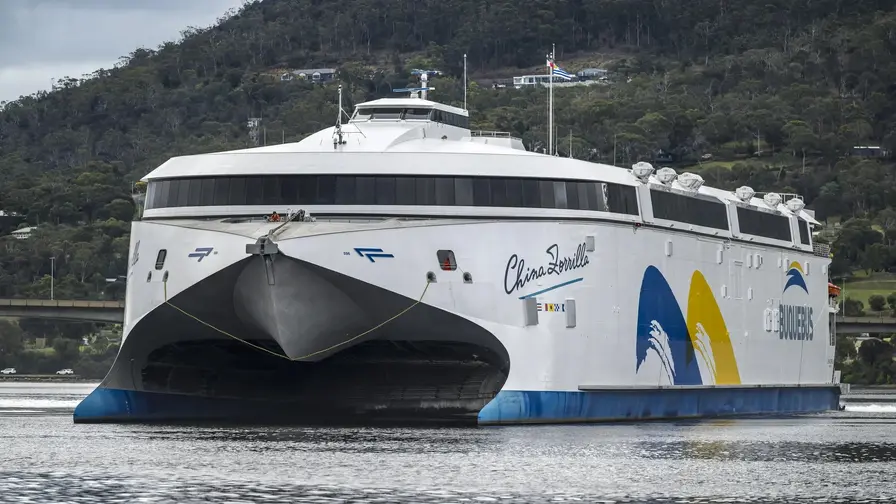
Incat Tasmania's Hull 096, now christened China Zorrilla, has entered commercial service as an all-electric ferry powered by 250 tons of batteries with a combined capacity of 40 megawatts. The vessel completed its maiden commercial crossing on the River Plate between Buenos Aires, Argentina, and Colonia, Uruguay, and the manufacturer and operator describe the trip as the start of a new phase in maritime transport.

Specifications and service profile
The 427-foot (130 meters) China Zorrilla is configured to carry up to 2,100 passengers and 225 vehicles. Propulsion comes from eight Wartsila waterjets, which are high-thrust marine drives that draw water in and expel it to produce forward motion; the arrangement gives the ship a quoted top speed of 29 mph (46 kph). Onboard passenger amenities include a duty-free retail area covering about 25,000 square feet (2,300 square meters).

Incat reports the vessel's battery mass at approximately 250 tons and its installed electrical capacity at 40 megawatts, a battery installation the company says equals the capacity of roughly 487 Tesla cars and is four times larger than any previous maritime battery fit-out. The manufacturer and operator present the China Zorrilla as the largest electric vehicle of any kind on the planet based on those figures.

Range, charging and programmatic context
The ferry's maximum single-charge range is stated as 115 miles (185 km). It was reported that the ship requires charging after each crossing, with up to four crossings planned per day; however, Buquebus has not published details on charging duration or the number of passengers and vehicles carried on the inaugural trip. The project was originally intended to use a liquefied natural gas powertrain, but the design changed to an all-electric configuration during development.

Incat describes Hull 096 as one of the most ambitious and technically complex projects it has undertaken. The Hobart yard has additional electric and hybrid work under construction, including three battery-electric ferries for Danish operator Molslinjen that are marginally smaller than China Zorrilla, plus two hybrid-electric vessels about half the size.
The deployment of China Zorrilla marks a notable scale-up in maritime battery installations, but manufacturer statements and operating details such as charging times and commercial loadings remain the primary public sources for now.

Leave a Comment
Comments
No comments yet. Be the first.