

Tom Lee flags risk of Ethereum selloff after KOSPI collapse
Fundstrat co founder Tom Lee raised a warning that South Korea's dramatic equity selloff could spill into cryptocurrency markets and place renewed downward pressure on Ethereum. The caution followed a sharp intraday collapse in the KOSPI index on October 13, 2026, when the benchmark plunged more than 6% and emergency market controls were triggered. Lee highlighted the role of margin liquidations at brokerages and high retail participation in crypto as channels that could transmit losses from Korean stocks into ETH and other digital assets.
Summary of the market move and immediate implications
- South Korea's KOSPI fell over 6% intraday, triggering program trading suspensions and sell side controls.
- Tom Lee warned that forced sales by leveraged investors might create selling pressure in crypto through liquidations and asset conversions.
- Ethereum was trading near the mid 2,500s after a week that showed a 6% pullback, with immediate technical support and resistance levels under scrutiny.
- Institutional treasuries continue to accumulate ETH, with BitMine reporting a fresh purchase that brings its holdings close to a 5% supply target.
What happened on South Korea's markets
Korean markets opened sharply lower and extended losses through the morning session. Program trading was paused for five minutes when KOSPI 200 futures fell past a 5% threshold, and the exchange implemented sell side sidecars to slow order flow after the index lost momentum. Major technology and semiconductor names led the decline. Samsung Electronics and SK Hynix each logged losses approaching or exceeding 8%, pressured in part by weakness in U.S. tech shares and fresh concerns about memory chip competition and the outlook for AI infrastructure demand.
Market structure in South Korea allows brokerages to liquidate customer positions that fail to meet margin requirements. In a severe market drop, that mechanism can force investors to raise cash quickly, sometimes by selling other assets held outside the local equity market. Lee's concern is that cryptocurrency portfolios, where Korean retail participation is significant, may be an obvious source of liquidity for investors hit with margin calls.
Margin loans and leverage: a known vulnerability
South Korea's leveraged investing landscape has shown elevated margin loan balances in prior months. Reports from mid 2026 cited margin loan balances near 38.63 trillion won in June, while total investor debt exceeded 60 trillion won in May. Those figures describe the scale of leverage earlier in the year and underline why a sharp equity drawdown could prompt forced selling. Lee emphasized this channel as a plausible contagion route but did not provide evidence that margin liquidations had already caused large, measurable ETH sales tied directly to the October 13 session.
How this could affect Ethereum and crypto markets

Liquidations and forced selling can create short term liquidity squeezes across asset classes. If leveraged Korean investors must raise cash fast, selling pressure could show up in spot crypto markets, derivatives liquidations, or exchanges where retail traders are most active. Lee described the likely outcome for Ethereum as short term pain, stopping short of a specific price forecast or a quantified estimate of crypto liquidations.
Past episodes have shown correlations between Asian equity weakness and heightened crypto volatility, but historical coincidence is not proof of causation. Market participants will watch order books, exchange liquidation feeds, and on chain flows to judge whether equity losses are translating into meaningful ETH outflows or margin events.
Market reaction and immediate price action for ETH
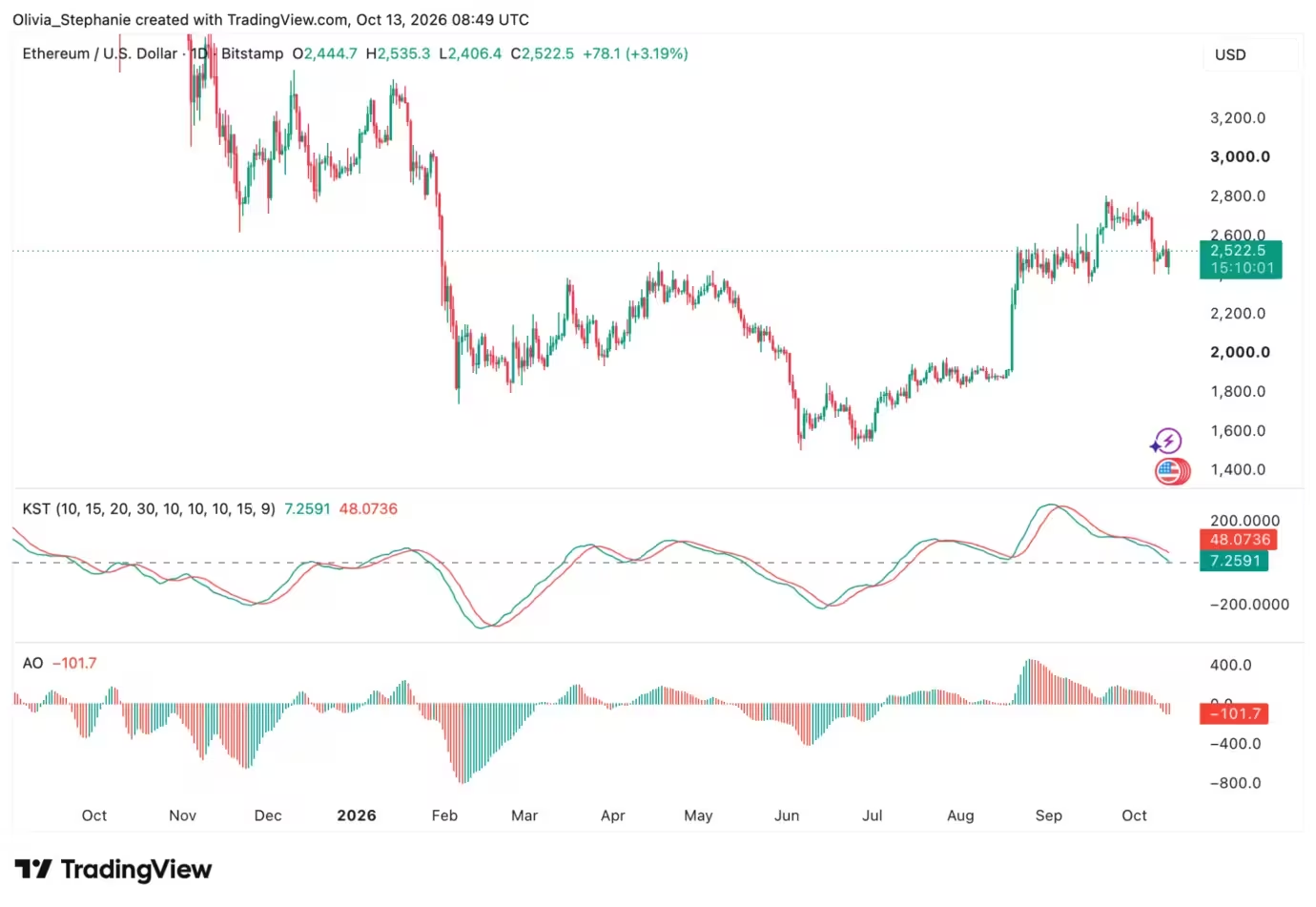
Ethereum traded near $2,530 in the wake of the Korean selloff, with 24 hour ranges showing intraday swings between the low 2,400s and the mid 2,500s. Seven day performance reflected a larger pullback of about 6%, while daily trading volume remained elevated, indicating active market participation and rotation.
Technically, short term support was identified in the $2,400 to $2,450 band, with a deeper buffer around $2,200. Resistance sits at $2,550 and $2,600, and reclaiming those levels would be necessary to restore a more constructive recovery bias. Analysts in crypto markets pointed to $2,550 as an immediate area to watch and cautioned that a confirmed breakout above $2,600 would be required to shift momentum back toward the late September trading range near $2,750 to $2,800.
Ethereum had previously rebounded from June lows near $1,550 but remained beneath the late September highs, leaving room for volatility around key technical thresholds. Traders will also monitor daily volumes, derivatives funding rates, and on chain metrics such as exchange net flows and realized volatility to evaluate the persistence of selling pressure.
Technical indicators suggest weakened buying momentum
On daily charts, momentum indicators that had supported earlier recovery attempts showed signs of exhaustion. One momentum oscillator illustrated a decline in short term upside momentum versus its prior signal line, while another popular indicator printed negative readings, signaling weaker short term momentum compared with longer trend measures. These technical cues corroborate the observation that the recent bounce may lack the breadth to withstand a renewed bout of selling tied to macro or equity shocks.

Ethereum (ETH) price chart
The immediate implication is clear: a sustained move beyond $2,600 would improve Ethereum's recovery prospects and reintroduce the $2,750 to $2,800 region as the next meaningful resistance zone. Conversely, losing the $2,400 support zone could expose ETH to a retest of lower support near $2,200, increasing downside risk for traders and leveraged positions.
Analyst views and the multi year range debate
Market analysts remain split on the near term trajectory. Some highlight that ETH has traded in a sideways multi year range and that a decisive breakout above long term resistance could trigger a substantial rally. Others caution that structural macro risks, leveraged positions, and the potential for forced selling in correlated markets mean volatility could persist before a durable trend emerges.
Neither view offers a guaranteed outcome, and the balance of probabilities will shift as data arrives from exchanges, brokerages, and macro markets.
Institutional accumulation and BitMine's strategy
Against the backdrop of potential short term pressure, Ethereum treasury accumulation continues at scale. BitMine Immersion Technologies reported acquiring an additional 12,532 ETH in the week ending October 11, increasing its reported holdings to 6,028,946 ETH, roughly 4.9% of a 122.1 million token reference supply. The company said it was about 99% of the way to its stated goal of owning 5% of Ethereum's supply and characterized its treasury plan as focused on accumulation and staking to earn rewards.

Using the company's reference price near $2,544 per ETH, BitMine's ETH allocation corresponds to a multi billion dollar position, and the firm disclosed combined assets including crypto, cash, and marketable securities of approximately $16.2 billion as of October 11. Management indicated that its buying pace would likely slow as it nears the 5% supply threshold, though it did not rule out additional purchases in the future.
BitMine also reported that roughly 5.07 million ETH was staked as part of its operations, reflecting a treasury approach that blends accumulation with yield generation via staking. Large corporate treasuries and balance sheet holders can be stabilizing forces when they buy consistently, but slowing or paused accumulation could modestly reduce a demand tailwind that has supported Ethereum in prior months.
What traders and investors should monitor next
Key variables to watch in the coming sessions include:
- Exchange and on chain flows tied to South Korean entities, if available, to detect cross market selling.
- Derivatives liquidation feeds and open interest movements, which can accelerate price moves when leverage is squeezed.
- ETH spot volumes and bid/ask depth around $2,400 to $2,600, which will show how resilient support levels are.
- Macro headlines and U.S. tech sector performance, given the correlation between chip sector weakness and the Korean equity move.
- Large treasury moves or corporate disclosures affecting institutional ETH demand, such as additional BitMine filings.
Market participants should treat Lee's warning as a risk signal rather than a confirmation of contagion. He articulated a plausible mechanism — margin calls forcing asset sales — but did not cite specific on chain or exchange evidence linking Korean brokerage liquidations to immediate ETH outflows. The possibility of contagion is real, particularly given South Korea's high retail involvement in digital assets, so vigilance is warranted.
Bottom line
Tom Lee's caution underscores a broader truth for crypto investors: cross market linkages matter. Sharp equity drops, especially in regions with high retail leverage, can translate into episodic crypto volatility through forced liquidations and rapid reallocation of investor portfolios. Ethereum's near term path will depend on whether selling pressure proves transient and contained or whether it feeds through into sustained reductions in risk appetite. Traders should watch support at $2,400 and resistance near $2,600 closely, track liquidity metrics and liquidation data, and remain prepared for heightened volatility as markets digest ongoing developments in South Korea and beyond.


Leave a Comment
Comments (1)
Is this even true? Lee's mechanism sounds plausible but where's the on-chain proof, exchange flows? could be panic, or just noise. curious