
5 Minutes
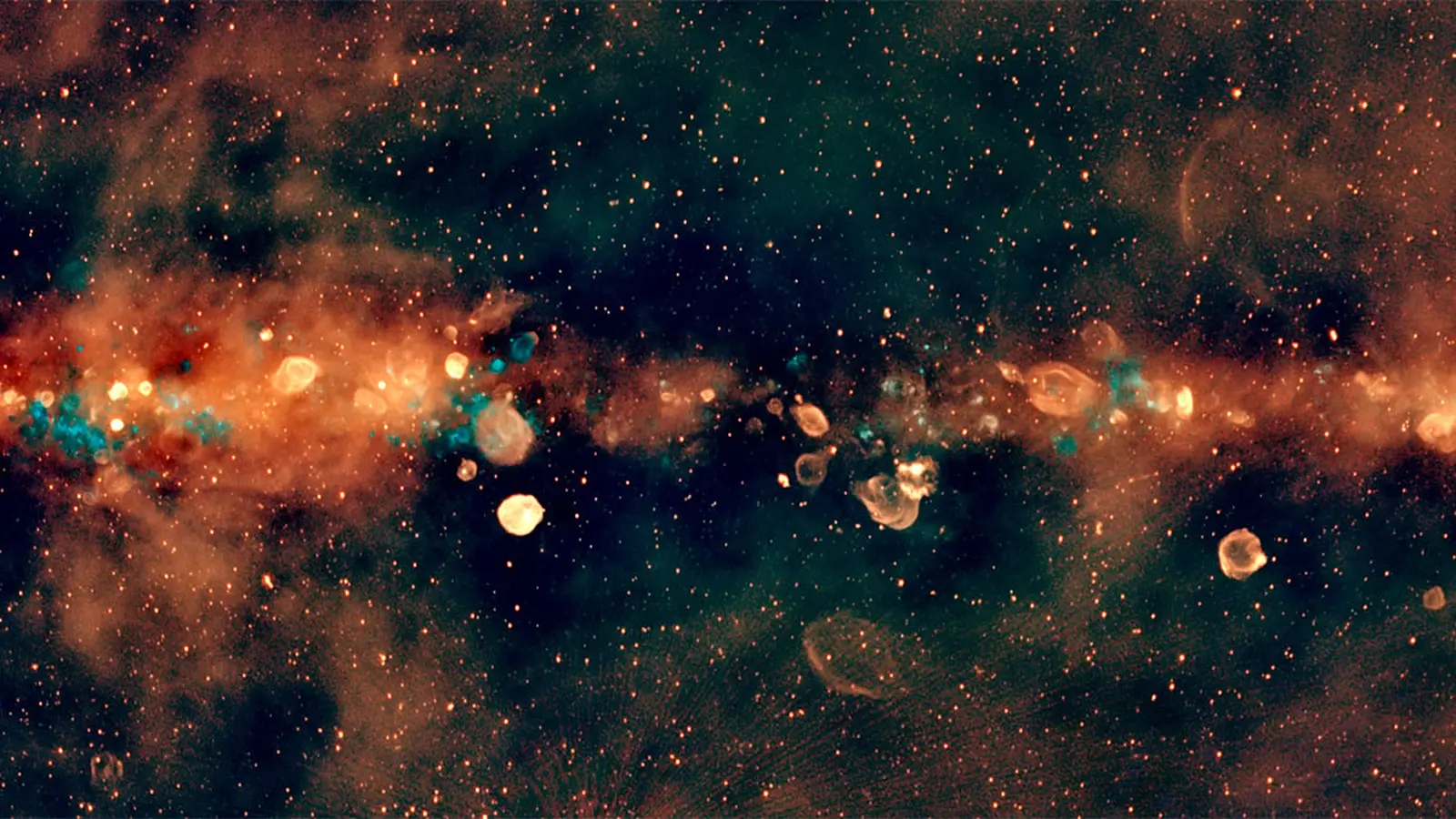
Astronomers have stitched together the most sensitive, wide-area low-frequency radio image of our galaxy to date, revealing the Milky Way's plane in unprecedented ‘‘radio colour.’’ The map combines years of observations to show where magnetic fields, hot gas and the ghosts of past star explosions glow across the sky — and it opens new paths for studying the galaxy's evolution.
How a giant radio mosaic was built
Creating a single, coherent portrait of the Milky Way at low radio frequencies required two complementary surveys run with the Murchison Widefield Array (MWA) in Western Australia. Between 2013 and 2015, the original GLEAM survey scanned the southern sky across a broad set of low frequencies, producing the first ‘‘radio colour’’ view of the sky. After an upgrade in 2018 the enhanced GLEAM-X program delivered much higher resolution and sensitivity, picking up fine details the original survey missed.
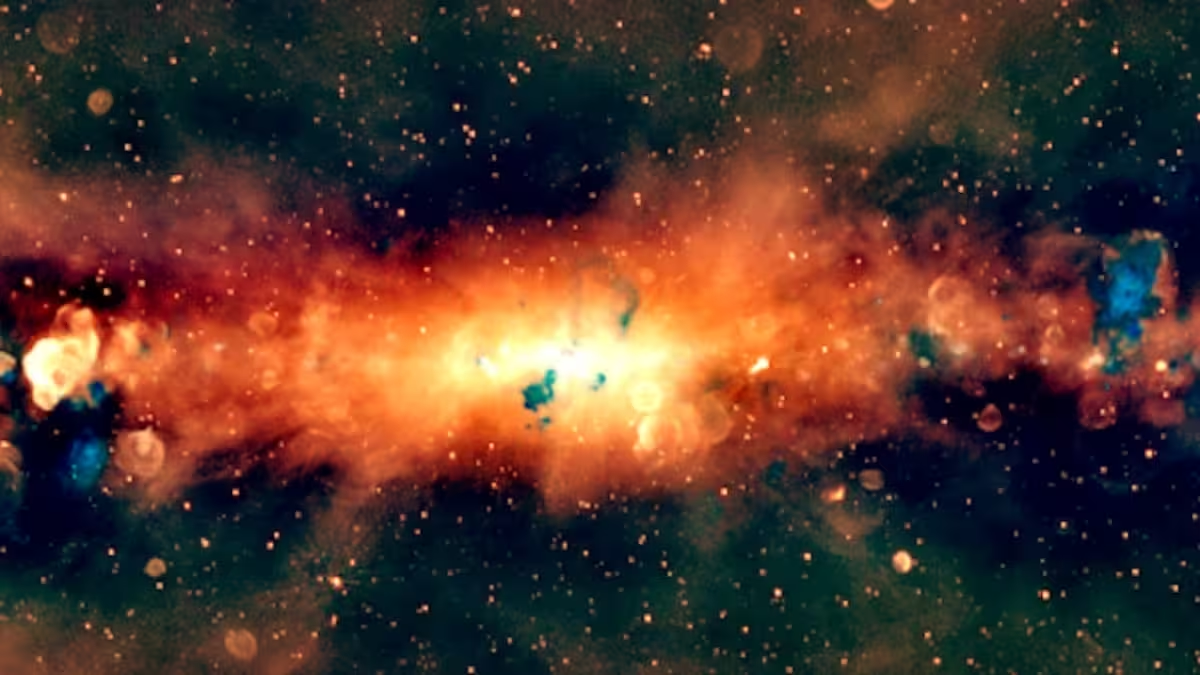
The Milky Way's galactic plane in radio light
To combine the strengths of both projects — GLEAM's wide coverage and GLEAM-X's fine detail — researchers used a new processing method called image domain gridding. This approach aligns and stacks thousands of individual observations into one huge mosaic. Because the array observed at different times, the team had to correct for ionospheric distortions (small shifts in signal paths caused by Earth’s upper atmosphere) to avoid misplacing sources between nights.
Those corrections and the mosaicking demanded enormous computing power. The team ran more than one million processing hours on Pawsey Supercomputing Centre systems to produce a continuous image that spans 95% of the Milky Way visible from the southern hemisphere and covers frequencies from 72 to 231 MHz.
What the colours mean — reading the galaxy in radio light
The map encodes frequency as colour: the lowest frequencies appear orange, middle bands green, and the highest low-frequency bands blue. This ‘‘radio colour’’ makes it easy to distinguish different physical processes at a glance. Wide, orange-glowing structures typically trace synchrotron emission — charged particles spiralling in magnetic fields — which is often the signature of old, fading supernova remnants. Blue areas highlight higher-frequency emission from hot ionised gas, marking active star-forming regions and young stellar nurseries.
Because the mosaic spans a broad frequency range, astronomers can separate thermal emission (from hot gas) and non-thermal emission (from cosmic rays and magnetic fields) more reliably than with a single-frequency map. That separation is crucial for building physical models of the interstellar medium, measuring magnetic field structure, and finding faint, old supernova remnants that have been invisible to previous surveys.
Science unlocked by the new map

The mosaic is already a trove for galactic science. Researchers can now:
- Identify faint and ancient supernova remnants that reveal the history of star deaths in the Milky Way.
- Trace the distribution and energy of cosmic rays as they move through the galactic disk.
- Map magnetic field patterns across large swathes of the plane, improving our understanding of magnetised turbulence.
- Study the interplay between dust, gas and energetic particles in star-forming regions.
In short, the mosaic provides an observational foundation for many follow-up studies — from targeted deep observations of odd features to statistical population studies across the whole plane.
From MWA to SKA-Low: what comes next
Although the new GLEAM+GLEAM-X mosaic is the most sensitive map at these low frequencies today, a much bigger leap is coming. The Square Kilometre Array’s low-frequency component, SKA-Low, will be thousands of times more sensitive and deliver much higher resolution than the MWA once fully operational. Until SKA-Low arrives, this mosaic stands as a preview of the faint, diffuse, and intricate structures that future instruments will study in far greater detail.
Expert Insight
“This map is a milestone,” says Dr. Elena Torres, a radio astronomer not on the original team. “Combining such wide-area coverage with multi-frequency colour information changes how we prioritise follow-up studies. With this dataset we can pick out subtle features — the dying embers of supernovae or unexpected filaments of magnetic fields — and ask new questions about the Milky Way’s life cycle.”
Beyond pure discovery, the mosaic also refines techniques for handling ionospheric effects, calibration and massive image combination — methods that will be essential for SKA-era data processing. In other words, scientists not only gained a map, they also sharpened the tools needed for the next generation of radio astronomy.
Technical context and public access
The mosaic covers 72–231 MHz and integrates data from 4,096 MWA antennas spread across several square kilometres. The image domain gridding technique and careful ionospheric alignment allowed seamless stacking of observations taken across multiple years. The final products are being released to the community, enabling astronomers worldwide to mine the data for specific objects and statistical surveys alike.
For now, this radio mosaic is a powerful new way to ‘‘see’’ our galaxy — not with visible starlight, but in the glow of electrons, magnetic fields and the remnants of stellar explosions. It’s an invitation to explore familiar constellations in an entirely different light.













Leave a Comment
Comments (2)
Interesting but… how solid are the ionospheric fixes across nights? Stacking years sounds neat, but could subtle shifts fake features? idk, curious.
Woah, the colours are wild! Never thought the Milky Way would look like this in radio, so many ghostly filaments, and that million CPU hours… insane