

A short, targeted course of mental exercises appears to leave a surprisingly long shadow on brain health. In a large, long-running trial funded by the U.S. National Institutes of Health, older adults who completed a specific kind of cognitive workout—called speed-of-processing training—were substantially less likely to develop dementia two decades later.
Study design and the surprising longevity of benefit
The trial, known as ACTIVE, enrolled more than 2,800 volunteers aged 65 and older and compared three different cognitive-training approaches: memory, reasoning and speed of processing. Participants received an initial five to six weeks of training tailored to each approach. Some also returned for brief “booster” sessions during the first and third years. When researchers checked health outcomes roughly 20 years after the intervention, only the group that had practiced speed-of-processing tasks showed a marked reduction in dementia diagnoses.
How large was the effect? Among those who completed the initial training and the early booster sessions, the incidence of dementia was about 25 percent lower than in the control group that received no training. This was not a fleeting improvement in a laboratory test; it was a durable reduction in clinically diagnosed cognitive decline two decades on.
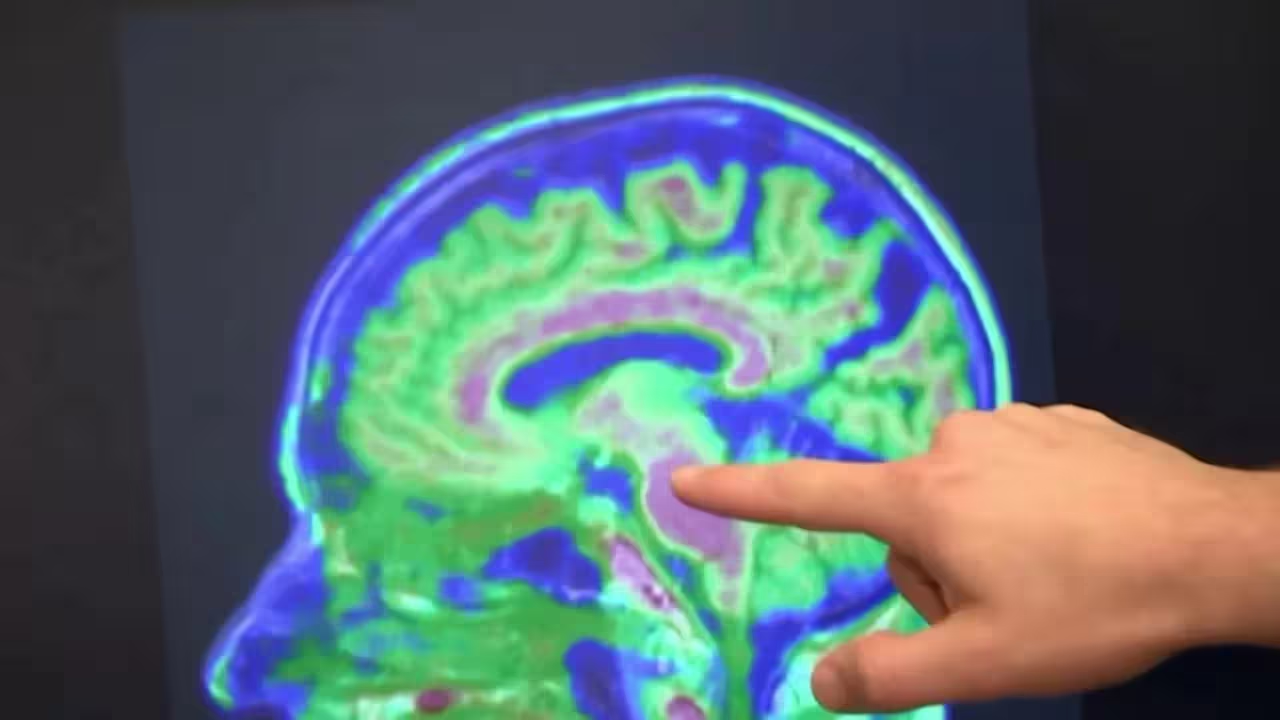
What is speed-of-processing training?
It isn’t memory drills or crossword puzzles. Speed-of-processing exercises are typically computerized visual tasks that force the brain to identify brief, subtle cues on a screen and to divide attention across multiple items. Think of it as reaction-work for perception: the software presents fleeting targets, increases difficulty when a person performs well, and eases up when performance slips. The adaptive nature of the training—keeping each user at a challenging but achievable level—appears central to its impact.
Researchers propose two mechanisms. First, the training taps implicit learning: skills that become automatic and durable in ways different from memorizing lists or facts. Second, adaptive tasks drive sustained engagement of brain networks involved in attention and visual processing, strengthening neural connections through experience-driven plasticity.
As Dr. Marilyn Albert of Johns Hopkins, director of the university’s Alzheimer’s research center, put it in commentary on the findings: “That a brief, non-drug intervention can have protective effects lasting up to two decades is remarkable. Even a small delay in the onset of dementia translates into meaningful public-health benefits and lower costs for care.”
Context, caveats and practical implications
These results do not spell a cure. Lifestyle factors remain foundational: blood pressure control, healthy glucose levels, regular exercise and good sleep continue to be the cornerstones of brain health. Still, adding speed-of-processing exercises to a prevention toolkit could be a practical, low-risk strategy for older adults.
There are further questions to answer. Which platforms or specific tasks deliver the best transfer to daily function? How much training or which booster schedule is optimal? And how do these exercises interact with other interventions, like physical activity or vascular risk management? Future trials and replication work will help refine recommendations.
For clinicians and caregivers, the takeaway is straightforward: cognitive training matters, and not all training is equal. Exercises that demand fast, adaptive visual attention seem to fortify neural systems in a way that memory-only drills do not. That distinction could change how we design preventive programs for aging populations—and how individuals choose cognitive activities to protect their minds over the long run.


Leave a Comment
Comments
No comments yet. Be the first.