
6 Minutes
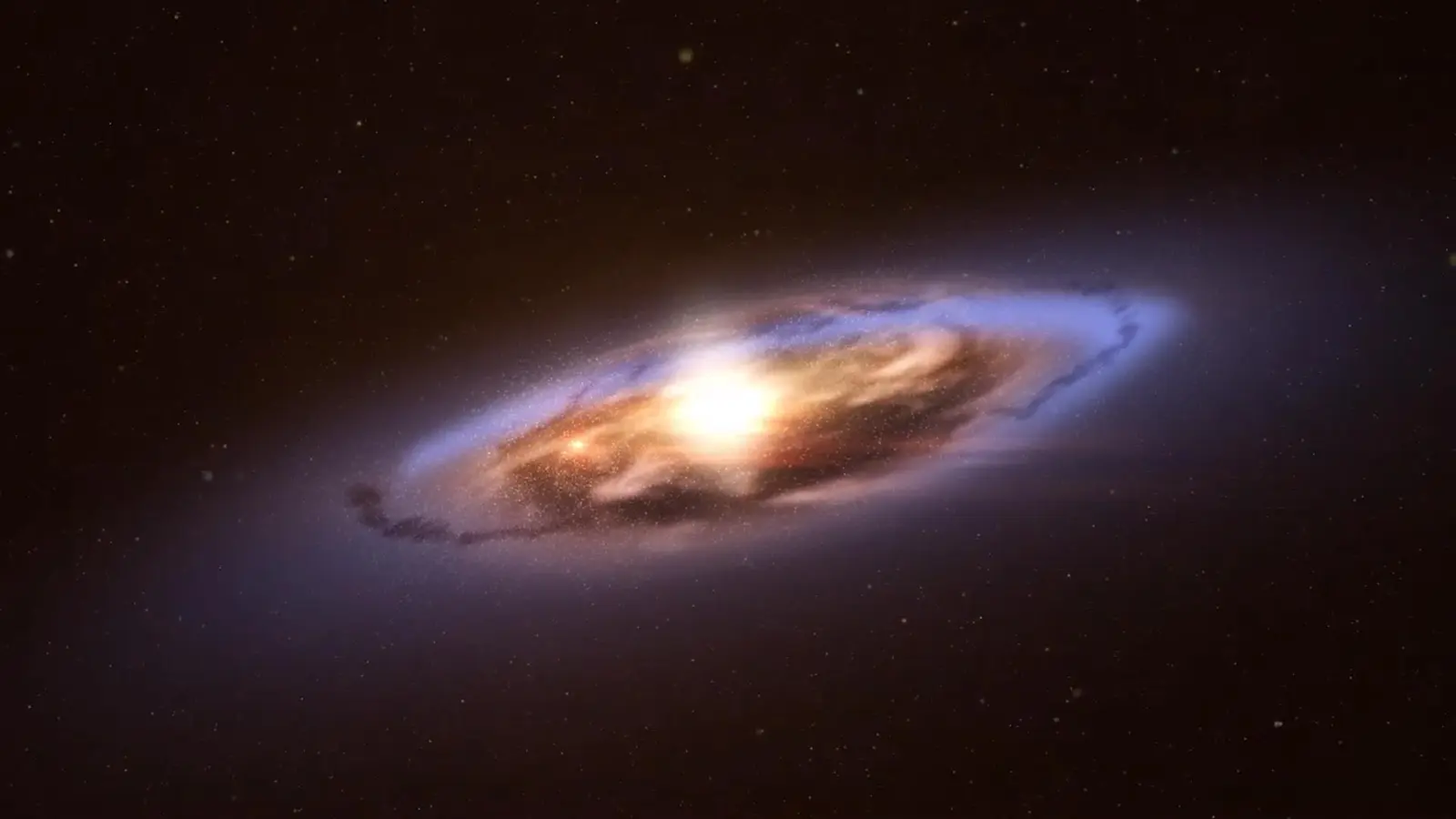
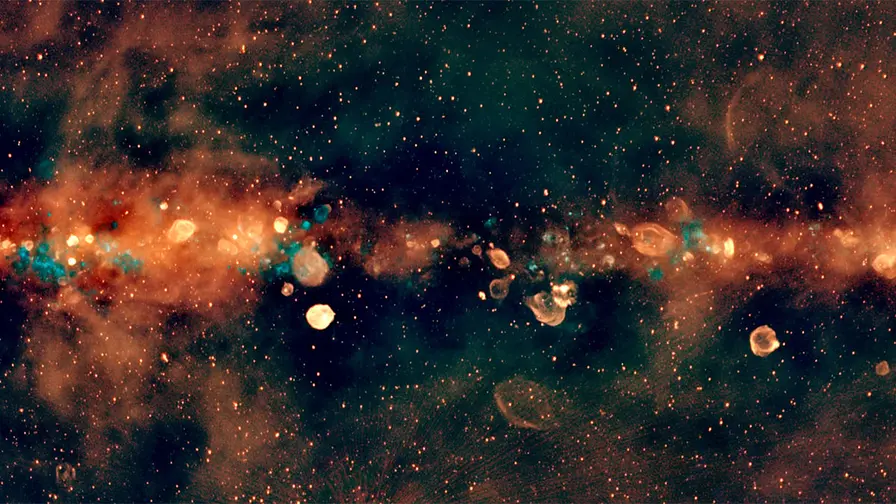
The Milky Way has a hidden architecture—one written in magnetism rather than stone. New radio observations are turning that invisible scaffolding into a high-resolution map, and the picture is messier, richer, and far more informative than astronomers expected.
Mapping the invisible: how DRAGONS sees magnetic threads
Magnetic fields do not glow. They leave traces. One of the most powerful tracers is Faraday rotation: polarized radio waves twist as they pass through magnetized plasma, carrying a record of field strength and direction. If you observe that twisting across many radio frequencies, you can tease apart overlapping structures along the same line of sight and begin to reconstruct a three-dimensional picture of the field.
This is the premise behind the Dominion Radio Astrophysical Observatory GMIMS of the northern sky, nicknamed DRAGONS. Using the DRAO 15-metre radio telescope near Penticton, British Columbia, an international team led by researchers at UBC Okanagan assembled the first broadband, all-northern-sky Faraday rotation map. The 15-m dish, originally built as a prototype for the Square Kilometre Array, can sweep the sky rapidly, producing a dataset that reveals polarized emission across a wide frequency range—precisely what you need to separate complex magnetic features.
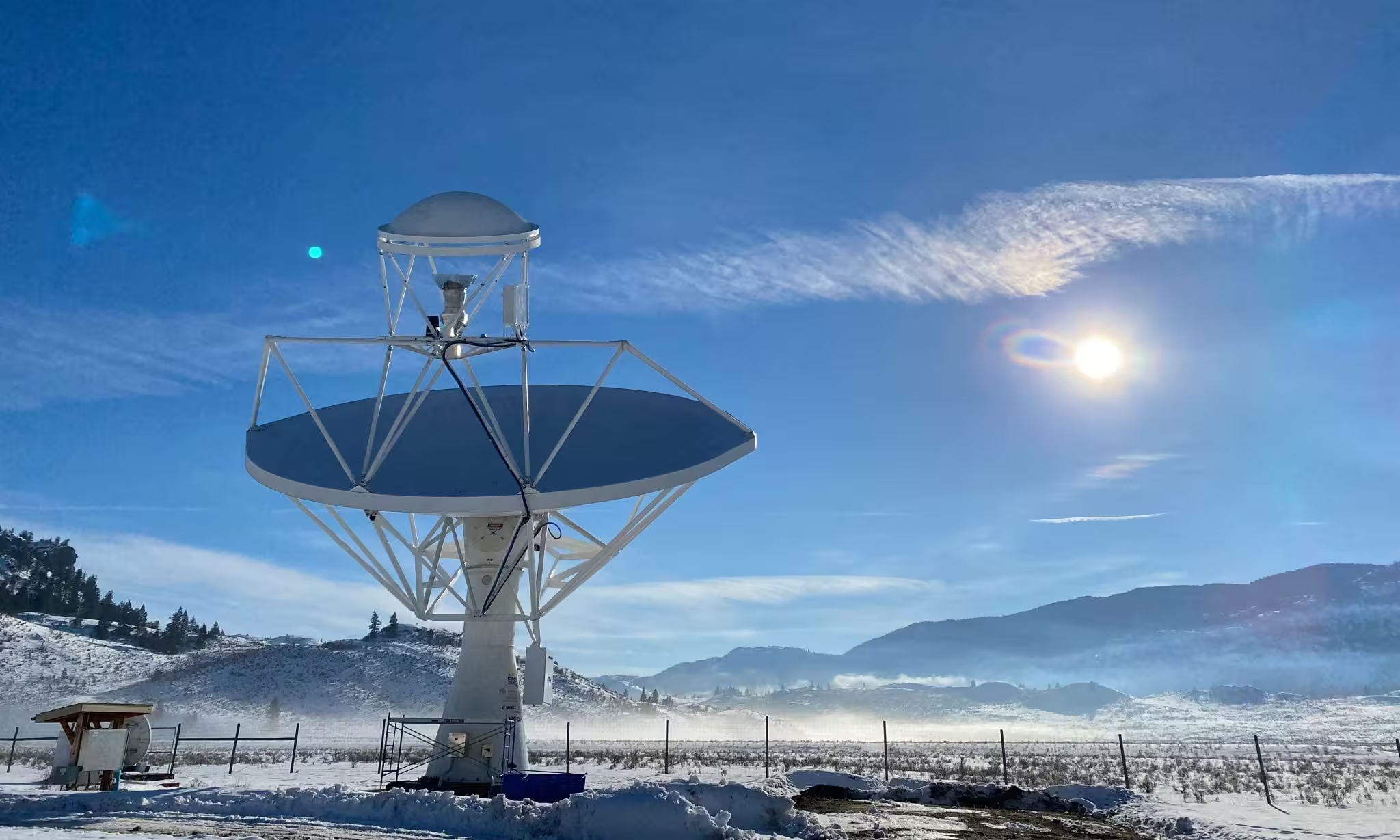
The DRAO 15m telescope at work scanning the sky for the DRAGONS survey. The data collected by this survey is a new generation of radio surveys that allow scientists to continue mapping the Milky Way and its three-dimensional magnetic field structure.
DRAGONS is embedded in the larger Global Magneto-Ionic Medium Survey (GMIMS), an effort launched to map the magnetized interstellar medium across both hemispheres. The northern component, driven by scientists including Dr. Anna Ordog, Dr. Alex Hill, and Tom Landecker, exploited broadband receivers and careful calibration to deliver sensitivity to structures that narrower surveys either blurred together or missed entirely.
What the map reveals and why it matters

The headline finding is straightforward: the Milky Way’s magnetic field is more often complicated than simple. More than half of the northern sky covered by DRAGONS shows what astronomers call “Faraday complexity”—multiple magnetized regions along a single sightline that produce a layered, twisting signal. In plain terms, the galaxy’s magnetic landscape is full of folds, reversals, and localized features tied to physical structures such as spiral arms, supernova bubbles, and interacting gas flows.
Why does that matter? Magnetic fields influence how gas collapses to form stars, how cosmic rays propagate, and how energy and momentum move through the interstellar medium. A coarse, averaged magnetic measurement can hide key physics. The DRAGONS map exposes the filamentary and tangled nature of these fields, supplying constraints that theory and simulations have lacked.
Particularly intriguing is evidence for large-scale reversals—regions where the direction of the magnetic field flips across kiloparsec scales. New analyses of the DRAGONS data, including work by University of Calgary doctoral student Rebecca Booth, show that such reversals persist when viewed in broadband Faraday space, strengthening the case that they are genuine galactic features, not artifacts of limited observations.
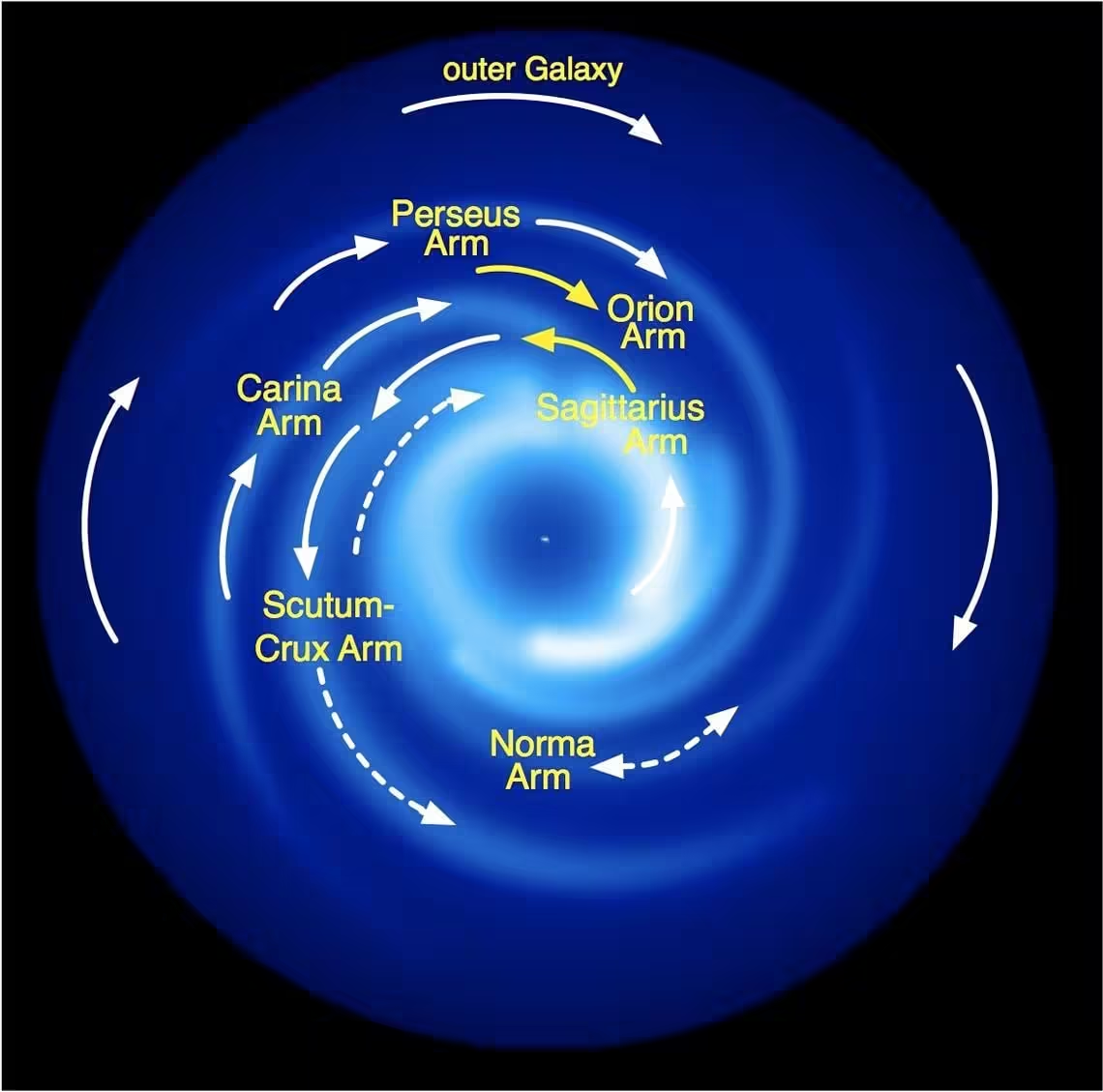
Diagram of the Milky Way galaxy, showing the reversed magnetic field from the Sagittarius Arm.
The survey also demonstrates how magnetic fields thread and interact with structures produced by stellar feedback. Supernova explosions carve bubbles into the interstellar gas; the DRAGONS data show how magnetic lines bend around and connect these cavities, hinting at a dynamic interplay between explosive events and the global magnetic geometry.
For researchers, the dataset is both a tool and a challenge. It opens questions about the origin and maintenance of galactic magnetic fields: are the complex patterns relics of past activity, signatures of a dynamo process sustained by galactic rotation and turbulence, or a mixture of both? With the new map, modelers can compare synthetic Faraday spectra from simulations directly with observations, tightening the loop between theory and measurement.
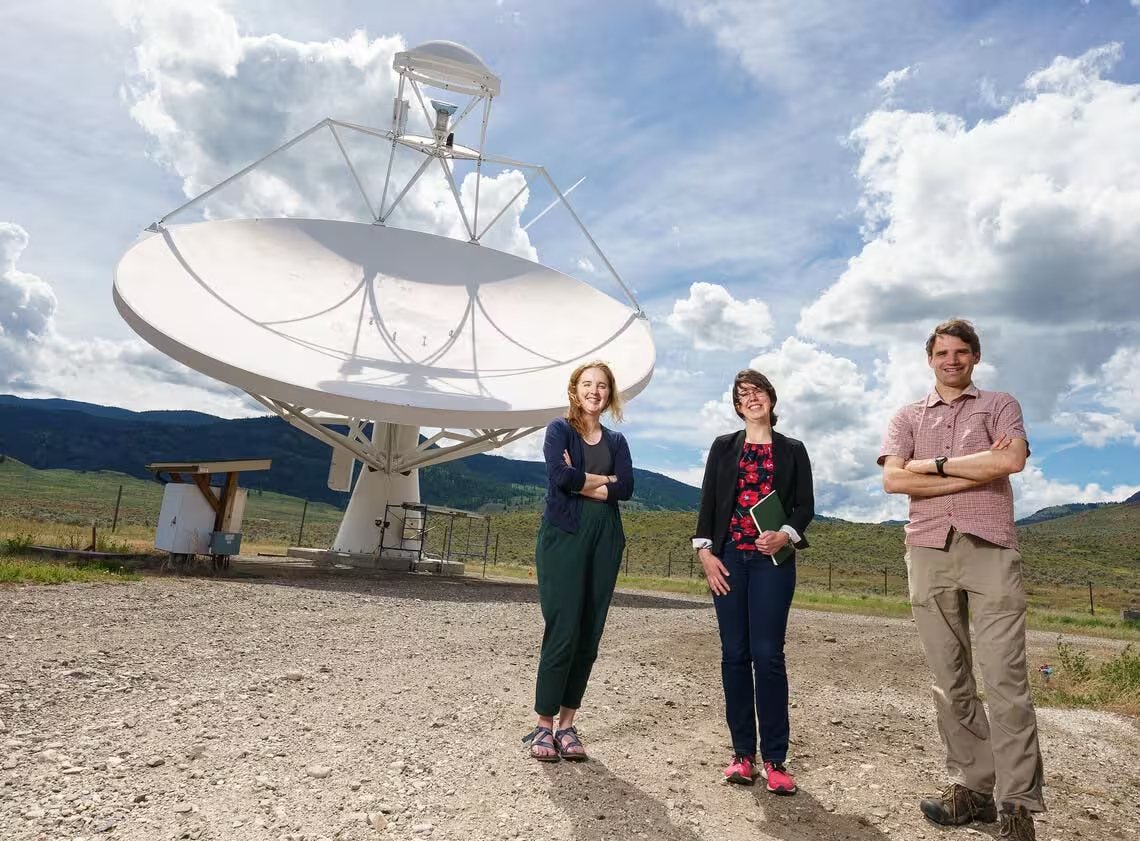

Researchers, from left, Rebecca Booth, Anna Ordog and Alex Hill next to the telescope used to collect the data for their study.
Technical context and future prospects
DRAGONS showcases how modern broadband radio instrumentation changes the game. Early Faraday studies in the 1960s established the method qualitatively, but lacked receivers spanning many frequencies. Today’s systems capture hundreds of megahertz or more in one sweep, enabling techniques like Faraday tomography that disentangle multiple components along the line of sight. The 15-m telescope was an ideal platform for this all-sky endeavor because it can raster-scan large areas efficiently, producing uniform coverage in months rather than years.
Beyond the immediate findings, DRAGONS is a pathfinder for future surveys with larger arrays and higher sensitivity. Instruments such as the SKA and its precursors will extend this work into greater depth and resolution. That means not just better maps but the ability to probe magnetic structure inside individual star-forming clouds, across galaxy halos, and in the tenuous medium between galaxies.
Data from DRAGONS will remain a resource for years. It already underpins studies of field reversals and will feed research on cosmic-ray propagation, the role of magnetism in launching galactic winds, and cross-comparisons with neutral and ionized gas tracers. For students and early-career astronomers, the survey was also a training ground: team members from UBC Okanagan and the University of Calgary gained hands-on experience with instrument commissioning, interference mitigation, and pipeline development.
Expert Insight
"Seeing Faraday complexity across such large swaths of sky is like opening a new window on the galaxy," says Dr. Maya Chen, an astrophysicist not affiliated with DRAGONS but familiar with magneto-ionic studies. "It forces us to move beyond simplistic field models and to test how turbulence, stellar feedback, and large-scale flows each leave their imprint on magnetic geometry. The observational constraints are finally catching up to what simulations have been predicting—only now we can discriminate between competing theories."
Dr. Chen emphasizes the importance of combining datasets: "Pairing these Faraday maps with surveys of neutral hydrogen, polarized dust, and cosmic-ray tracers will let us build a coherent physical picture of how fields influence and respond to galactic processes."
Looking ahead, DRAGONS is not an endpoint but an invitation. It points to more ambitious campaigns, deeper frequency coverage, and synergies with next-generation telescopes that together will reveal how magnetic fields shape galaxy evolution. The Milky Way’s magnetic maze is vast, and with sharper maps we are finally beginning to learn how to walk its corridors.
The DRAO 15m telescope at work scanning the sky for the DRAGONS survey. The data collected by this survey is a new generation of radio surveys that allow scientists to continue mapping the Milky Way and its three-dimensional magnetic field structure. Credit: Luca Galler










Leave a Comment
Comments (2)
Is this really resolving true field reversals or could some be observational ghosts? broadband's great but, I want cross-checks with other tracers before I buy it
Wow, the galaxy actually has magnetic threads? Mind blown. Maps that show folds and flips… gotta read the paper, but this is wild, science getting artsy