
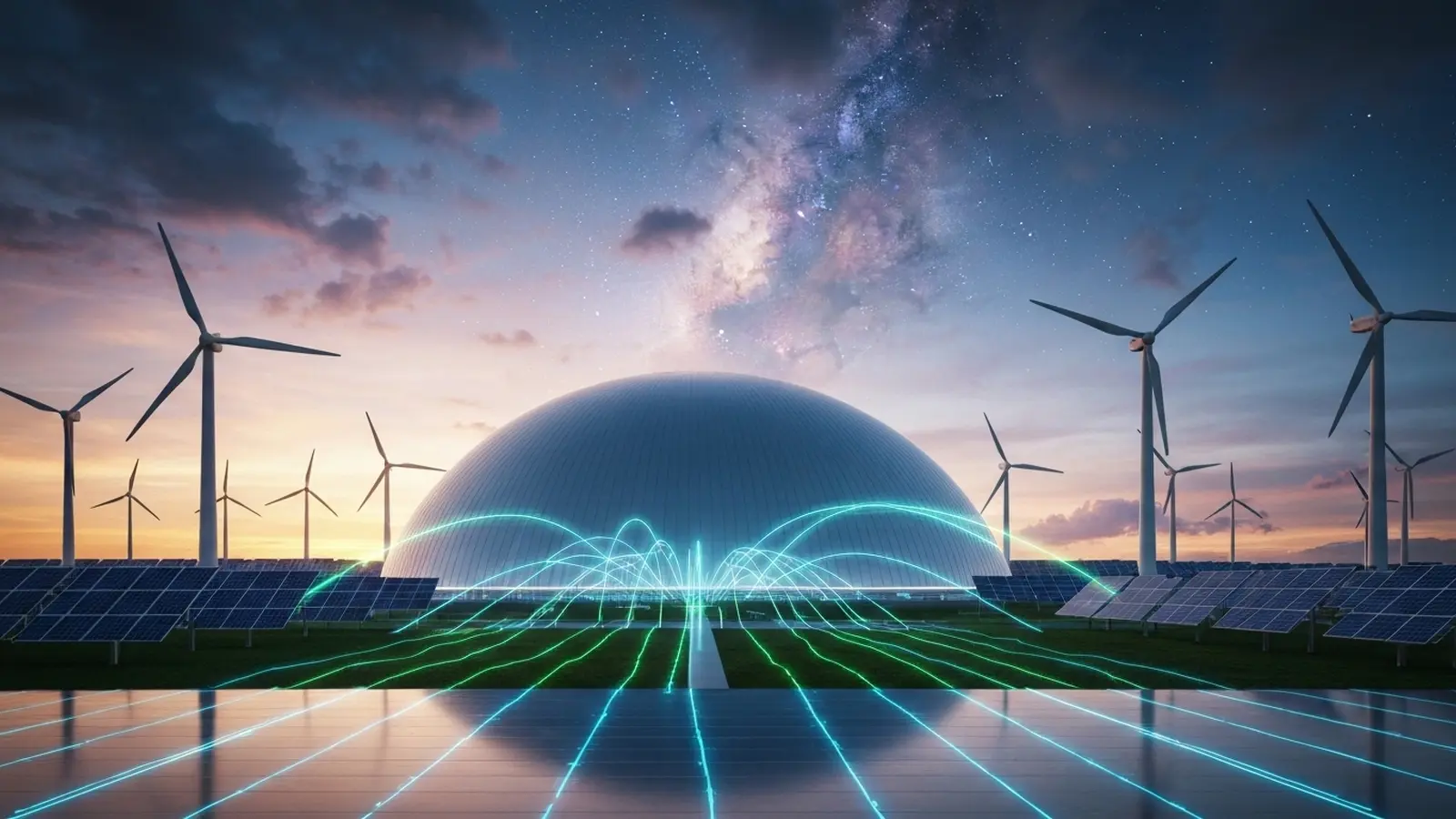
Google is backing a bold approach to long-duration energy storage: giant domes filled with compressed CO2 that act like rechargeable batteries. The idea, developed by Italy’s Energy Dome, could help store vast amounts of renewable power and feed it back to grids or data centers when solar and wind are quiet.
How a CO2 "battery" actually works
Energy Dome’s system uses thermal storage and the phase change of CO2 to hold energy. During a roughly 10-hour charging cycle, the system cools and liquefies CO2, locking energy inside pressurized domes. When power is needed, the liquid CO2 is allowed to re-evaporate, warm up and drive large turbines to produce electricity.
Each dome can store on the order of 200 megawatt-hours — enough, according to company figures, to supply roughly six thousand homes for a day. That scale puts CO2 storage in a different category from short-duration battery systems and positions it as a contender for bridging multi-hour or even multi-day gaps between renewable generation and demand.
Why Google is moving fast
Earlier this year Google entered a partnership with Energy Dome, and company leaders now say they plan rapid deployment at key data center sites across Europe, the U.S. and the Asia-Pacific. For Google, the attraction is simple: an energy storage approach that’s modular, uses widely available materials, and doesn’t depend on rare minerals or complex supply chains.
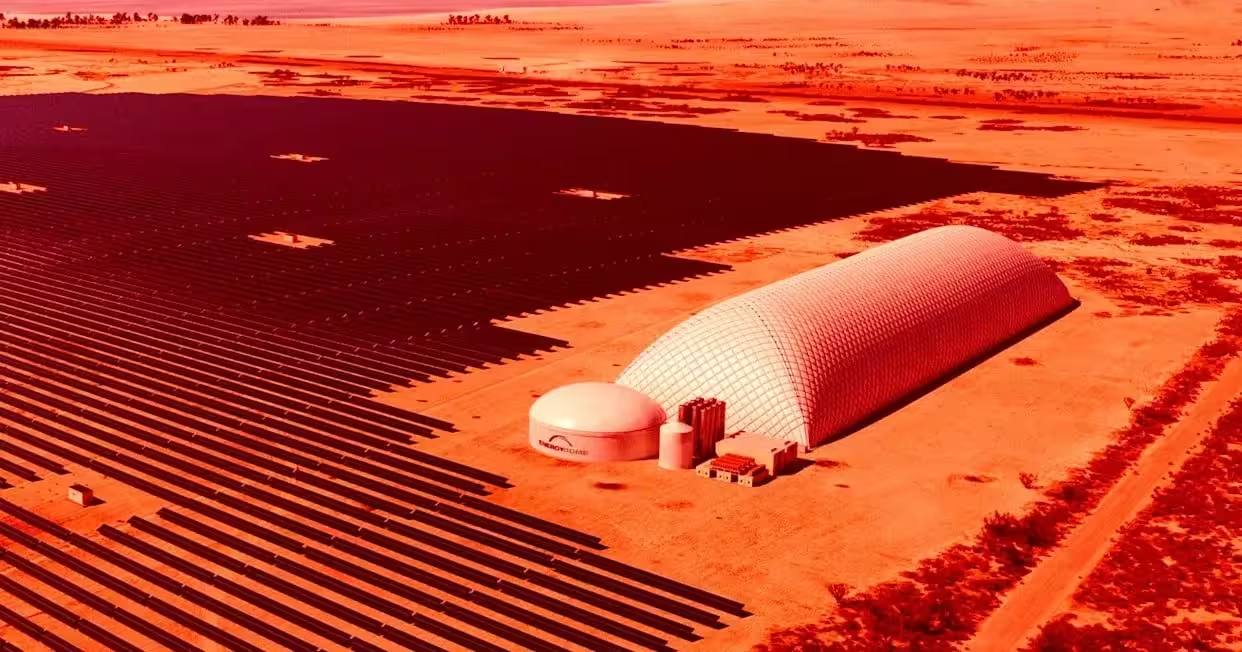
Data centers run around the clock and need reliable, low-carbon power. Imagine a cloud facility that can soak up midday solar and then use stored energy during evening peak hours — that’s the operational gap CO2 domes aim to close.
Where the technology will be tested next
Energy Dome is already building a pilot project on the Italian island of Sardinia. If that proves successful, the company plans to scale quickly, first moving into Karnataka in India and then to a site in Wisconsin, U.S. Those steps mirror Google’s interest in deploying the technology across multiple regions to support resilience and decarbonization goals.
Benefits and trade-offs
- High capacity: roughly 200 MWh per dome targets long-duration needs that lithium batteries don’t economically address.
- Material simplicity: the system avoids dependence on rare-earth minerals or specialty battery chemistries.
- Grid flexibility: good fit for smoothing solar and wind variability and meeting evening peaks.
- Early-stage risk: commercial viability still hinges on pilot outcomes, integration costs, and long-term reliability.
Energy Dome’s CO2 battery is not a silver bullet, but it is a promising new tool in the toolbox for utilities and hyperscalers trying to run clean, reliable infrastructure at scale. If pilots and early deployments prove cost-effective, this thermal-CO2 approach could reshape how operators store renewable energy for hours or days, not just minutes.


Leave a Comment
Comments
No comments yet. Be the first.