

A humanoid robot just landed a flying kick. The clip is arresting because it looks—plain and simple—like someone training in a stunt studio. Only the performer is metal and motors.
Agibot unveiled the Expedition A3, a biped that executes rapid kung-fu sequences: airborne strikes, consecutive mid-air hits, and tightly controlled rotations. Short bursts. Long arcs. Sometimes a heartbeat of silence between two impossibly coordinated moves. The company says the footage was shot under real-world conditions with no CGI or AI-generated effects, and if the sensor readouts match what you see on screen, this is more than choreography; it’s a serious exercise in balance, whole-body control, and dynamic coordination.
Why show off martial arts? Because agility is the headline metric for the next generation of humanoids. Can a robot move like a person in a crowded store? Can it pivot, recover, and keep a conversation going while doing it? Agibot positions the Expedition A3 as a platform built for high-frequency interactions—retail guides, promotional events, stage entertainment—where fluid motion matters as much as speech recognition.
Last week’s Agibot Night in Shanghai leaned hard into that thesis. The 60-minute event featured 16 humanoids performing music, dance, and comedy alongside human performers. Agibot framed the show as a transition point: visual intelligence stepping out of the laboratory and into cultural spaces. The sequences doubled as stress tests—sustained routines that evaluated system stability, multi-robot synchronization, and real-time coordination between humans, G2 humanoids, and D1 quadrupeds.
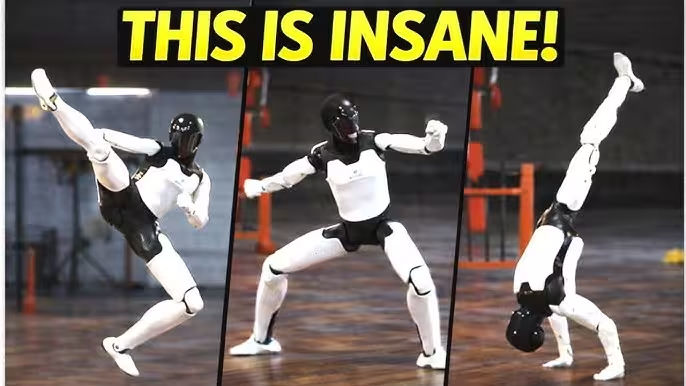
This isn't a stunt—it's a testbed for service robots that need to move and interact reliably in public spaces.

Expedition A3 is built with human-like degrees of freedom, including a flexible waist designed to replicate human ranges of motion. Lightweight, exoskeleton-style leg structures aim to boost agility and stability. Arms can lift up to three kilograms and the tool-center-point speed tops out near two meters per second. Onboard power comes from a dual-battery layout embedded in the torso, enabling up to eight hours of operation with a fast-swap system to cover full shifts.
- Human-like full-body degrees of freedom and flexible waist
- Exoskeleton-like lightweight leg structure for stability and agility
- Arm payload: up to 3 kg; tool-center-point speed: ≈2 m/s
- Dual battery system: up to 8 hours runtime; hot-swap capability
- Video capture shared at 720p and 1080p
- AI activation option via a shoulder tap using a large onboard model
Beyond the A3, Agibot displayed a family of robots for different roles: the A2 series for multi-modal interaction and autonomous navigation in public venues, the compact X2 for conversational scenarios and human-like walking in education and entertainment, the industrial G2 focused on force control for factories and logistics, and the D1 quadrupeds for inspection tasks and rough-terrain mobility. Together, the lineup paints a picture of an ecosystem rather than a single product.
Commercial timing is aggressive. Agibot says more than 5,100 units will ship by the end of 2025, with mass production scaling into tens of thousands of units during 2026. The company also announced its US humanoid market entry at CES 2026, presenting three humanoid models and one quadruped as ready-for-deployment options.
The showmanship matters, but so does transparency. Agibot insists the kung-fu sequences were filmed live in a training studio and that what you see is the robot’s real-time balance and motion control on display. Skeptics will ask for raw sensor logs and independent tests. Enthusiasts will imagine retail greeters that dodge obstructions or performers that repeat a choreography for hundreds of shows without overheating.
So where does that leave us? Watching machines learn to move like people is thrilling. Watching companies push those capabilities into stores, stages, and factories raises practical questions about reliability, safety, and social acceptance. Keep your eyes on the next demos and on the rollout schedules—this feels like the start of a very public chapter in robotics.


Leave a Comment
Comments (2)
Is this even real? they claim no CGI but i'm skeptical. show raw sensor logs, independent tests, and how it behaves around people in a crowded store. if it's real, big deal.
wow didnt expect a robot to pull a flying kick, legit felt like a stunt double but it's metal. kinda awesome and kinda creepy... how do they not fall?!