
4 Minutes
An artificial intelligence has just punctured an eighty-year mathematical intuition. Last week an OpenAI model produced a counterexample to a conjecture Paul Erdos posed in 1946 — a neat, stubborn question about dots on a plane and the distances between them — and the reaction among researchers has been a mixture of awe and curiosity.
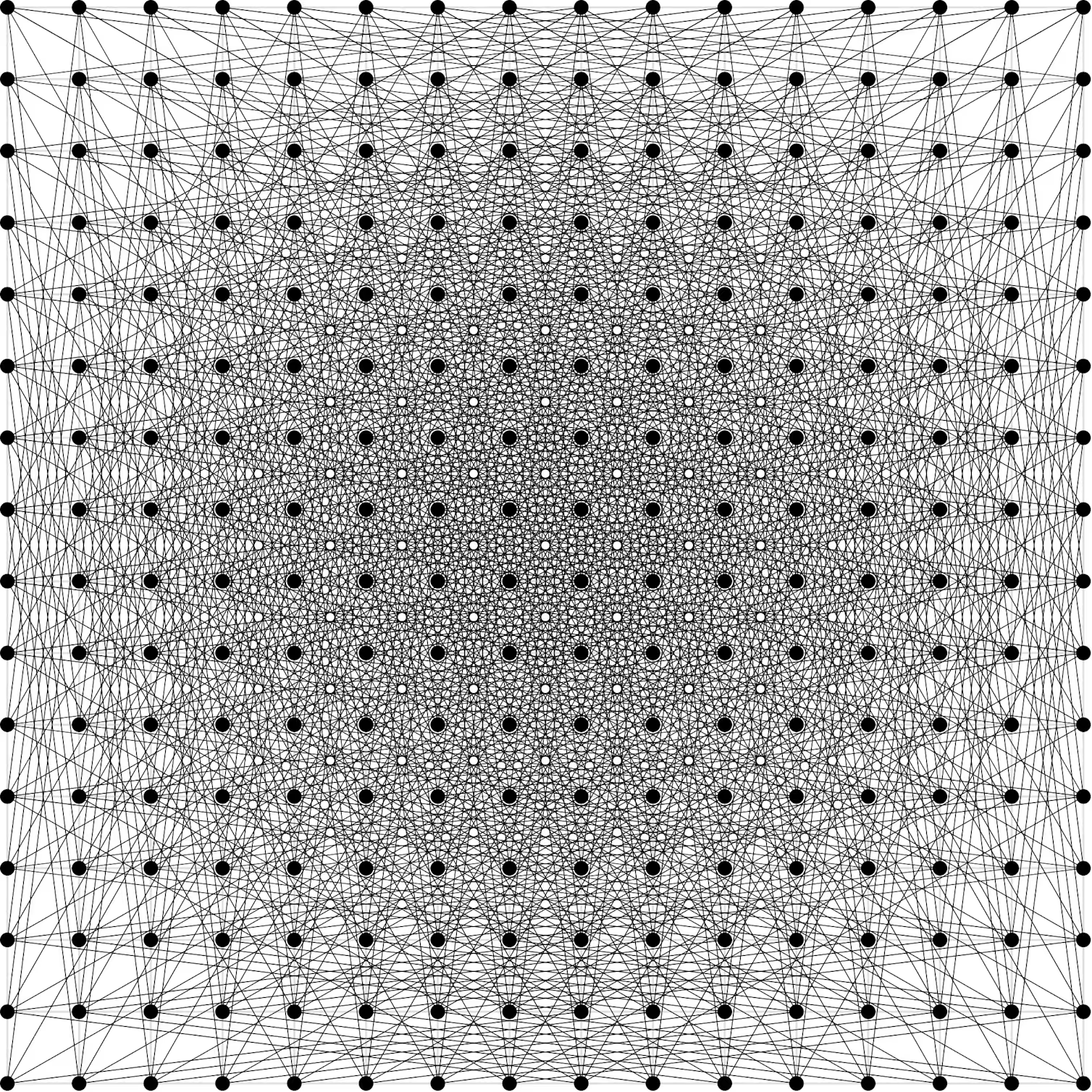
The problem sounds like a party puzzle. Place n points on an infinite sheet of paper. Arrange them however you like. How many pairs of those points can be exactly one unit apart? For generations the square grid has been the go-to picture. It is tidy. It piles up many equal-length pairs. It feels optimal. Erdos conjectured something like this: no construction could beat the grid by a meaningful margin for very large n.
That belief shaped decades of work. Combinatorics, graph theory, incidence geometry — these fields kept circling the same idea, trying to prove the grid was essentially best. Many partial results supported the intuition, and most mathematicians quietly assumed Erdos was probably right. Then a general-purpose AI model, not a math-specialised system, found a configuration that produces far more unit-distance pairs than the grid predicts, for infinitely many values of n.

This is not a marginal tweak. The new constructions draw on algebraic number theory and other classical tools, producing arrangements that outperform the grid once n is astronomically large — think 10 raised to the power 2,000,000, a one followed by two million zeros. For everyday sizes the grid still looks unbeatable. But from a theoretical perspective the conjecture is no longer true.
Leading figures in the field have been quick to weigh in. Daniel Litt, a Canadian mathematician, called the result the first autonomously produced AI mathematical outcome he finds intrinsically interesting. Timothy Gowers, a Fields Medalist, said he would have recommended the work for top journals if submitted by a human, noting the depth of the ideas involved. Those are not casual endorsements.

OpenAI published the model's findings alongside the paper, including the original prompt and an account of the model's chain of thought. That transparency matters. It lets researchers trace which known ideas the model pulled together and where it nudged the argument into new territory. It also shows something surprising: the breakthrough came from assembling and recombining ideas already present in the literature, rather than inventing a wholly alien trick.
What the episode makes plain is how AI changes the practice of mathematical research. Traditionally, breakthroughs rely on three intertwined ingredients: deep expertise honed over years, patient exploration of many dead ends, and those rare conceptual leaps that reframe a problem. Computers have long been excellent at brute-force exploration. Modern language models bring two more advantages: they're encyclopedic about past work, and they can pursue vast numbers of speculative paths without human fatigue.
That capability explains much of the present success. Give a model a few nudges and it can retrieve obscure lemmas, experiment with variations, and assemble long chains of reasoning. Sometimes the result is a convincing human-level argument. Sometimes it is a seed that a skilled mathematician can polish into a formal proof. In this case the model's output was convincing enough that subsequent human work — including an improved result by Will Sawin — built directly on its line of reasoning. Google DeepMind teams have also used their own models to resolve several smaller questions in Erdos's corpus, underlining a broader pattern.
But can AI be the source of genuine conceptual revolutions? The hard, creative flashes that feel like a lightbulb are stubbornly elusive to formalise. They often require intuition that cannot be decomposed into routine lookups or combinatorial trial-and-error. Whether machines can produce those leaps autonomously remains an open question. For now, they excel at amplifying human reach: bringing together scattered ideas, exploring the combinatorial wilderness, and surfacing promising routes that would take people far longer to find.
There are deeper implications too. The episode forces a reevaluation of what counts as mathematical work. If a model autonomously finds a counterexample, who gets the credit? How should peer review adapt when papers include machine-generated chains of thought? How will training and collaboration change when researchers routinely consult systems that can roam and recombine centuries of mathematics?

Mathematics has always been a conversation across generations. Erdos himself loved that image: an idea tossed from mind to mind, refined in collaborative bursts. Now the interlocutor is sometimes silicon. Researchers are discovering that machines can be both tireless assistants and, occasionally, originators of genuinely interesting mathematics. The next big insight might arrive from a proof scribbled on napkin, a late-night conversation, or an algorithm that saw an old problem in a new light — or from all three, working together.

Leave a Comment
Comments (2)
is this even autonomous or just remixing decades of human math? feels like assisted creativity, not a lightbulb moment. how will journals vet machine chains of thought
wow didnt expect an AI to bust an 80-year math intuition. mind blown, kinda nervous too. if that's real then credit? authorship murky...