
4 Minutes
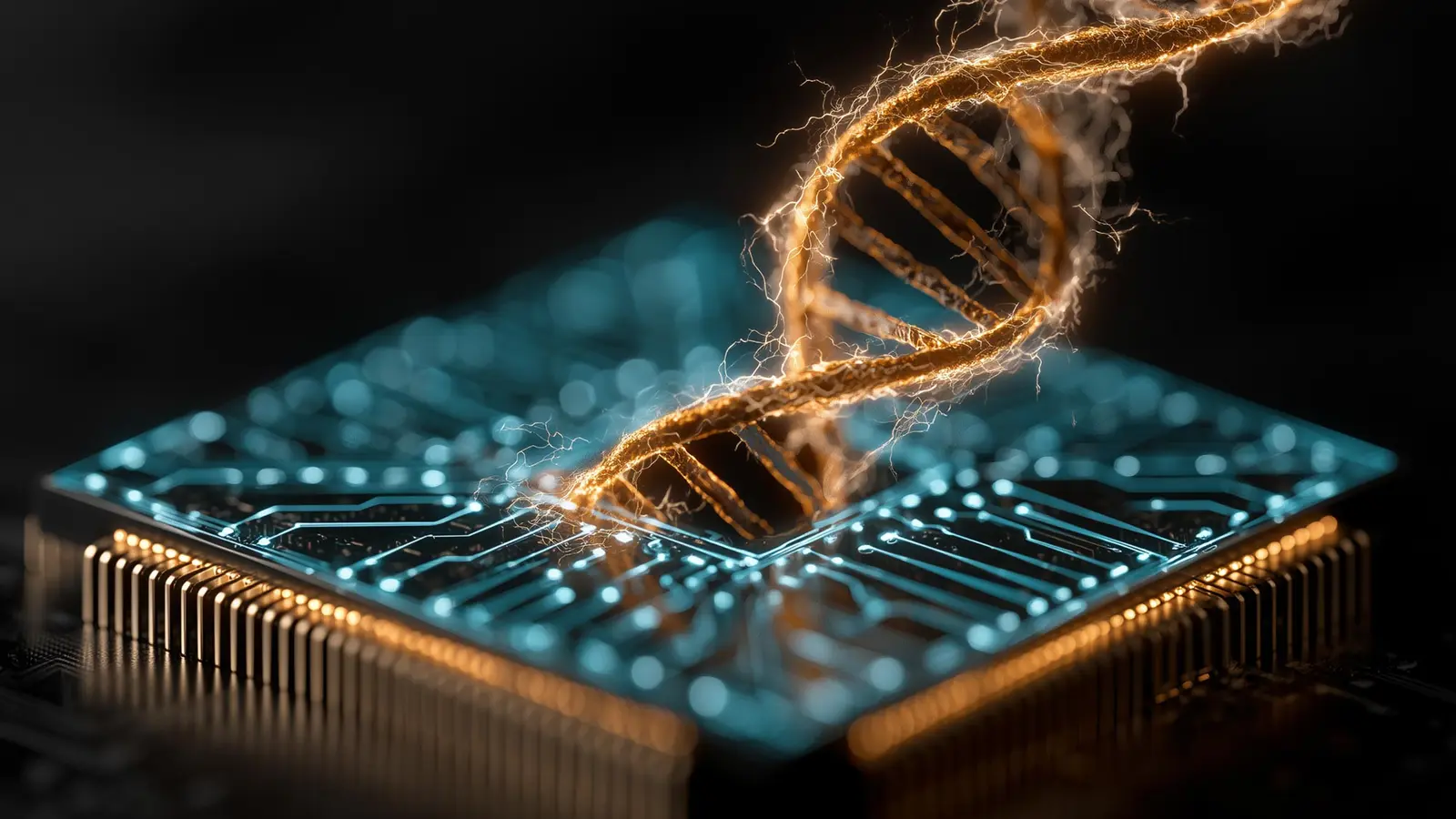
Imagine a microchip that does more than compute: it assembles the letters of life. Tiny currents, pure water, and enzymes replace vats of toxic solvent. The result is a silicon surface that can write many different DNA strands at once.
Harvard engineers retooled a chip once used to eavesdrop on neurons and turned it into a chemical workshop. At each of 64 synthesis sites on the chip, concentric ring electrodes choreograph local chemistry. Send current through the inner ring and protons are generated to drop the pH where the DNA strand sits. Run the outer ring the other way and stray acidity is mopped up before it wanders to a neighbor. The trick is surgical: local acidification drives enzymatic steps that add nucleotides one by one, and the rings keep those reactions confined so adjacent sites do not interfere.
The chip produced 64 distinct DNA sequences, each up to 39 nucleotides long. That number is modest compared with industrial phosphoramidite platforms, which churn out millions of strands, but it is a decisive step for enzymatic, water-based synthesis. Why does that matter? Because conventional DNA manufacturing relies on hazardous organic solvents and centralized factories. Enzymatic methods work in water and mirror how biology itself builds DNA, opening the door to smaller, safer, and more environmentally friendly devices.


The chemistry behind the scenes is both elegant and finicky. DNA grows one nucleotide at a time, and after each addition a temporary blocking group prevents further extension. Removing that blocker — a process called deprotection — is triggered here by a local drop in pH. The chip’s electronics make those local acidic pockets appear only where needed, enabling parallel synthesis across the surface by activating different sites in successive cycles.
Yet hardware is only half the story. When the team pushed for denser layouts, the electronics behaved exactly as designed, but chemistry betrayed them. It turned out the acid does not directly strip the blocking group. Instead, acid creates intermediate molecules that perform the actual deprotection, and those intermediates can diffuse beyond the tiny acidic islands. In plain terms: the silicon can keep the acid confined, but the chemistry sends couriers that slip out of bounds. That mismatch points to the clearest next move for the field — invent a deprotection route that acts fast, locally, and without mobile intermediates.
Practical applications are already in view. The researchers encoded a 169-byte text into the 64 synthesized strands as a demonstration of DNA-based data storage. Encoding small files into synthetic DNA has been shown before, but doing so with a greener, enzymatic approach hints at how future storage systems might scale without multiplying chemical waste. Synthetic biology and diagnostics could also benefit if water-based synthesis scales up; making DNA-writing devices portable and safer would change how labs and clinics work.
Repurposing a neuronal-recording platform for molecule-by-molecule control captures a current in science: tools designed for one domain can unlock surprises in another. The Harvard team converted the chip’s precision current injection — once used to open cell membranes — into a way to sculpt pH landscapes millimeters wide but microns precise. It is a lesson in lateral thinking and in the technical patience required to marry circuits and chemistry.
There are still barriers. Scaling to the astronomical volumes needed for practical DNA data storage or industrial synthetic biology will demand not only more synthesis sites but redesigned chemistries that play nicely with the chip’s spatial precision. But the experiment has already reframed possibilities: a microchip that writes DNA in water suggests portable, low-waste DNA printers are conceivable, and that machines built for electrons can be coaxed into making molecules. If chemistry can catch up with the hardware, the way we manufacture genetic material could feel very different soon.

Leave a Comment
Comments (2)
sure sounds neat, but can those intermediates be tamed? 64 strands and 39nt each is tiny scale. Where's the throughput? skeptical.
Wow this is wild, chips that write DNA in water? If they fix the chemistry leak it's a game changer. Still nervous about DIY biolab stuff though