

Imagine a paramedic speaking into the hush of a resuscitation room while a patient’s heart lies still: could words—or even simple sounds—be reaching a mind that looks, to all outward signs, gone? A new study suggests this is more than speculation.
Researchers recruited just over 140 volunteers across 13 hospitals in the United Kingdom and Spain to test whether people who suffer cardiac arrest can form memories of sounds played during the first minutes of resuscitation. The experiment was unsettlingly simple in design, and elegant in implication: if the heart stopped, speakers in the resuscitation area played audio during the first two minutes of CPR. After recovery, survivors were given a memory test featuring ten clips—five that might have been played during their rescue and five that were never used.
Participants were split into three groups. One group heard familiar, natural sounds—birdsong, rain, the slap of surf. A second group heard newly composed melodies intended to minimize confusion with prior memories. For both of these groups, the choice of which specific clips to play or omit was determined by measurements from a quantum computer that used entanglement as a randomizing mechanism. A third group also heard the fresh melodies, but their selections were made by a conventional system with no quantum entanglement involved.
The results were subtle but provocative. Survivors in the first two groups averaged roughly six to seven correct identifications out of ten. The third group averaged about five correct—statistically close to random guessing. In plain terms: people exposed to sounds during CPR were slightly more likely than chance to later recognize those sounds, provided the sounds had been chosen under the quantum-linked procedure or were familiar natural stimuli.
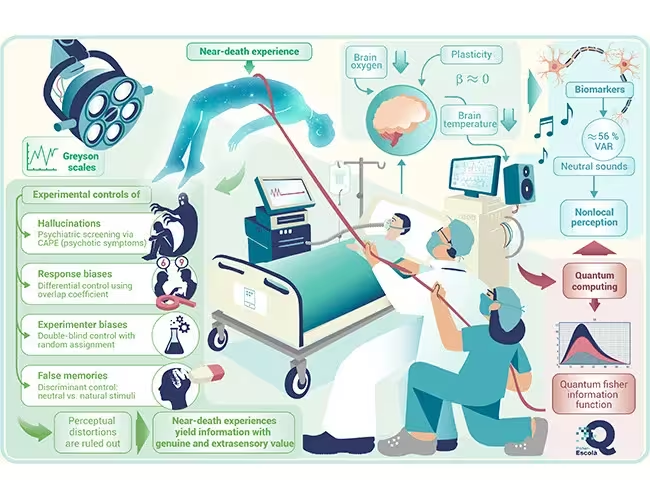

Even more curious was the relationship between brain oxygenation and reported experience. Lower measures of cortical oxygen—markers of greater physiological stress during arrest—correlated with stronger near-death phenomena and with better performance on the sound-recognition test. In other words, the more the brain was pushed toward hypoxic conditions, the more likely some survivors were to report vivid experiences and to identify sounds played during the rescue.
These findings sit alongside earlier work that documented organized bursts of electrical activity in brains at the point of clinical death—patterns sometimes associated with conscious processing. Survivors of cardiac arrest often describe encounters with light, rapid life reviews, or unusual clarity of thought. The new data suggest a plausible mechanism: even as normal circulation falters and consciousness appears lost, pockets of organized brain activity might persist long enough to process external input or stitch together experience.
There are cautions. Memory can be messy. Stress, trauma, and the passage of time alter recall. The study does not claim that all patients remain aware during CPR, nor does it pinpoint a single brain structure or circuit responsible for these impressions. It does, however, challenge a widely held assumption: that the absence of outward responsiveness equals an absence of experience.
The clinical term used in the paper—clinical death—refers to a state in which the heart has stopped but the person can be revived. CPR, while imperfect, can still deliver some perfusion to the brain. So cardiac arrest need not mean an absolute shutdown of all cerebral activity. If fragments of perception survive, even briefly, the ethical and practical implications matter. The researchers suggest that medical teams should assume the possibility of residual awareness during resuscitation and address patients with respect when speaking or touching them.
Published in the journal Innovation, the study adds a careful, data-driven voice to debates about near-death experience, memory formation under extreme stress, and the boundary between life and death. It raises questions rather than settles them. How does the wounded brain prioritize, encode, or fabricate experience under collapse? And what should clinicians change—if anything—about how they behave when a patient’s world might still be listening?


Leave a Comment
Comments
No comments yet. Be the first.